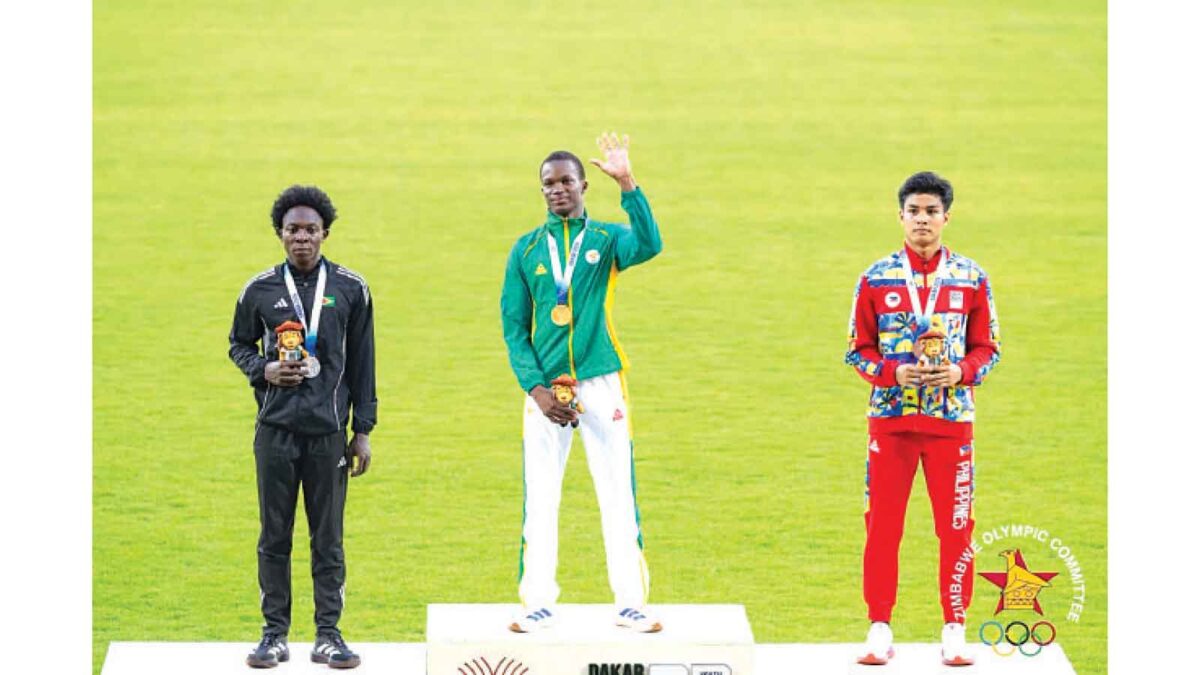
ZIMBABWEAN sport, athletics in particular, was thrust back onto the spotlight this week following the milestone by teenage sprinter Ropafadzo Mzondo who claimed a gold medal at the Youth Olympics Games.
The historic dash in the men’s 200m final at the Dakar 2026 Youth Olympic Games in Senegal earned the country its first ever medal at the youth competition.
The Kwekwe-based prodigy did more than just cross the finish line first when he clocked a commanding 21.04 seconds in the final. He had also blazed to a personal best of 21.02 seconds in the semi-finals of the same competition.
Held on African soil for the very first time, the Dakar Games provided a fitting stage for a victory that has united the whole nation in euphoria.
The ecstatic scenes at the Robert Mugabe International Airport when the team returned home on Thursday demonstrated the unifying power of sporting excellence. It was a moment of national pride.
In fact, Mzondo’s feat was celebrated nationwide, with echoes from the townships to the highest office in the land, as President Mnangagwa and the government saluted the rising star for hoisting the national flag high.
As the President rightly noted, when given the stage, Zimbabwean talent has the potential to shine brightly before the world.
This makes it imperative not to treat the success as an event, or an isolated stroke of luck, considering the potential that abounds in the country.
For a developing nation like Zimbabwe, Mzondo’s victory on African soil represented a strong psychological breakthrough that it can be done.
It proved beyond a shadow of a doubt that raw Zimbabwean talent can stand shoulder-to-shoulder with the world’s best and emerge victorious.
As the dust from the Dakar celebrations settles, there is need swiftly give way to deliberate, strategic action going forward, so that Zimbabwe can have more podium performances at global events in the future.
Mzondo’s gold medal must serve as the launchpad for a comprehensive sporting renaissance, with the 2028 Los Angeles Olympic Games firmly in our sights.
We must not be content just being part of the global events, but aim to win medals.
The good news is that Zimbabwe has witnessed a remarkable resurgence of track and field events recently. Over the past three years, our athletes have steadily announced their arrival on the global stage.
We witnessed the breathtaking spectacle of Tapiwanashe Makarawu and Makanakaishe Charamba reaching the men’s 200m final at the 2024 Paris Olympic Games, a feat that reignited national belief in our sprinting pedigree.
There has also been a formidable wave of talent including Denzil Simusialela, Methembe Tshuma, Thandazani Ndhlovu, Leeford Zuze, Dennis Hove, and Gerren Muwishi who have consistently flown our flag high in international competitions and relay events.
This golden generation presents Zimbabwe with an unprecedented opportunity to build sustainable sporting success. Yet, talent alone is never enough.
The transition from a promising junior champion to a senior Olympic medallist is not a stroll in the park. Without a robust support ecosystem, even the brightest stars can dim.
To nurture Mzondo and his peers toward LA28 and beyond, a coordinated, all-hands-on-deck approach is imperative.
The Government, through the Ministry of Sport, Recreation, Arts and Culture, must lead from the front by prioritising budgetary allocations for sports infrastructure and athlete welfare.
We cannot expect world-class times from athletes training on dilapidated tracks. Rehabilitating existing stadiums and constructing modern tartan tracks across all provinces must become an urgent national priority.
Simultaneously, the National Athletics Association of Zimbabwe (NAAZ) and the Zimbabwe Olympic Committee (ZOC) must deepen their synergy.
Their mandate goes beyond administrative oversight; they must champion modern sports science, nutrition, medical support, and international exposure.
Securing Olympic Solidarity scholarships, establishing high-performance training camps, and ensuring our local coaches are continuously upskilled with modern technical expertise will bridge the gap between domestic potential and global standards.
Furthermore, we must cast our net wider and not just focus on large cities and towns. It paid off, having to scout Mzondo from all the way in Kwekwe. His school, Goldridge College from the mining town, was also proud of their product.
Needless to say, the cradle of Zimbabwean sport has always been our schools. Reinvigorating grassroots talent identification programs from rural growth points to urban centres will ensure that no future Mzondo goes unnoticed simply because of geography or lack of resources.
The corporate sector and private players must also step off the sidelines. Sport is a multi-billion-dollar global industry, and corporate sponsorship is its lifeblood.
By adopting athletes, funding academies, and sponsoring domestic leagues, private enterprises can partner with the State to commercialise sport, turning athletics and other disciplines into viable, lucrative careers for our youth.
What works for track and field can, and must, be replicated across the board. Whether in swimming, cricket, football, rugby, or cycling, the blueprint remains the same: early talent identification, scientific coaching, adequate facilities, and institutional backing.
Mzondo has done his part. He ran his race, broke the tape, and etched his name into immortality. Now, the baton passes to our administrators, policymakers, and corporate leaders.
Let us honour this historic Dakar gold medal not merely with words of praise, but by building a sporting system worthy of producing more champions.