

 Online Reporter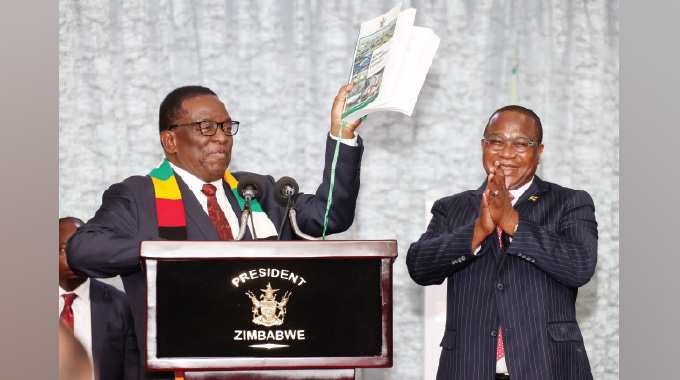
THE new National Development Strategy 2, launched by President Mnangagwa last week, opens on New Year’s Day in just over four weeks, ensuring continuity from the highly successful NSD 1.
NDS 1 ran for five years (2020-2025) and that, in turn, built on the solid foundation of the Transitional Stabilisation Programme (2018-2020) that defined the sound economic policies the Second Republic would follow.
The basic premise behind all three programmes is at its core two-fold, that the Government and the private sector will push economic growth so Zimbabwe as a nation becomes significantly more wealthy and that the fruits of this growth will be spread across the nation, with no place and no person left behind.
Both targets are vital. It is possible to grow an economy and reserve most of the benefits for a small group.
The colonialists did this with less than four percent of the population enjoying well over half the wealth and income. But not only is it grossly unfair, it also limits the speed of growth which requires all to contribute as well as to benefit. The second reason for having the double approach is to answer the question of “Why bother?”
People will push the envelope of innovation, hard work and involvement when they know that they are right there in the group that benefits.
In this instance, everyone will put their shoulders to the wheel and push Zimbabwe forward.
As President Mnangagwa stressed last week, NSD2 is designed to continue building the shared national responsibility for progress in both economic growth and the availability of people-centred high-quality services that are the hallmark of an upper-middle income country, the Vision 2030 that stands as the next goal of Zimbabwe and its progress.
So as NSD2 takes up the baton run so well during NSD1, there is besides the continuity of many successful policies, a renewed emphasis on devolution and decentralisation, found to be among the most effective ways of ensuring that no one and no place are left behind, largely trusting local communities to act responsibly to maximise their gains.
Making sure the youth and women are not just included, but are active participants is also important. We cannot limit or ignore the contributions of groups that quite often fell behind in the past, and which despite some serious catching up seen in NSD1 are still not operating at their full potential to accelerate both economic growth and fairness. Once again fairness and sound economics are on the same side.
The priorities of NSD2 are pretty much as expected: macro-economic stability and financial sector deepening; inclusive economic growth and structural transformation; infrastructural development and housing; agriculture, food security, climate resilience and environmental protection; science, technology, innovation, digitalisation and human capital development; job creation, youth development, creative industry and culture; social development, gender and social protection.
These created the “standard” 5 percent annual growth during NSD1 and which can be extended.
The Second Republic, for example, made practical the benefits of land reform by ensuring those resettled could get inputs, training and advice they needed simply by being prepared to work hard, with corrupt activity in access to anything effectively barred.
That in turn was part of the programme to ensure that smallholder farmers would all be part of the revolution that turned millions of families from subsistence farmers left behind into business people, albeit with small businesses, but businesses that could grow each year.
Changing the whole set of farming systems to incorporate the methods needed to combat climate change, choosing the right crops and, in an important development, seeing small scale farmers acquire several streams of income, ensuring that they could move into the middle income brackets needed for fulfilment of Vision 2030.
The President and his Government showed their determination to turn the talk and valuable research into practical action, which, we stress, was open to all ready to put in the hard work, which now produces results.
The Government also took a deep breath and decided to fix the infrastructure. This required some innovative financing and in several cases cleaning up the bodies that were to produce that financing.
The story of Zinara, going from an agency with top managers being jailed for corruption to a champion agency with perfect accounting and finding most of the cash for fixing the highways is an example of what can be done.
The private sector is now described as a “trusted partner” in national development. It too has had to push through a stream of reforms and accept that the way to make money is to make things and sell them, rather than manipulate markets and financial systems and play games with foreign currency.
So we have a growing number of businesses who are making new products, realising that quality products will sell in competitive environments, investing properly and generally getting on with it.
Admittedly the reforms of fiscal discipline and the subsequent stabilisation of currencies and now fast falling inflation, reforms by the authorities, helped create the necessary environment for the private sector to push forward.
We all fit together in a unified country with the same goals. Investment has been rising fast as a result, and while in mining and industry it can take a bit of time for a new major mine or factory to be developed and open, the stream of these being commissioned every month means that this is now working.
So NSD2 is not just a continuation of NSD1, it continues many programmes that are working, but it is also able to build on what has been done to open new doors.
Some of the stresses and emphasis we see are designed to ensure that everyone wins from the development, directly and indirectly, since an upper-middle income country must encompass a population who are upper-middle income.



