admin
admin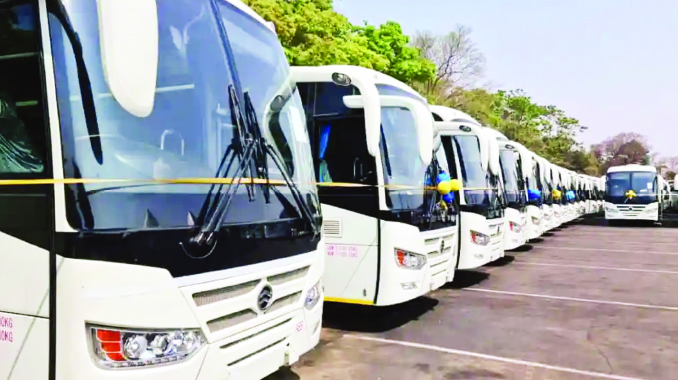
The announcement that 1 000 new buses will be bought for Zupco over the next two years, with the first 250 being made available in the first quarter of next year, should provide the needed injection to have urban transport properly organised, although including the more responsible elements of the private operators.
During the Budget debate last week in the National Assembly, Finance, Economic Development and Investment Promotion Minister Mthuli Ncube acknowledged that there had been significant pressure for a determined effort to sort out the urban transport quagmire, and said he had responded with some detailed budgeting.
The 1 000 buses he was looking at over two years will be a huge injection into the Zupco fleet, and even with the expected slice dedicated to join the fleet already serving civil servants transport needs, there should be a large number that Zupco can now use to rebuild its urban fleet and start that steady creation of a decent urban public transport service.
We saw during the Covid-19 lockdowns that it was possible for something a lot better than what we had before and what we have now.
Admittedly the lockdown meant that a lot of people who normally used public transport had to stay and work from home, or do their schooling at home, and the ban on intercity transport meant a lot of bus operators were prepared to work urban routes under a Zupco franchise.
But that success, on the limited service needed in a lockdown, shows how Zupco can now build something that can be fairly reasonable and, as we move towards our Vision 2030, can be the sort of service that cities can be proud of.
But it will require a major joint effort. Some of the necessary parts are already there. Harare, for example, has two large associations of kombi operators and at least two newer and smaller ones.
These are already bringing some order to several routes, with the associations laying down minimum standards for members and already these branded kombis are the first choice of an increasing number of people who use public transport.
Zupco, for a start, is not getting 1 000 buses tomorrow. The orders will be spread over two years.
Secondly although 1 000 buses sounds a lot, a decent urban transport service in the third decade of the 21st century will require a lot more. The two companies that provided most urban services in 1980 had a combined fleet a little under that size when they were nationalised and combined into Zupco, and since then urban populations have grown dramatically, and more importantly cities have spread ever further.
A third good reason for bringing in the respectable element of the kombi operators is that many services and many routes are best served by smaller buses.
Even as Zupco builds up its urban services along the major routes, there are times of day when a more frequent service supplied by kombis will be appreciated, and there are many side routes and routes into the depths of suburbs where passenger demand is sufficiently low to give the kombis good business and Zupco too many empty seats.
The other point that needs to be addressed urgently is the clean up of the terminuses, and the management of the terminuses. Covid-19 lockdowns showed again what was potentially possible.
Terminuses, for health reasons, had to be kept clean and organised and the attempts by vendors and space barons to turn them into markets defeated.
We see no problem in having limited market stalls next to terminuses, but preferably not in terminuses.
At the same time every terminuses should have a supervisor, and Zupco and the associations brought in should be able to provide necessary traffic marshals, and be able to keep mushikashika and unregistered kombis out.
Urban terminuses are owned by the city councils, and the usual problem of bad council management is seen here as well.
Just having light bulbs in the tower lights seems an impossible operation, and the need for garbage bins is glaring, although with frequent emptying.
To give the bus operators and passengers at these terminuses their due there are attempts to at least stack garbage, but something better is required, like bins and trucks emptying them frequently.
Another point that needs to be fixed is payment of fares in a country that lacks a lot of small change.
Again the Covid-19 lockdowns provide a guide. One bank, but only one bank, had a tap card that could be charged at the Zupco office at each terminus and then tapped as the passenger boarded a bus to pay the fare.
The trouble is that the card readers broke down, and tap cards were not universally available. The idea was good, but it needs all banks to be involved, possibly through ZimSwitch, and the simple readers need to be more robust. There also needs to be agreement on currency, which because of the fuel industry demanding US dollars probably needs to be in foreign currency.
Minister Ncube brought up another point. Out of the first batch of 250 new buses he has demanded that at least 50 will be electric buses, with batteries and electric motors not diesel engines.
Considering that the world is now committed to phasing out fossil fuels this is a modest start, and it will allow Zupco to build up the infrastructure, such as charging points at terminuses so buses waiting to fill can get a charge even if only for a few minutes.
Passengers and others will also need to get used to the near silent operation of electric vehicles and be willing to keep their eyes open. The reform of the terminuses, with a far more orderly operation, will help ensure the safety when almost silent buses are moving around. Pedestrians will know where to expect them and so be able to keep clear.
As the new Zupco fleet starts arriving we think that there is need for frequent consultations between Zupco, the respectable elements in the private sector, the local authorities and, most importantly, the representatives of passengers who are supposed to use the services.
Zupco is not always in contact with its passengers, unlike those public transport operators in some countries who insist top managers take the bus to work so they know the problems intimately.
But Minsiter Ncube is now making a determined effort to phase in something a lot better, and the public transport sector must start working with that to move away from the free-for-all that is so dangerous and difficult for passengers and start building, in a public and private co-operative deal, something that will be an adornment for an upper middle income country.


 Online Reporter