Online Reporter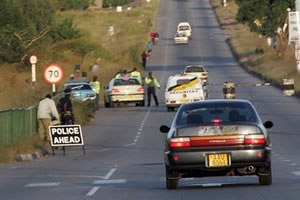
The police have once again warned that they are looking out for vehicles not fitted with number plates and that these vehicles will be impounded.
This warning has been given in the past, with little effect. This time the police need to carry it through and the vehicles need to be impounded until the owner or approved agent turns up with the registration sheet for the vehicle, plus currency insurance and current licence, plus a set of number plates that can be fitted then there.
Number plates are no longer in short supply since the University of Zimbabwe started manufacturing them in a secured business innovation. Since legal changes a few years back, new owners can take over the old number plates when they buy a car inside Zimbabwe.
So a car without plates is an import, and it is quite likely that the required taxes have not been paid to Zimra and the necessary procedures then followed to get the vehicle registered and licensed.
This well-founded suspicion of unpaid taxes probably gives the police more than enough legal authority to hang onto the vehicle. They do not have to rely totally on the road traffic laws.
Systems were put in place to allow vehicles to be registered after being cleared at a border post, with the temporary plates that were once popular and significantly abused phased out. If there is still some loophole at border posts this needs to be closed, so that a vehicle cannot be driven away from a border post, or from very near a border post, without being totally compliant on taxes, registration, insurance, licensing and plates.
The first tollgate from the border post should have the extra function of making sure that the vehicle is legally in the clear.
The need for all vehicles to have proper legal number plates is not just to ensure that every vehicle can be identified on the road by police and other law enforcement.
It allows ordinary people to be able to make a complaint, or given police vital information in the case of many crimes, from hit-and-run accidents onwards.
We can also use modern technology to make going through a barrier, such as the boom as a tollgate, much simpler.
Several countries have systems that see vehicle owners or drivers keeping a positive balance in a prepaid float, and when they come up to a tollgate a scanner reads their plate, the software deducts the toll fee, and the boom opens, without the driver even having to stop although they do have to drive slowly.
It is fairly easy to have on multiple lanes at a tollgate, having a reserved lane for those using this system so they do not have to queue and pay at the toll window but can just drive through without even coming into contact with a human member of staff.
Similar systems have been introduced at car parks in some cities and countries and there are other opportunities to make life much easier for the compliant.
Already tollgate receipts record whether the vehicle has an up-to-date licence, with a one month grace period allowed. After your licence has expired for more than a month, you simply cannot go through a tollgate, so the scanning technology is already in use.
A lot of people still try and assume that paying taxes is voluntary.
A vehicle licence with its radio adjunct can be thought legally as a tax, just as the vehicle import duties and the registration fee are also legally taxes.
Everyone needs to understand that paying taxes is not voluntary. We are now at the start of the process of getting the informal sector to understand that taxation is compulsory and this goes for vehicles as well.
We have in the past pressed the police to look at more automatic enforcement of laws, with those automatic speed readers being one of the ways that can be used to put technology to work to give the police far more coverage in their law enforcement.
We note that this technology does require a readable number plate to identify the speeding vehicle, which is another good reason for making sure all vehicles have number plates.
To check on this, and the basic cleanliness that is needed to make plates readable, we could easily have the scanners and booms that should be a tollgates at automatic roadblocks, perhaps close to the automatic speedtraps.
The non-speeding vehicles with readable number plates simply go through as the boom lifts, while the speeders and the those with dirty plates have to turn off for tickets and fines and any other action seen as legal and appropriate.
Such checking software could even decide on the red-on-white plates needed by buses and kombis whether these are compliant with the additional licensing requirements for public service vehicles.
The small cost of the extra technology will be more than recovered from the fines, or better still from the lack of money spent on health care for the injured since there will be fewer of these.
A bonus is that it is impossible to bribe a computer, so the problem of potential corruption is automatically eliminated.
Meanwhile, let us this time round make sure that the plateless vehicles are impounded until the plates turn up and that those who feel they do not need number plates to drive around start understanding that this is not the option.
The options are to register and get the plates, or walk.