Online Reporter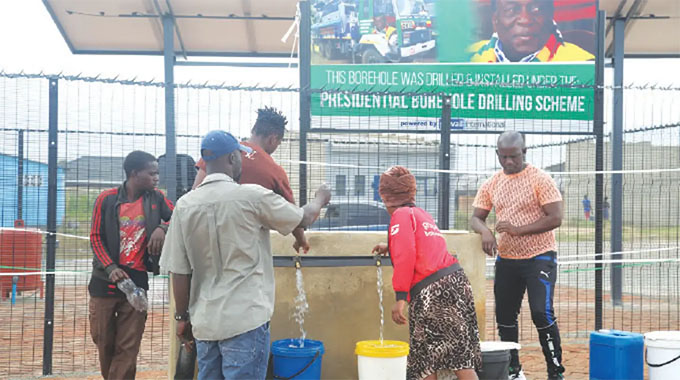
A great deal of effort has been exerted by the Second Republic to create practical schemes for elevating the quality of life of many rural areas, schemes that can be implemented and are being executed.
Among the first was the Presidential borehole drilling programme, designed to give each of the 35 000 villages in Zimbabwe their own borehole. This was quickly extended in two directions. The boreholes now come with solar pumps and are designed to be the foundation of a village business unit, one that produces a modest crop of horticulture for the community and for sale.
The scheme was also extended in space, to encompass every school in Zimbabwe, giving them their own water supply as well as an additional stream of income when they upgrade facilities.
A second major programme has been the rural electrification of villages, using whatever seems the most appropriate source of supply. Some villages can be connected to the national grid, but most would require long and expensive grid connections if this route was chosen
This is one reason why the Second Republic has been using alternatives, mini solar grids in some areas and direct solar connections to groups of houses, schools and clinics in other areas. This has now seen the electrification of 1 300 villages in a scheme that is characterised like so much of what the Second Republic is doing by practical and workable solutions.
Both the water and the power schemes are handed over to the villages. The boreholes and their pumps and irrigation equipment are transferred to the village to ensure that the communities take ownership and, most importantly, accept that they have become responsible for maintenance and repairs.
The rural power schemes that are funded via the rural electrification fund, that small levy on all electricity sales, uses a subsidy system.
Public institutions get the full connection financed by the fund, although they then take responsibility for maintenance, security and repairs.
Groups of at least 10 people in any one village can get a 50 percent subsidy and single households outside groups can get a 40 percent subsidy.
The system is designed to encourage the build up of community operated schemes as experience shows that these are looked after better and that the communities are prepared to make sure all members pull their weight.
But while the 1 300 villages that are now powered is impressive, this is dwarfed by the effort put into rural institutions. So far 4 621 primary schools, 1 538 secondary schools, 1 037 rural health centres, 1 279 business centres, 303 chiefs’ homesteads, 870 small-scale farms and villages, as well as grinding mills, irrigation schemes and base stations now have a power supply.
Urban people tend to take water and power supplies for granted, even when there is water rationing and load shedding. And however much we complain about our local authority or Zesa, most rural people would be more than happy to have most urban problems, so long of course they could keep their farms and continue building up their businesses.
We have had water and rural power programmes before with varying degrees of success, but it took the clear-sighted wish by President Mnangagwa to make these practical programmes that deliver the water and the power, employ the communities and make sure that the communities not only benefit, but also take responsibility. This means they last.
Oddly enough, the actual cost of the programmes for each village or each homestead is not very high. It is the totals that build up the budgets. This means that the increase in standard of living is quite modest, but that is dwarfed by the huge increase in the quality of life.
Very often quite small investments for each home or school or clinic can make a huge difference to the quality of life.
Having running water, having electric lights and being able to power up ordinary appliances, being able to access the internet at even the most remote school, and being able to see when treating patients in a clinic make huge difference to our quality of life.
Quality of life investment often requires different sorts of rules to upgrades in standards of living since fairly modest investment can make a huge difference in how well people can live and work, and we continually need to be on the lookout for such investment where such huge positive gains can be generated by very modest investment.
The other part of the Second Republic programmes, transferring ownership and responsibility of the people who benefit is also important.
Not only does this ensure that there will be proper maintenance and security, but it also means that it is easy as the standards of living follow the upgrade is the quality of life for people to add to the installations, perhaps even having another borehole drilled or installing a few more solar panels.