Online Reporter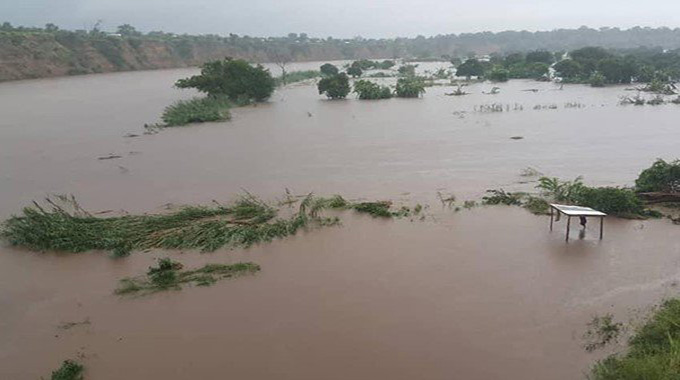
Heavy rains falling across much of SADC have brought many benefits to communities — from farmers securing decent harvests to hydro-electric power stations generating more energy. Yet these gains often make us forget the downside.
Already, scores of people have drowned, usually after taking unnecessary risks, while dangers to entire communities are becoming more probable.
In Chipinge, for example, there is a notorious island in the Save River which can be cut off even under moderate rainfall.
Despite repeated warnings, 10 people who ignored the advice are now marooned and had to be rescued by authorities and civil protection workers.
More worrying still is the risk posed by thousands of small farm dams across the country.
Where dams are privately managed or shared by a few neighbours, maintenance is usually carried out and spillways kept clear.
But in places such as Odzi, where dams are shared by many small-scale farmers without a proper community management structure, misuse and neglect have weakened dam walls.
One such dam, used as a bridge, is now at risk of breaching. While small dams may not flood vast areas, they can devastate nearby villages, especially those poorly sited.
This highlights the need for civil protection authorities to intervene.
An audit of these dams may be necessary, given that many host farmers or communities lack the expertise to maintain them properly.
These dams, together with boreholes, provide vital irrigation for local farms, supplementing the fewer but larger dams managed by the Zimbabwe National Water Authority.
Rivers and streams bursting their banks remain another hazard. Communities familiar with past floods are more cautious now, and drivers increasingly avoid crossing bridges submerged by fast-flowing water.
Education campaigns have helped, though it is tragic that lives are often lost before lessons are fully embraced.
Zimbabwe is now entering the heart of the cyclone season in the south-west Indian Ocean, usually affecting the Mozambique coast.
So far, the first five major tropical storms have missed us, but to expect this luck to continue would be wishful thinking.
Cyclones move quickly and unpredictably.
Meteorologists estimate nine cyclones this season, but cannot predict their exact timing, strength, or routes.
Civil protection staff often have only a couple of days to prepare detailed plans.
This reality has driven the creation of a national preparedness plan, with every district brought to readiness.
Most districts may never face a cyclone, but none can afford complacency.
Cyclone Idai in March 2019 taught Zimbabwe that sometimes only a few hours are available to act decisively and save lives.
The civil protection system has a core of trained managers, but implementation often falls to local government staff with other day jobs.
They have been trained to act swiftly: evacuation plans are ready, sanctuaries identified and relief supplies pre-positioned.
District leaderships now have cash advances to buy fuel and food immediately, ensuring local responses can begin within minutes while national support mobilises.
As in medical emergencies, the first hour can mean the difference between life and death. We cannot eliminate risk and climate change will only increase it.
But by ensuring trained people are on the ground, backed by strong systems, Zimbabwe can cope with serious floods and cyclones.
With readiness and rapid response, the worst disasters can be limited to property damage, not loss of life.