admin
admin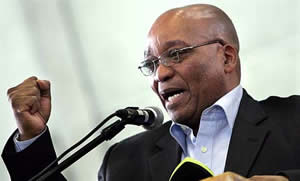
Addressing a rally to mark the African National Congress’ 103rd birthday in Cape Town last month, South Africa President, Jacob Zuma expressed frustration at the slow pace of land redistribution in his country.
He said the willing-buyer willing-seller approach adopted at independence in 1994 was an impediment to faster land redistribution. In 1994, the ANC committed itself to redistributing 30 percent of South Africa’s farmland, or 24,6 million hectares by 2014 but less than 10 percent has been made available.
ANC spokesman, Zizi Kodwa told our Harare Bureau on Thursday that the government would adopt a fast-track land redistribution programme through expropriation after the failure of the market-based approach. The ANC government is drafting the Land Appropriation Bill to quicken the process.
Expropriation, defined as the act of taking of privately owned property by a government to be used for the benefit of the public, is permitted under the South African constitution but has to be accompanied by fair compensation.
Kodwa said:
“We intend to introduce a number of policy interventions to fast track the land redistribution exercise. Our aim is to radically transform the economy and at the centre of that transformation is the issue of land. At a time when we are celebrating 60 years of the Freedom Charter, we felt it fundamental to address the issue of land. One of the clauses of the Freedom Charter says that the land must belong to those who work on it. We felt that we needed to introduce radical measures retrospectively cognisant of the fact that 87 percent of land is in the lands of the minority whites while only 13 percent is owned by the majority black people as a result of the 1913 Land Act.”
The land reform goals set out in 1994 had three broad thrusts. The first was the strengthening of tenure rights for the rural poor. Second, land restitution was to be made to those who could prove that their or their family’s land had been stolen under apartheid. And the third was to redistribute 30 percent of agricultural land to the rural poor.
Apart from general unwillingness by the wealthy farmers to give up land, the few who are offering them want hefty prices.
Zimbabwe experimented with the willing-buyer willing-seller method from 1980 but abandoned it in 1992 as no farmer came forward. The government, post-1992 still had to buy land at market prices but had authority to do that even if the farmer was unwilling to sell. White farmers knew the government did not have money to pay fair compensation, so they held on.
In a bid to raise the required money, the government hosted the land donor conference in 1998, but the response was poor. Matters came to a head when the landless themselves went ahead and reclaimed their land through revolutionary means. The government moved to protect the land occupiers and came up with legislation demanding Britain to pay for acquired land, with the state compensating farmers for on-farm improvements. About 300,000 people now own land that was previously owned by around 4,500 whites.
We look to South Africa with interest to see how the expropriation method will work given the lessons from Zimbabwe.
Section 25 of the South African Constitution states that property may only be expropriated “subject to compensation, the amount of which and the time and manner of payment of which have either been agreed to by those affected or decided or approved by a court”.
Expropriation can work because theoretically, the government simply needs to identity land for resettlement and prove that indeed the land will benefit the public. The farmer will not have grounds to defy the expropriation because the constitution approves it. However, the next step, of agreeing on the quantum of compensation can be problematic as farmers can, as some have already been doing, demand high prices which the government could struggle or fail to pay if it has to undertake a programme on a national scale.
In case of a stalemate on the value of the land, courts can intervene, as the constitution says. We have experience of some courts in Africa perpetuating the old order, particularly on land. South Africa might fare worse on this, with a largely apartheid justice system still holding sway there.
A tougher approach than expropriation would have consequences. The privileged class at home and their powerful backers abroad will always hit back.
But having fought white domination for so long and defeating it, the dispossessed blacks and their majority government can withstand that. There is no justification for South Africans to continue living in Bantustans 21 years after independence. They expect the new approach, which is already provided for in the constitution anyway, would enable them to get the resource back.
But it will not be easy.


 Online Reporter