
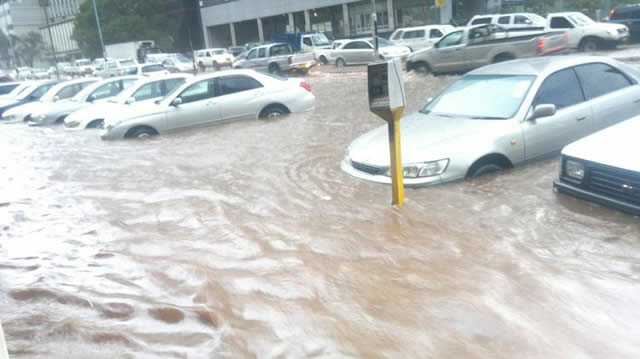
THE flash floods across areas of Harare, mostly in the suburban south and southwest of the city this heavy rainy season, have seen inherent weaknesses since these suburbs started growing, some legally, some regularised or at least potentially regularised, and some where housing was a bad idea from the start.
A lot depends not just on identifying wet lands in time, but also on what measures are taken later to allow or block development, and the sort of measures a developer must be required to do to cope with the major changes to the natural drainage that a lot of buildings will create.
Most of Harare is gentle undulating land with islands of well-drained soil cut by numerous streams and, because of the nature of most of the land with wide vleis rather than narrow gorges.
Perhaps as much as half the land could be classified as wetland, depending on your definition, and obviously we have not allocated half the city area to public open space because it was a bit swampy in wet weather.
In fact a lot of effort was put into using a good part of this land before most people could define a wetland.
So even in the city centre, the “stinking fetid swamp”, to quote a very early visitor, that separated the two halves of the initial tiny 1890s settlement positioned at the foot of the kopje and north and east of African Unity Square, had to be drained if the inhabitants were not going to die of every waterborne disease known.
It was, and the deep drain is covered by one of the carriageways of Julius Nyerere Way although it took another 80 years before skyscrapers could be built along that major street.
Many of the inner suburbs had very wide wetlands that the early authorities drained with deep trenches as part of a malaria control measure, to kill mosquito breeding sites.
Later research into the use of reinforced concrete slabs, rather than traditional trench foundations, allowed a lot of building on the heavy clay soils now exposed, although a respectable drainage corridor still had to be maintained.
With environmental law strong and actually enforced, quite a few groups have been using this law on wetlands to create and preserve decent open public space, and certainly rapacious legal and illegal developers would otherwise invade anything resembling a park and try and subdivide and sell it off.
There have even been determined attempts to take over golf courses, most of which were put into wetlands as this was not the best building land, and turn them into housing estates.
We must have the public open space and a lot more than we now tend to get in most development, and defining wetlands can help and in theory this land is less desirable for development.
But we also need to recognise that wetlands cannot just be left without some management.
Urban development, and especially higher density development, does alter drainage patterns significantly.
When a large percentage of an area is covered with roofs, roads, hardstanding parking and paved courtyards and other areas, rainwater rushes off quickly in a flash flood. On a farm or game park it could spend days soaking into the ground; now it must be drained off in hours.
So even when wetlands are still around to act as a buffer, they have to cope with surges of flood water rather than a continuous more gentle inflows, and that creates dangers they cannot cope with and extra emergency drains will be needed. Solutions are not automatic and need to be planned in advance.
A major problem with some of the newer suburbs, even when they could be regularised as they are on reasonable building land, is that there were no developers putting in the infrastructure before the buyers of the land started building.
Part of that infrastructure is storm water drainage, and road drains so the roads do not resemble a river when it rains.
The main difference quite often between older suburbs and these newer settlements is simply the better drainage in the older suburbs.
For a start, someone with an engineering background or degree planned it from the start, and then usually in the first decade adjustments could be made.
When the flooding was continuously severe, a larger area could be blocked off against further development without having to demolish hundreds of homes.
In a lot of areas good town planning has been totally ignored, or even perverted by developers wanting to extract the last dollar.
We need to go back to the basics and plan properly, which means making use of wetlands, usually as the core of public open space, but also allowing where appropriate respectable development, since we cannot convert half the city into parks.
The regularisation process now in progress is going to need some intelligent and careful remedial planning with conditions set.
A fair amount of land can be used for building, so the structures can remain.
Other areas can be used if more money is spent on managing water flows, while some areas can never be safely built on and the people who might be there have to be helped to move.
Solutions are not always simple; that is why experts have to be called in.
What is definite is that we cannot leave the southern city floodplains to rot.
We need to work out what can be done, how street drains can modify flash floods, and make sure that if people have to be moved some sort of fair arrangement is made to compensate them.