admin
admin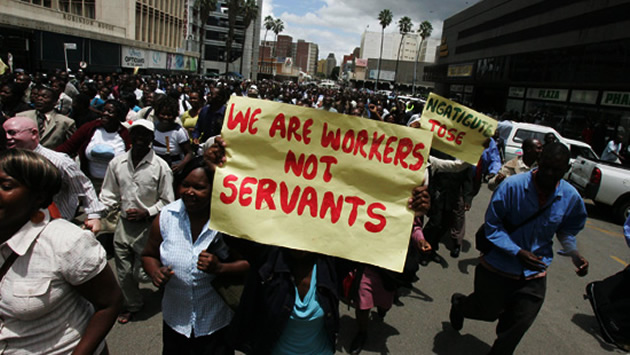
 Civil servants have been agitating for a poverty datum line minimum salary since 2013, but it is clear to them that their employer is unable to increase wages any time soon amid a challenging economic environment.
The government is struggling to raise enough money for their salaries and has had to change pay dates so that as soon as the little drops into the treasury, it is forwarded to one segment of the civil service and another later as more is raised. University lecturers have been on strike on-off since January over late bonus and salary payments.
Industries that pay — or must pay — tax to fund the national budget are shutting down and thousands have lost jobs or go unpaid because of the economic problems. National Railways of Zimbabwe workers launched a sleep-in protest at the utility’s Main Station in Bulawayo, pressing for salaries that are unpaid in 10 months.
Zimra has had to resort to draconian measures to raise revenue, draconian we say in the context of our non-performing economy that must actually be benefitting from a mass tax amnesty instead of having companies’ bank accounts garnished.
Inflation figures released this week for February put the state of the economy into perspective. The rate continued in negative territory last month, -1,40 percent from –1,28 percent in January. As far as statistics go, the state of the economy is worsening.
Civil servants appear to have grasped the enormity of the prevailing constraints so have toned down their demands for higher salaries, but have made some noises on government’s promise for non-monetary benefits. They have rightly judged that they, at least, are better that their salaries come on time and in full than NRZ workers who are unpaid in nearly a year.
Now the government is putting in place an innovative strategy to deliver a portion of the non-financial perks that its workers should start accessing by July.
The National Social Security Authority (NSSA), a state entity, will provide $5 million to set up a building society geared towards providing civil servants more affordable housing loans, Public Service, Labour and Social Welfare Minister Cde Prisca Mupfumira said Thursday.
“We’re most likely going to see a NSSA bank before the end of the second quarter of 2015 as negotiations with key stakeholders are at an advanced stage” she said.
“As you could be aware, the government has promised non-monetary benefits to civil servants and this is one of government’s gestures towards fulfilling that promise. This is also in line with government’s economic blue print, Zim-Asset, where accommodation is one of our top priorities. Everybody who is interested is supposed to benefit from this scheme.”
Owned accommodation, as opposed to that which is rented has much significance in Zimbabwean society, compared, for example to the West where one can actually decide to rent a house all their life, and not buy. Socially, owning a house gives one and one’s family prestige, peace of mind, emotional satisfaction, stability, predictability and an overwhelming sense of achievement. In addition to the social benefits, there are economic ones the new home owners can enjoy for instance when one wants to offer his house as collateral in an application for a loan to invest in a business. This stimulates broader socio-economic wellbeing for the home owner and the country.
Furthermore, the advantages of a successful NSSA scheme would be felt at government level as the employer would be able to attract and retain staff better. A teacher who owns a house courtesy of a government-initiated scheme is unlikely to leave his job during the loan repayment period and after as easily as does one who is renting two rooms.
The NSSA facility must succeed. It is the only window through which civil servants can be able to own a house. Mortgage finance on the open market comes with strict requirements and high salary thresholds that the majority of government workers will be unable to meet. We are heartened by Minister Mupfumira’s assurance that the scheme would offer more affordable loans and is geared towards civil servants. It would be regrettable for a facility set up in the name of government employees ends up benefitting others.
Zim-Asset has a section dealing with the need for provision of decent accommodation to Zimbabweans so the planned NSSA scheme would contribute towards achievement of that goal.
As with all funding facilities, there is the possibility of beneficiaries failing to repay loans. With regards to civil servants, we don’t see this affecting NSSA because repayments can be made on stop order basis through the Salary Service Bureau.
Having said this, we feel that the government needs to make a provision for private sector workers to benefit as well. They have been contributing to NSSA for longer than civil servants so it would be grossly unfair for a segment of contributors which joined much later to benefit while the founding contributors continue to rent homes or live in shacks.
But this is a good starting point for the government, other non-monetary perks like vehicles and farms can follow.



 Online Reporter