admin
admin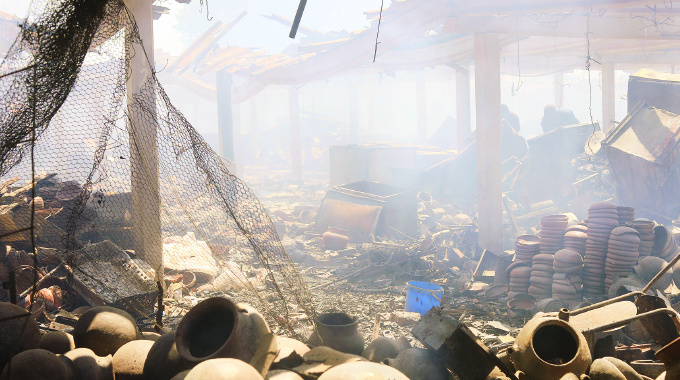
THE destruction of the huge main market at Mbare Musika in Harare by fire on Tuesday night is a tragedy for the 4 695 traders earning their living at the more than 1 565 tables, but also makes life a lot harder for their tens of thousands of customers and creates a gap for the many who supply the traders.
Fire brigade experts will work out where the fire started, and perhaps even how it started. But that, for those whose property was destroyed, will not be much help.
Even if someone or a group can be found to be responsible through carelessness, there is no use suing them as they will not have the money to replace the lost stock and make up the lost incomes while alternative arrangements are made.
The main tragedy arises from the fact that a fire can grow and spread through the whole complex.
If it was some sort of formal structure, following laid down model building by-laws and approved by the city fire brigade, the fire might still have started, but have been slow to spread and been brought under control very quickly.
Perhaps a dozen stalls might have fire and smoke damage, but for most life would go on without a break. We have had major fires before in the semi-formal markets, twice in the Glen View furniture industrial complex, but this fire in terms of livelihoods seriously affected is the worst.
We need to remember those 1 565 tables and 4 695 traders. It was a huge market.
The market clearly filled a need. Positioned in the middle of the most highly populated suburb in Harare, and able to serve in addition the thousands every day who used the wholesale vegetable market and the long-distance bus terminus, it was a natural market place and provided a living to probably almost 5 000 families.
The sheer size of the market would attract shoppers, since the high levels of competition would ensure that there was no price gouging and the large number of tables would ensure that almost any product needed day to day was on sale, along with a moderate selection of other goods.
Clearly the market needs to be rebuilt, but we now need to build it right. Already the Government has started working on a proper response, while the fire brigade has been checking that every ember was extinguished.
Minister of Women’s Affairs, Community, Small and Medium Enterprises Development Monica Mutsvangwa said her ministry was now consulting and coordinating other relevant ministries and agencies to see what should and could be done, and saw the matter as urgent.
Fairly obviously, the market needs to be rebuilt, but it needs to be rebuilt right and the opportunity now exists for a proper market structure to be built.
This does not have to be expensive or luxurious, but it needs to fulfil the needs of the thousands of small traders, and, very importantly, be safe and secure.
Perhaps a utilitarian factory-type structure could be the starting point, with a strong framework that can be clad and upgraded later.
Importantly, those sort of designs normally include fire-prevention with flameproof materials, a sprinkler system and laid down suitable points where fire hoses and fire extinguishers must be positioned.
All these are fairly cheap if done at the design and building stage, rather than retrofitted later.
A good design would allow future upgrades, perhaps a second floor and if the right framework is there from the start, the cladding, upgrading the cladding and even future subdivision into larger stalls.
There would need to be a capital injection to get the basic structure built and the essential safety equipment, what will be used to extinguish any fire, put in place. But that investment will produce a return.
Rents of market space, and even daily charges for the smallest tables, cannot be high, but when you are talking about 1 565 payments, even daily charges of ZiG25 or US$1 bring in a lot of money, allowing after maintenance an income flow that can pay back that initial investment and provide the income that makes future upgrades easy and possible. In fact the market can, and should, be a bit more flexible when it comes to space and fees. Some businesses are very small and do not require a lot of room; others are larger and need more space and should be prepared to pay more.
If you look at the commercial markets that innovators in the private sector have been erecting, the stalls vary in size from a modest slab or a small tall cupboard to quite large retail premises that rival formal shops.
A redesigned and rebuilt Mbare Musika main market could bring in the same level of flexibility and increase the income, speeding up the return on the investment and mobilising the resources for continual improvement.
The viability of the market is obvious and trying to move it or close it is not an option.
Government, working with the Harare City Council, should make sure that a respectable and safe new market structure is built, and this time built right. The disaster and the tragedy will then lead to something a lot better.


 Online Reporter