admin
admin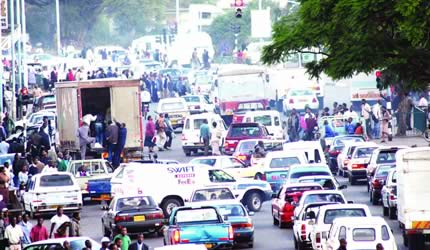
Urban tollgates are being considered by the Government, says Minister of Transport and Infrastructural Development Dr Obert Mpofu, but will be rejected, we hope.
Even given that such tollgates are the best way to ease congestion and raise more revenue for road building and maintenance, an assumption that is not obvious, two basic conditions are missing for successful implementation of such a scheme in Zimbabwe: a decent public transport system and small change, because charging someone US$1 to enter or leave the city centre is clearly absurd.
The traffic densities at present will not support the creation of the required huge electronic infrastructure for automatic e-tolls.
There are many better ways of achieving the minister’s goals than urban tollgates in any case.
Congestion, especially in the early morning and late afternoon, is already a problem and becoming worse. The first set of measures that help cut this are already in place, enforced high parking charges. Driving into the city centre, unless one has off-road private parking, is not cheap. Even those with monthly contract parking have to pay around US$2 a day to park in town, and street parking will absorb at least US$8.
With those sort of charges, even a fairly basic but decent public transport system would attract takers and ease congestion, but the Transport Ministry has yet to figure out how to get that public transport system into place. We note that any other anti-congestion measure, and tollgates are included in that list, would run into the same problem. There is often no alternative to private transport.
In any case charges are not always the best way to ease congestion. Germany, for example, where the motor car was invented, has decongested its city centres, simply by building first class public transport facilities and then banning cars from the city centre. The order of the measures needs to be noted.
Few would deny that more money is needed for road building and maintenance. And fairness demands that those who use the roads more should pay more.
Quite a lot of money is already collected through the licence fees and the existing tollgates. And a surprisingly high percentage of that collected money goes on administration and commissions, rather than on building and repairing roads. Layers of bureaucrats are getting fat on high salaries, instead of our roads getting better. So one way to raise more road money would be to use what is raised a lot better.
If the minister is seriously concerned about urban roads then he should also revert to the older system whereby main through roads in the cities were seen as partly national roads. Harare, for example, should not just get the road licence fees from its own residents but should also get some of the existing toll money.
Samora Machel Avenue, Mutare Road, Lomagundi Road, Simon Mazorodze Road, Enterprise Road and Sam Nujoma Street Extension are more than just city roads, they are also part of the national road system.
In the past, the Government used to give Harare a grant for these roads. Whatever it spent, say, on maintaining a 20km stretch of the Mutare to Bulawayo highway it would give to Harare to maintain the 20km stretch of that highway running through the city. The city council obviously had to top this sum up, but that was fair enough since the extra cost was pure city traffic.
Raising licence fees would be unfair; this is a flat charge paid by a motorist regardless of whether they drive 10km a month or 200km a day. The present low fee basically just gives a car owner the right to use the road and that is fine; anything more requires those who use the roads more pay more.
The obvious solution is not high-cost e-toll gates, but a levy on fuel if more revenue just has to be raised, and even that needs to be a very modest and extensively debated measure. But a 1c/litre levy, say, would be extremely cheap to administer and would fall on all road users, not just those who work in the city centre. Some authorities claim such levies are a declining source of revenue as cars become more efficient; but efficiency is a desired goal and a more efficient car is likely to be a lighter car, and so one causing less damage to roads. So the authority still wins. Germany, incidentally, likes the fuel levies a lot more than tolls and charges.
Slavishly copying controversial systems used in some countries is not the way for a new minister to proceed. We need Zimbabwean solutions, fitting Zimbabwean conditions and purses. We do not need a debate on urban toll gates. We need a debate, and a set of solutions, to raise revenue for roads and decongest traffic. Tollgates are just one possible solution, an expensive and inefficient one in our opinion. A wider debate will find better ideas.



 Online Reporter