

 Online Reporter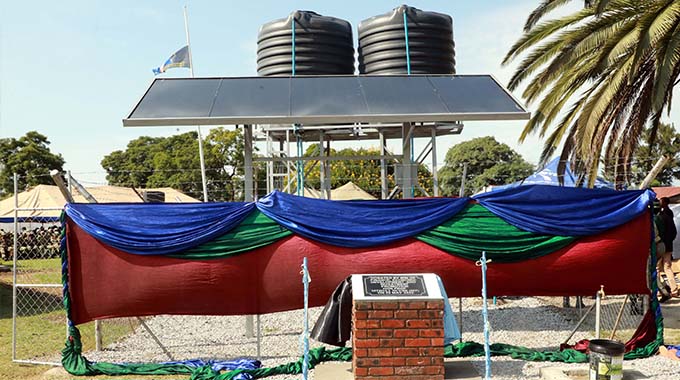
THE Presidential programme to drill a borehole in every village is just the first stage of a follow up programme to establish a village business unit in each of these villages using the surplus water from the borehole once household needs have been met.
So far 3 703, more than 10 percent of the planned 35 000 village boreholes, have been drilled with the rigs working steadily to bring water to more villages, plus ensuring that every school will have a borehole, the village and school drilling being done in tandem in the five-year dual programme.
Early in these drilling programmes, it was decided to upgrade them by incorporating a plot in the village or the school, usually around 2 hectares, where vegetables could be grown to improve diets and start the community earning money from the sale of surpluses.
This required more investment, beyond the original borehole, solar powered pump and initial tank, and some detailed organisation in the village to ensure equitable access to both the water and the land and the communal management of the water, pump, irrigation equipment and irrigated land.
Drip irrigation was chosen as the ideal method of irrigation, since it made best use of the limited water supply and the fairly small plot size meant that the capital investment was a practical option. This means that there is significant extra work that needs to be done after a successful borehole has been drilled, first to install the pump and panels and then clear and fix the levels in the horticulture plot and install the drip irrigation system.
Another additional source of better food and income are the fishponds and fish tanks that have started to be added in pilot projects, that can make double use of at least the irrigation water, first to grow the fish and then to water the land.
The community also has to take control of the borehole and the village business unit.
These units are registered as a private company, with the community members as the shareholders. This way they now become responsible for the maintenance and repair of all infrastructure and equipment.
The programme gets them started, and will back up with advice, but the community takes over the financial rewards and future costs.
This ensures that the village business units will be self-sustaining and will look after all the equipment and infrastructure.
Villages are already making sure that the solar panels, pumps and other equipment are well guarded.
The result is worth all this extra labour and equipment.
The Agricultural Marketing Authority, which monitors the scheme, reported that in the first two months of this year, 75 fully functioning units generated over US$200 000 in sales, that is the income from the surpluses produced after the village families had eaten their share as they upgraded their diets.
There are good markets for decent vegetables, including green mealies, in nearby mines, towns and cities and among the non-farming rural population, which will be continually growing as the swathe of rural development programmes now being pushed create opportunities for many others, such as builders, mechanics, furniture makers and specialist food processing.
The Ministry of Lands, Agriculture, Fisheries, Water and Rural Development has a wide range of responsibilities, as its name suggests, but critically its main functions combine to ensure that Zimbabwean farmers grow enough food for everyone to eat, and equally importantly that rural areas develop.
The two fit together, at least in modern Zimbabwe as opposed to the colonial scheme of the food coming from large estates and the small-scale farmers hopefully growing enough so that they did not starve.
The modern concept is that all farmers will produce surpluses of an ever growing range of crops and livestock to ensure that they do not just feed their own families but earn ever better incomes as they sell food to the non-farming population, both in their districts and in the towns and cities of Zimbabwe.
This means that the whole population can move forward to Vision 2030, an upper middle income economy. That requires that the overwhelming majority need to be upper middle income, at least in the way they live and eat.
The borehole programme and its major add-ons are there to improve both the quality of life and the standards of living.
Having water on tap as it were does not really upgrade the standard of living; but it increases the quality of life significantly. The same goes for the programme to install basic solar systems in each home.
The village business unit takes the village borehole a step further, both in quality of life and in standard of living, by making it a lot easier for the villagers to eat better, but also to start earning some extra money, and spreading this income stream.
Women, who traditionally tend the vegetable plots, have already noted that they now have their own secure income so the programme is bringing in more gender equality as well as a better life.
We would imagine that as time goes on those village business units can be continually upgraded as a village community starts working on improvements and builds on the co-operation that running such a unit successfully requires.
In developed countries where there is still extensive small-scale agriculture, communities now also process specialist products from the local grains and livestock. In France, for example, an entire community will agree on producing a particular regional variety of cheese that can be sold as a semi-luxury item.
This sort of cooperative and community rural development produces a widening range of streams of income for each rural family, and when those are added together, along with better housing, a power supply and piped water, the rural families often have a quality of life at least equal to many urban people and sometime superior.
There is no single magic wand for rural development, but combining the range of programmes that the President and Agriculture Ministry have launched and then fitting them together means that each community and each family can climb the ladder to a decent life and prosperity.



