admin
admin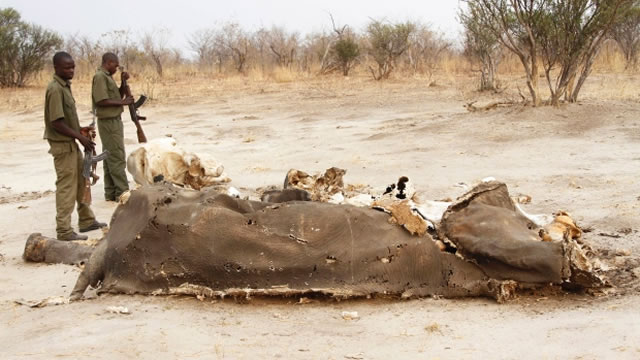
 Five more carcasses of elephants suspected to have been poisoned by cyanide were recently discovered at Ngamo Forest which borders Hwange National Park. This brings to 95 elephants that have so far been recorded as having been killed by cyanide poisoning. The number of elephants and other game species that could have been killed as a result of cyanide poisoning could be much higher given the fact that investigations are yet to establish the area covered by the poaching syndicate that was using cyanide. The discovery of carcasses in the Ngamo Forest confirms that the poisoning is beyond Hwange and Tsholotsho districts.
The Hwange National Park ecological disaster is very disturbing but what is however comforting is that cabinet is seized with the challenge. Cabinet ministers have been to the National Park several times to assess the situation on the ground and assist in mapping the way forward.
Those that have been to the park include Defence Minister Dr Sydney Sekeramayi, Information, Media and Broadcasting Services Minister Professor Jonathan Moyo, Environment, Water and Climate Minister Saviour Kasukuwere, Mines and Mining Development Minister Walter Chidhakwa, Local Government, Public Works and National Housing Minister Dr Ignatius Chombo, Health and Child Care Minister Dr David Parirenyatwa and Agriculture, Mechanisation and Irrigation Minister Dr Joseph Made.
In a bid to minimise the impact of the disaster, the Parks and Wildlife Management Authority has started burning carcasses of animals killed by poisoning while the Environmental Management Agency is working on de-contaminating the affected areas. The police, EMA and Parks and Wildlife Management Authority have launched a joint operation aimed at getting to the root of the problem which is threatening to wipe out game in the Hwange National Park and surrounding areas.
The joint operation has led to the arrest of seven suspected members of the poaching syndicate and five businesspersons who are alleged to have supplied the poaching syndicate with the deadly cyanide. Three of the poachers have since been sentenced to 16 years in prison and in addition two of them were ordered to pay $600 000 restitution to the Parks and Wildlife Management Authority while the third was ordered to pay $200 000.
The judiciary should be applauded for passing deterrent sentences and this is as it should be. Poaching using chemicals such as the deadly cyanide should be condemned in the strongest terms because the effects of using such chemicals are just too ghastly to contemplate.
The effects of the poachers’ callousness are likely to be felt for many years to come. Game is one of Zimbabwe’s tourism pillars and the majority of foreign tourists in fact visit the country just to see the wild animals in their natural environment.
The challenge therefore is to ensure that we protect this valuable tourist asset. It should be the responsibility of each and every Zimbabwean to fight all forms of poaching. What is encouraging is that chiefs in Hwange and Tsholotsho districts that have been affected by the poisoning of elephants have pledged their full support in fighting poaching.
The chiefs have urged their subjects to report any strangers that visit their areas to authorities as part of measures to fight poaching.
The Government on its part should allocate more resources to the Parks and Wildlife Management Authority to enable it to fight poaching.
The private sector especially those in tourism should also assist with resources because it is their industry which is under threat as a result of this stepped up poaching that involves mass killing of game using chemicals.
The war against poachers should be won at all costs and we strongly believe there is no task or challenge which is insurmountable as long as there is unity of purpose. We want to once gain urge stakeholders to put their heads together and collectively fight poaching which is threatening our tourism industry.



 Online Reporter