BY buttressing the economy against climatic and global shocks, and helping farmers produce during an El Nino, the Government reckons it can maintain 5 percent annual growth in the Gross Domestic Product, the value of everything everyone produces, next year.
Already the Government has gone beyond looking at ensuring everyone has enough to eat in what could well be a difficult year with an El Nino now certain and already building up in the Pacific Ocean to unprecedented levels.
The measures to mobilise food reserves and ensure the private sector millers can import what they cannot procure locally are already in place, so we will all eat.
But going well beyond this, the plans include measures, again already being implemented, to minimise agricultural losses and maintain the highest possible farming output while making sure other sectors of the economy, especially mining and manufacturing, continue moving ahead and driving economic growth and job creation.
This will be a centrepiece of the next national budget. Although public discussions on the budget are now starting, there are areas where there cannot be any retreat.
Money has to be found to keep expanding and maintain irrigation, for example, in the capital spending and the social services of education, health and social protection must be continually upgraded.
The Government has largely maintained its percentage of tax revenues devoted to these services constant, meaning in an expanding economy the actual sums rise each year so more can be done. This is another reason to maintain economic growth. Better services are guaranteed when there is a steady improvement in the money available.
During the last El Nino and the worst drought since independence in the 2023-2024 season, the growth rate fell to 1,7 percent in 2024 with the lower harvests. But it is important to realise that the economy as a whole kept growing, albeit at a slower rate.
Built-in resilience meant that last year the recovery in harvests and the higher global mineral prices pushed growth up to around 8,3 percent. That high rate of growth was a combination of the recovery percentage on top of the basic growth rate.
Other lessons from the 2023-2024 El Nino was the far lower loss of livestock compared to previous droughts, largely owing to measures taken to harvest hay and grow stock feeds under irrigation and using boreholes to provide critical watering points.
A fair amount of this work was done on the run, reacting to the drought, but since then we have been continuing. Already smallholder stock farmers are producing a lot more silage, thanks to readily available inputs, and the village borehole programme steadily increases the number of boreholes. That is another service that needs to be properly funded, so we do keep drilling.
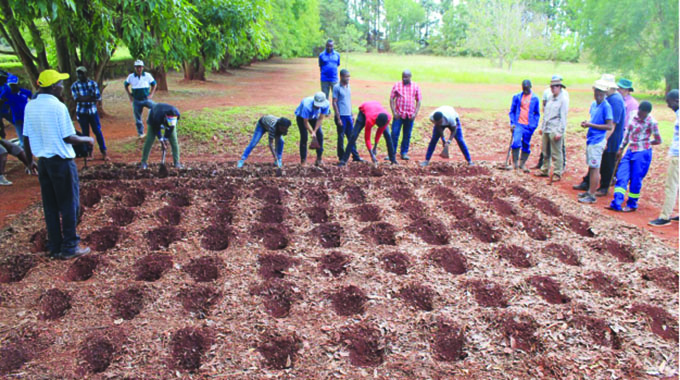
Climate-proofing crop production, with the Pfumvudza/Intwasa scheme leading the way among smallholders, is being continually refined. Already we know, from experience, that making sure the crop holes are the optimum size, and really good supplies of mulch, are the critical factors. Combining Pfumvudza with other water conservation and water harvesting methods, everything from swales onward, increases benefits.
Again there are costs involved, but we have already found that first it is cheaper to help farmers grow enough of their own food rather than hand out relief supplies, although these are still needed.
But secondly, it is critical to improve harvests in all sorts of years so that farmers can earn more money and improve their own prosperity. That means all farmers need to be supported to produce during drought years so that they can at least maintain progress, even if that slows.
We also know more about what sort of crops and what varieties of these crops can cope with forecast conditions, and our seed companies have been increasing their own research into more modern and useful varieties. These produce higher yields in good years but, ever more important with increasing climate instability, produce adequate harvests in quite bad years.
Even with irrigation expanding, better pasture management, better cropland preparation, and better varieties and species of crops means the irrigation water goes even further, and more hectares can be irrigated with the same amount of water. This also helps keep costs within reason as well as allowing output expansion.
With the value addition becoming more common in mining, with Government pressure although the economics also make it a worthwhile investment, and our rising industrialisation now based on processing our own raw materials rather than assembly work on imported components, we can maintain high rates of economic growth even if farming has to be more of a holding operation in a bad year.
But a holding operation should not see heavy losses or dramatic falls in value. And that is now the prime Government agricultural policy for dealing with El Nino, a challenge rather than a survival operation.