admin
admin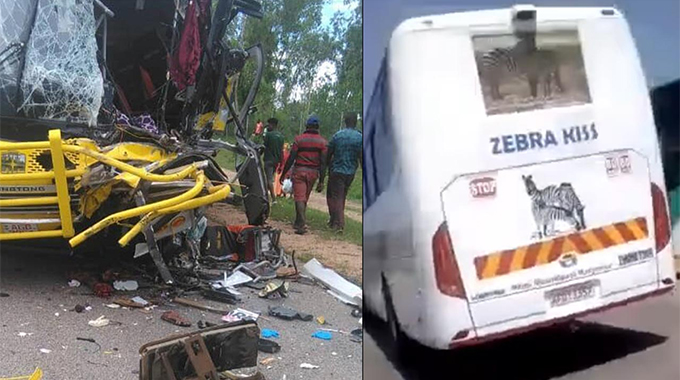
Everyone involved in public transport was impressed and excited when the festive season, traditionally from mid-December to the middle of this month, passed without a bus figuring in the accident statistics.
We thought the problems, especially those involving human error and bad management, had largely been sorted out. We were wrong. The very next day there was a fatal bus accident in Mutoko when a lot of errors piled up together.
So far as everyone can figure out, two buses from Rimbi Tours and Zebra Kiss were racing each other along the Harare-Nyamapanda highway, or apparently racing.
They were at least overtaking each other fairly frequently. About 140km from Harare, the Zebra Kiss bus pulled over into the oncoming lane to overtake a tipper truck, and the Rimbi Tours bus, which had been trying to overtake the other bus, carried on straight in the left lane and hit the rear of the moving truck. One person died. But this time there was more Government reaction than the standard police traffic investigation and anything from the VID.
The Ministry of Transport and Infrastructure Development unveiled a new policy, that where there was rational suspicion of management failure or systematic abuse of road rules, it would suspend the public transport licences of the potentially offending companies.
So Rimbi Tours and Zebra Kiss had their licences suspended and their bus fleets grounded.
What is still needed is something more precise over exactly what a suspended company needs to do to satisfy the Commissioner of Road Transport that it is now a fit permit holder to resume operations. But a good start has been made in taking effective action, rather than just being sorry for the deaths on the roads.
This has already had an effect. The two companies have already stated that they are organising refresher courses for all drivers.
The Zimbabwe Passenger Transport Organisation, the trade group that brings together all bus companies, held an emergency meeting to tell the companies that the Government was now serious about exercising its powers and that all operators needed to conform to the set standards. The organisation also wanted more co-operation among companies on the same route so that buses were not leaving and travelling at the same point at the same time.
This presumably would need modifications in timetables so that respectable intervals were between buses on the same route in the same direction.
But that is just a practical modest measure, and does not mean that a bus company can ignore its responsibility for tightly managing its services and staff.
In any case, competition should be on service, not being first at a bus stop. Passengers already gravitate towards companies that have clean, well-maintained buses with safe and polite drivers and adherence to realistic timetables.
More can be done in enhancing competition in that regard, including better posting of timetables so everyone knows when the “good bus” will arrive at a stop.
There is more than can be done, especially with modern technologies. Modern satellite tracking of vehicles is commonplace and many private transport companies have fitted this to their fleets, as have companies that assign company cars to their executives and key workers.
Part of this was to be able to track down a stolen vehicle, but many users of the technology find it very useful to be able to find out just where their vehicles are, just what routes their drivers are following, and even how they driving. The times allow simple calculations to be made over speeds.
One measure whose time seems to have come is to make satellite tracking of bus fleets compulsory, where a company has not already implemented this on its own, and then to go one step further in the case of public passenger transport, the bus companies, and insist that the log-in codes are shared with the Commissioner of Road Transportation.
A small monitoring and audit unit in the Ministry would then have the effective means of seeing, in real time as well on recorded data, just what the buses of each company were doing and be able to take action.
This is not outlandish or unjustified Government interference in private companies, since lives of passengers are involved.
We need to remember that bus drivers are a small and exceptionally highly trained group. To get the class one omnibus licence a driver has to go through the normal procedure to get a car driver’s licence.
Then they have to learn how to drive a heavy truck, and gain their class two licence. Only then can they start their lessons for driving a bus and eventually take the tests for a class one licence. So the skills level is high.
In addition this group of active bus drivers have to continuously renew their defensive driving licences, and that involves an exceptionally high level of knowledge of the Highway Code, if nothing else, and the latest version of the code at that.
This is far more than most car drivers will know. So along with their high level of skill the bus drivers also have a high level of knowledge about road rules.
But they need to apply both and this is where bus owners and bus company managers come in. The competition and racing we see on some routes has been going on for decades. Some may just be human nature, as you can get with fatal results when teenage boys race. But some may be systematic arising from managerial policies.
Bus drivers ought to be on pure salary, with no commissions and the only performance bonuses being for tight adherence to timetables and zero complaints or traffic tickets.
Targets and the like can only be for meeting the timetables and following rules, not for the actual number of passengers carried. And attempts by some bus crews to earn a bit on the side by not recording a passenger picked up halfway and replacing a passenger who got off at that point must be suppressed.
Compulsory satellite tracking would remove temptations by drivers to speed or the like, and would remove excuses by bus owners that it is impossible to monitor their drivers.
This is what railways, incidentally, have been doing for almost 200 years and possibly helps explain their exceptionally low accident rates. Right from the early 19th century railways, train drivers have been tightly monitored.
Their arrivals and departures at stations are recorded, as are the times they pass signals, these days electronically but for a long time by signallers noting the times on a clipboard.
With modern satellite tracking and the instant communication of mobile phones, bus companies can give the same sort of managerial control they need for the best services, the ones that attract paying passengers.
The small costs will soon pay for themselves, and in any case most passengers would accept a ticket price rise of one or two percent in return for total safety.
The decision by Minister of Transport and Infrastructure Development Felix Mhona to start wielding the big sticks that Parliament has given him in the law, now need to be backed up by active use of available and inexpensive technology by the companies, so that he does not need to use those sticks.



 Online Reporter