dyton mupawaenda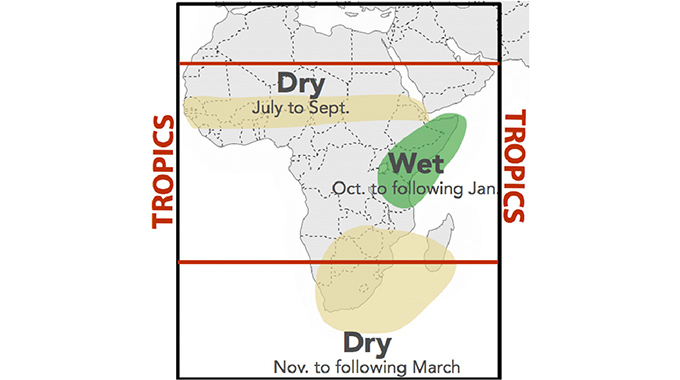
With decent heavy rains now falling at long last in most parts of the country, and reasonable rains expected to continue up to Christmas, Zimbabwe’s dryland farmers can finally start planting with some confidence that they will be able to harvest a crop next year.
The El Nino phenomenon this year has made the gradual retreat of the start of the rainy season more pronounced and more severe. Over the last few decades we have seen a trend of later starts, and part of that is directly related to global warming and the seasonal shifts such warming produces.
October is no longer the hottest month to be followed by the start of rains in the first week or fortnight of November, and as with this year the real start is almost mid-December. This does require a lot of adaptation.
The experts in the Ministry of Lands, Agriculture, Fisheries, Water and Rural Development are hammering home their advice to use the short season varieties of all grain, maize in the natural regions where it is still a potentially viable crop, and the traditional grains in the rest of the country where maize is no longer even a potential crop.
A lot of plant breeding work is being done in both the State and private sectors to create the new hybrids and new varieties of crops that climate change is demanding, varieties that can grow with less rainfall, can survive dry spells better and can mature in a short rainy season. We might be lucky and get a longer season, but that is no longer the way to bet.
But if a farmer has irrigation or supplementary irrigation available, then the longer-season varieties are an option, but past research has produced some incredible good seed types.
The present research is now pushing other limits. Short-season varieties can produce lower yields, since there is some trade off, but in a short and difficult season will at least produce a reasonable crop.
But in any case a lot of the work for most farmers on yields is not so much the variety, but the rest of the farming practice, the inputs, cultivation and the like.
Few farmers at present are getting anything close to the potential maximum yield of any variety and so going for short-season varieties will only enhance their output, rather than curtail it.
The Agriculture Ministry has been moving fast and effectively this year in getting a lot of irrigation schemes that were failing or had been forced to close back into commission, and as a result has managed to get over 400 schemes now growing maize, with more than 350 000 tonnes of irrigated maize expected to be harvested next year.
That is a good starting point and shows us our future.
Whatever is agreed in accelerating the retreat from carbon emitting energy sources, in not just protecting the natural environment but building it up as the needed carbon sinks, we need to accept that we are probably only about halfway through the sort of global warming we will experience before global temperatures can start dropping.
For Zimbabwe this means a warmer and drier climate. With our variable seasonal variations this in turn means more of these El Nino seasons, and so we have to be ready.
This season is the major test of so many of the special schemes of the Government in the Second Republic and it appears that we are at least prepared to take advantage of the gaps that may open.
One important point to note in all the advice now being given to get planting, is that no one is doubting that the farmers have the inputs and have them readily available. The fertilisers and seeds are there on or near the farms because everyone has been working on that since the last harvest. We no longer hear of farmers with rain falling on their fields, but still crying for inputs.
That particular victory is important. It appears now that we can get a spell of decent wet weather quite suddenly and quickly, with little warning, so when this sort of weather arrives we need to be ready.
It rains hard, the soil is wet, the expert says go, and the farmer leans over, grabs the seed and fertiliser and gets going.
Another sign of the more extreme weather we can now expect is that a lot of storms, especially the early storms in a season, can be more destructive than many might remember.
The civil protection statistics are worrying, 62 killed since October by storm and flash flood, with the risk-taking in flash floods being the main cause, although some lightning strikes have been vicious.
We are also seeing roofs being ripped off in some storms, a sign that there are a lot more buildings with proper roofs these days, but also a sign that everyone probably now needs to do the proper inspection of their sheet roofs to make sure everything is properly tied down.
We might also need design changes. Certain roof designs that are easy to make can be less wonderful in a strong surging gust, and the orientation of the roof needs to be thought about a bit more.
This is something, building design and maintenance procedures, that the practical research in our universities and colleges need to look at.
Since we are also likely in climate change to be hit by more cyclones, say two a year, we could well start looking at the sort of solutions other countries in the tropics who have been facing consistent hurricane and cyclone conditions for longer have been able to use design and research to continue to build affordable but safer buildings.
We are no longer thinking about this sort of weather being rare. Even “ordinary” storms with those vertically rotating high speed winds from cloud to ground can now produce, if very localised and very briefly, the sort of wind that a cyclone can produce over a larger area and for longer. So if we build for cyclones we build for thunderstorms.
With our agriculture research, with our putting experts back on the ground so they can advise farmers promptly and properly, with our systems to ensure farmers have the inputs on hand to react quickly to the advice, and with our much better organised civil protection systems now on alert, we are ready to cope with climate changes and more extreme weather.
We now just need to get better, and make sure that learn from all experience and continue in all areas to innovate.


 Online Reporter