

 admin
admin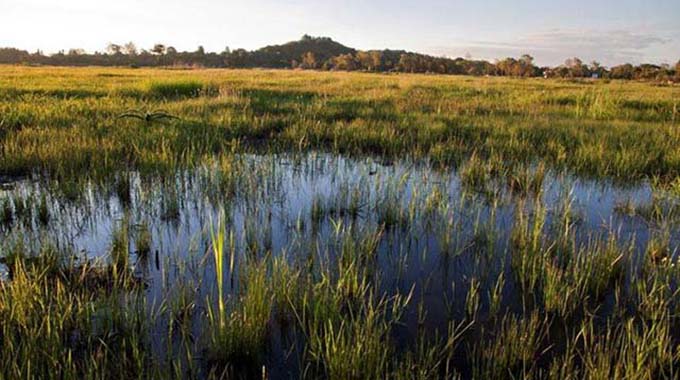
The continued destruction and nibbling away of the wetlands in Harare and the rest of the local authorities in Harare Metropolitan need to stop, for a wide range of reasons, and the pressure now being exerted by the central Government through the provincial headquarters for environmental and planning laws to be obeyed is welcome.
Secretary for Provincial Affairs and Devolution for Harare Metropolitan Tafadzwa Muguti has now made it clear that local authorities cannot simply tear up the environmental laws, which actually trump their planning authority, and need to switch their ideas instead of continually looking for ways to sell housing and commercial stands on the ever fewer wetlands they are supposed to be keeping.
Harare metropolitan is built on a fairly complex terrain of hills and good building land cut by rivers and streams all running through wetlands.
Properly planned and administered this could have been used to create an exceptionally liveable city and metropolitan area with a sea of brick and concrete holding islands of green space.
Instead the local authorities involved just want the sea of concrete, and a lot of the corruption and alleged corruption on the councils has come from the ways land suddenly changes its use and how council land, and because of past planning laws most of the wetlands are council owned, can be sold, often to enrich individuals in the administration if the charges before the courts are any guide.
On the most basic level we are already seeing the dangers of wetland destruction, people sold plots that ensure their living rooms are under water when it rains.
We can also see damage and incipient damage to structures built on pure vlei soils as walls crack. This is all dangerous and the only solution in most cases is to work out where they people can be moved to.
The wetlands are not just set aside to prevent damage, although they do this by acting as sponges that can absorb extra run off and reduce the danger that the city streams will flood quickly. The wetlands also provide a lot of positive benefits.
They can clean the sometimes filthy run off that comes down from roads and other less pristine urban surfaces. They recharge the underground water, and many Harare wells and boreholes have either run dry in recent years, or have had to be deepened to reach the falling water tables.
If run-off is just sped down a drain into a canalised river it will not soak into the soil. When it flows into a properly managed wetland it can gradually soak in and eventually reach the water table.
There are other environmental concerns and because the environmental issues were enacted into law, and the powerful Environmental Management Agency created to ensure those laws against the daft local authorities when they are in the wrong, a lot of people want to use the wetland issue for other reasons.
Many of the resident associations want to maintain some public open space in their suburbs and sensibly see that the continual conflict between developers and residents does have a rational solution, by setting aside that land that is definitely very unsuitable for development and building as that necessary green lung in the concrete jungle.
This started right in the early days of Harare, when it was still little more than a village. The large Harare Gardens were set aside when the only serious official interested in recreational and natural space, the parks superintendent, managed to persuade the incipient council to set aside the area where there were a number of natural springs as a park. He then started planting trees so that when money became available for further upgrades, the longer-term work was done.
Generations of flat dwellers and office workers have been grateful, and even though the park is now tatty and somewhat forlorn, it is still there and a better and smarter council can easily in future years restore it to its glory at little cost.
Avondale was the first private attempt at town planning in Harare when a farm owner started cutting it up. It was such a disaster that a lot of our planning laws arose from the need to stop this being repeated.
Despite the high percentage of flats, there is almost zero public open space, with even the stream running through the suburb confined to a concrete canal. Children wanting a place to play have to go outside the suburb, and even joggers have to use the roads.
There is need for major housing development in Harare Metropolitan, and the Government, wanting to stop the city spreading as far as Norton and Marondera, has correctly said that 40 percent of residential land needs to be flats, which means that at least 80 percent of new housing will be flats.
This is necessary, but it is also necessary that we have the rest of the facilities that a capital city of an upper middle-income country deserves.
So we need to preserve some open space where children can play and residents relax. We also need to remember that high density housing, and you get no more high density that flat blocks, produce more run-off when it rains so we need wetlands to cope with that water.
We will also need for schools, and playing fields are one of the few permitted encroachments on a wetland since they preserve the open land needed for a wetland to function.
The fact that the wetlands of Harare metropolitan meander around and through the ever denser urban development, and are close to almost everyone, makes them exceptionally useful as our green lungs.
The point is that environmental needs, planning needs, residential needs, recreation needs can all come together in a single policy that starts with preserving the wetlands, the land that should not be built on.
There are no serious arguments against preserving wetlands except those advanced by greedy developers and latched onto by local authorities who want new stands in favoured areas to sell cheaply to councillors, officials and their friends.
Wetland destruction is simply a product of greed, and there is no need to submit to that greed.
We can have a proper city, a city that take its place as one of Africa’s top capital cities in a developed continent, if we maintain our law and use that law to maintain our environment.



 Online Reporter