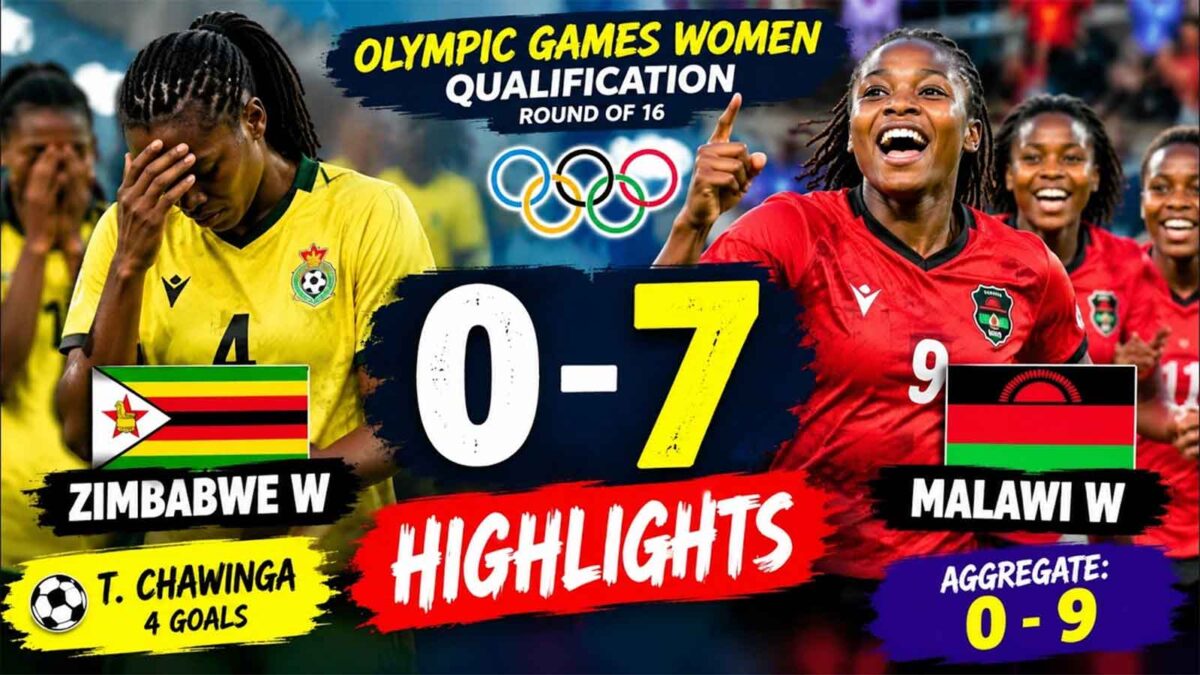
ZIMBABWE women’s football team’s crushing defeat at the hands of Malawi in a 2028 Los Angeles Olympic Games qualifier last week stirred mixed emotions across the domestic football landscape.
The 9-0 aggregate loss after the two-legged encounter was more than just a routine football result as it also shattered Zimbabwe’s hopes of playing at the quadrennial Games to be held in the United States of America in two years’ time.
Zimbabwe lost the first leg 0-2 in Malawi, and the plot went completely off the tracks in the return leg at the National Sports Stadium where the Malawians followed up with a 7-0 routing.
No one had anticipated this kind of a result, considering that no Zimbabwean team has ever lost by such a huge margin in international football.
It felt like the collapse of a once-proud reputation.
Feelings of shock, anger, humiliation, dejection and utter dismay were natural reactions after such a big loss because, in sport, emotions reign supreme.
But what is needed now are level heads to see where the team went wrong, what lessons can be drawn from the experience and how women’s football can be saved after plunging to the new lows.
The Mighty Warriors have suffered heavy defeats before, including against global powerhouses Germany, Australia and Nigeria, but this latest setback cut deeper because it came against a regional rival who few years ago was ranked below us.
In reflection, Malawi’s triumph was necessary to expose how far Zimbabwe have fallen behind in a game where neighbours are moving forward at a frightening pace.
For years, Zimbabwe have continued to speak proudly about the achievements of the class that qualified for the 2016 Rio Olympics.
Indeed, that remains one of the greatest accomplishments in the history of women’s football in this country. But football does not reward nostalgia. It rewards planning, investment and constant renewal.
While Zimbabwe were celebrating past glories, others were busy building for the future. Malawi have transformed themselves into one of the region’s emerging powers through a well-structured development pathway that is now beginning to give them results.
They held the continent spellbound at the recent Women Africa Cup of Nations where they shocked some of the continental powerhouses before settling for silver medal.
Yet Zimbabwe can only dream of qualifying for WAFCON.
The gap is no longer theoretical, it is visible on the pitch. Perhaps, that was the most painful lesson from the two-legged encounter between the two Southern African rivals.
In sport, there are defeats that hurt and there are defeats that force a nation to confront uncomfortable truths. The Malawi debacle belongs to the second category.
Under the circumstances, attention naturally turns to new coach Stella Gotal. Such is the nature of football. When a team loses 7-0 at home, questions will be asked about the coach, team selection, tactics and preparations. Some critics argue she tried to implement too many changes too quickly, while others feel Malawi exposed weaknesses in her game management.
However, it would be unfair, and perhaps dangerous, to reduce this defeat to a coaching problem.
Gotal has been in charge for barely a month. She inherited a team that has had limited activity over the years, inconsistent preparation and inadequate exposure compared to the continent’s emerging powers.
The Malawi tie was not a final examination of her capabilities. It was an assessment of the state of women’s football in Zimbabwe.
The reality is that women’s football in Zimbabwe has stagnated while others have invested.
Malawi’s recent rise, culminating in their strong performances on the continental stage, did not happen by accident. They had a five-year plan; they deliberately financed and built systems, developed players, strengthened leagues and provided consistent international competition.
Malawi are now even exporting players to top leagues in Europe and USA, with the formidable Chawinga sisters Tabitha and Temwa, now ranking among the most valuable talents on the continent, with a combined value of US$2m.
ZIFA cannot expect the senior team to thrive if the foundations are weak. The first priority must be the creation of a clear development pathway.
The appointment of junior national team coaches by ZIFA is a positive step, but that structure must be properly funded and supported.
The Under-17 and Under-20 programmes should become regular platforms for identifying, nurturing and exposing talent to international football.
Gotal herself appears to understand the magnitude of the task. Her repeated emphasis on building a system, identifying talent and creating alignment between junior and senior national teams suggests she recognises that sustainable success cannot be achieved through short-term fixes.
The coach should be given time, resources and measurable long-term targets. If the objective is genuinely to build a competitive team by 2028 and beyond, then she needs regular training camps, quality support staff, sports science expertise and a meaningful calendar of international friendlies.
Secondly, the women’s domestic game requires urgent strengthening.
A national team can only be as strong as the league that feeds it. Clubs need more competitive fixtures, better coaching standards, improved fitness, conditioning and proper player welfare.
Talented girls must have opportunities to play regularly in organised competitions from a young age. Schools, academies and community programmes should become active partners in this process.
Thirdly, ZIFA must cast the net wider.
There is talent within the country, but there is also a growing diaspora community that should not be ignored. Many successful African nations have benefited from integrating foreign-based players into their national teams.
Zimbabwe should aggressively scout both locally and internationally without compromising merit.
At the same time, brutal honesty is required regarding the current player pool.
There are players in the Mighty Warriors set-up who remain capable of contributing to the rebuilding project.
Yet the Malawi defeat showed that the overall quality, athleticism, tactical understanding and competitive experience of the squad are not currently at the level required to challenge the continent’s best teams.
The encouraging aspect is that this defeat does not have to be the end of the road. In fact, it should mark the beginning of a serious rebuilding process.