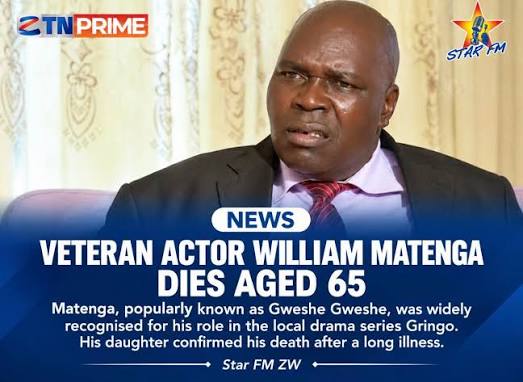
THE death of veteran actor William Matenga, popularly known as Gweshegweshe, is a painful loss for the country’s entertainment industry and the many people who grew up enjoying his performances.
We have lost more than an actor.
We have lost a familiar face who brought laughter into homes, entertained generations and helped shape the memories of television audiences through his outstanding contribution to local drama and comedy.
For many Zimbabweans, the name Gweshegweshe immediately brings back memories of the popular television comedy series Gringo, where he starred alongside the late Lazarus Boora, affectionately known as Gringo.
Their on-screen chemistry was something special.
The relationship between the strict employer, Gweshegweshe, and the mischievous gardener, Gringo, created some of the most memorable moments in Zimbabwean television history.
Matenga had a natural ability to entertain.
His expressions, delivery and commanding screen presence made his character unforgettable.
He did not need expensive production equipment or elaborate special effects to capture the attention of viewers.
His talent was enough.
That is the beauty of genuine acting.
It is about connecting with audiences, creating believable characters and leaving memories that survive long after the cameras stop rolling.
Matenga achieved all that.
His contribution went beyond Gringo. Having started his acting career in 1984, he featured in several television and radio productions, demonstrating a commitment to the arts that spanned decades.
His appearance in Gringo The Troublemaker in 2013 was another reminder of his enduring association with one of Zimbabwe’s most celebrated comedy productions.
His death also brings back memories of Lazarus Boora, who died in 2020.
The two actors gave Zimbabwe a partnership that will remain part of the country’s entertainment history.
It is heartbreaking that another familiar face from that memorable television era has now departed.
However, their work must not be allowed to disappear with them.
Zimbabwe’s broadcasters, film producers and cultural institutions should make deliberate efforts to preserve and celebrate productions that defined the country’s television history.
There is also an important lesson in Matenga’s death concerning how Zimbabwe treats its creative people.
For too long, local actors and other entertainers have struggled to make a decent living from their talents.
Some have spent years entertaining the nation only to find themselves facing financial difficulties when illness or old age makes it difficult to continue working.
Matenga previously appealed for financial assistance when he experienced health challenges and struggled to meet medical expenses.
This should make us reflect on whether Zimbabwe is doing enough to protect the people who dedicate their lives to entertaining the nation.
It is not enough to celebrate artists when they are successful, popular and appearing on our television screens.
They deserve support, dignity and recognition throughout their careers and even when they are no longer able to work.
The Government, broadcasters, producers and organisations representing artists must work together to establish stronger welfare structures for entertainers.
This includes medical assistance, social protection, fair remuneration and mechanisms that ensure performers benefit from the continued use of their creative work.