admin
admin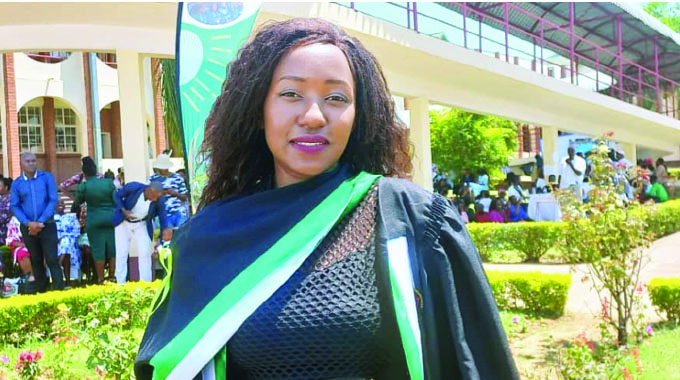
Sukulwenkosi Dube-Matutu
Bulawayo Bureau
The new Education 5.0 which is shifting the education system from a theory-based curriculum to a practical-based approach by focusing on teaching, research, community service, innovation and industrialisation has been grasped by Joshua Mqabuko Nkomo Polytechnic in Gwanda.
At least three students at the college have demonstrated the benefits of Education 5.0 by excelling in their programmes and showcasing their innovative and entrepreneurial abilities.
They are Senabelo Trymore Mpofu, Simiso Ndlovu and Sandisiwe Moyo.
Mpofu was the overall best student in secondary sciences, Ndlovu in technical education and Moyo in teacher education.
Mpofu, who was under the Division of Teacher Education, was involved in designing and installing a solar system for the polytech, which provided a reliable source of energy for its laboratories.
She also devised functional teaching methods for topics in physics, such as logic gates, light dependent resistors and thermistors.
During her teaching practice, she developed a solar-powered micro pump that minimises water contamination and wastage during practicals.
Education 5.0, which promotes industrialisation, modernisation and innovation, seeks to develop skills among students which is key in promoting industrialisation and the attainment of Vision 2030.
Mpofu said Education 5.0 has allowed her to explore her skills in innovation and technology. She is looking forward to coming up with solutions that will develop the nation.
“During my teacher practice, I identified areas where I could come up with solutions. I designed a solar system in order to address the issue of power supply,” she said. “I also decided to come up with a solution for water contamination and wastage which we see when learners are conducting their practicals.
“This motivated me to invent a solar micro pump which pumps from one point to the other minimising contamination and water wastage. The solar micro pump moves water from large containers to beakers and cylinders automatically using a switch without students having to scoop the water using beakers. Such a system can also be used within the community.”
Ndlovu, who majored in animal production, said it had always been her passion to study agriculture at tertiary level.
She did her attachment at dairy farms around Bulawayo as well as the Department of Veterinary Services.
She assisted cows that had delivery problems, nursed a goat that had uterine prolapse, conducted disease surveillance, foot-and-mouth inspections, branding and diagnosis of various animal illnesses. She scored 13 out of a possible 14 distinctions.
“I have a passion for animal health and I would like to pursue it further as a profession. It’s good that under Education 5.0 we are being empowered to become owners of companies and not just mere employees. This is that path which I want to pursue,” she said.
Moyo, whose area is music studies, said the new curriculum has presented learners with a wide scope of learning options.
She now wants to obtain a degree in music and become an entrepreneur.
She taught TjiKalanga across all the grades at Madabe Primary School, where she was deployed. She composed and recorded a TjiKalanga song “Kwegula Manyala”, which she has performed at various platforms.
“During the course of my studies I did my teaching practice at Madabe Primary School in Mangwe District. It was a pleasure to teach TjiKalanga to the learners and to contribute towards developing the language which was once marginalised,” said Moyo.
“I have a passion for music and I managed to record a song in TjiKalanga which was played during this year’s Zimbabwe International Trade Fair show among other platforms. I have also recited poems in TjiKalanga on different platforms. I love TjiKalanga which is my language and this platform had given me a chance to promote my language.”
Six hundred and eighty-one students graduated from the teacher education division while 281 were from the technical division.
This year’s graduation was held under the theme, “Promoting innovation and industrialisation through a transformed curriculum.”


 Online Reporter