Online Reporter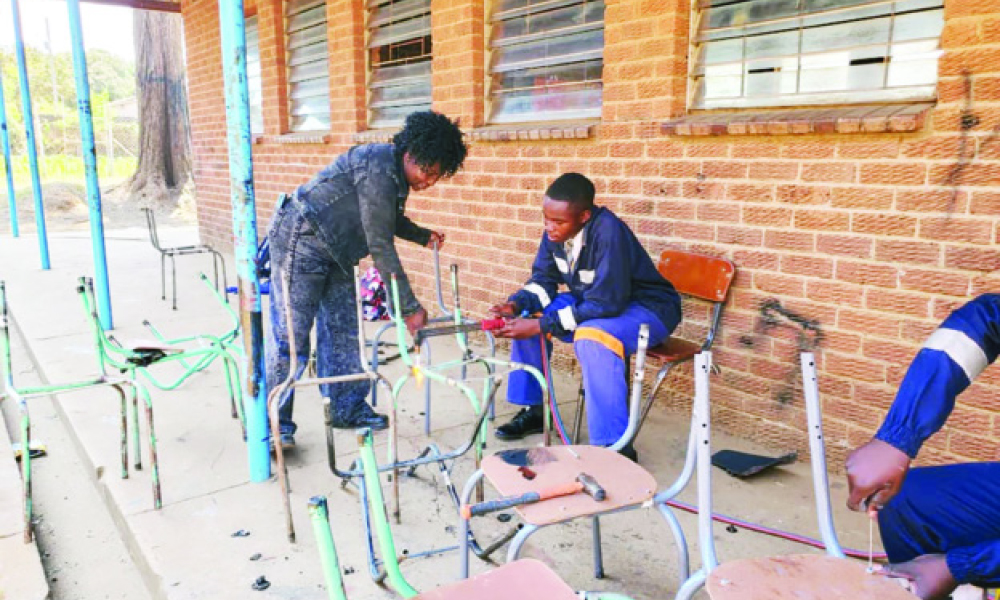
Theseus Shambare
Features Writer
THE smell of hot metal and sawdust hangs in the air. Sparks leap from the welding machine as a young girl hammers a piece of scrap metal into a shape she can barely imagine.
At first glance, it seems chaotic, a tangle of noise, tools and flying shavings, but under the watchful eye of Patience Karimatsenga (41) this is a classroom transforming more than furniture.
It is transforming lives. Karimatsenga, head of the metal technology and designing department at Hermann Gmeiner High School in Bindura, has spent nearly two decades teaching learners to believe that gender does not define skill or ambition.
Her classroom is alive with possibilities. Broken chairs and desks, once destined for the dump, now emerge from her pupils’ hands as sturdy, functional furniture. The practical lessons are about more than repairs. They are lessons in innovation, resourcefulness and entrepreneurship.
“I want my pupils to dream beyond finding a job,” Karimatsenga confided to The Herald recently, wiping sweat from her brow. “I want them to create jobs.”
Her journey was unconventional. Born second in a family of five siblings in Murehwa, Mashonaland East Province, she grew up in a family of achievers. All her siblings initially became teachers, but now she is the only one still in the profession.
Early on, Karimatsenga displayed a hunger for learning and a determination to break barriers. She started with food and nutrition in school, then pursued metalwork — a male-dominated field. At Advanced Level, she studied commercial subjects, but her conviction remained: to challenge norms and seize opportunities where a few women dared to tread.
After completing her mechanical engineering studies at Belvedere Technical College, she returned to teaching, convinced that this was her calling.
Today, her pupils, especially girls, see her as proof that determination and skill can redefine what is possible. Her classroom is a living example of Zimbabwe’s Heritage-based curriculum, which seeks to anchor education in local knowledge, culture and practical skills.
Through repairing furniture, welding and woodworking, learners engage with their heritage of craftsmanship while applying modern problem-solving and technical skills.
In doing so, Karimatsenga is cultivating a generation that appreciates local ingenuity and adapts it for today’s challenges.
At the same time, her teaching embodies the principles of Education 5.0, where learning moves beyond traditional academics to emphasise creativity, critical thinking, digital literacy and entrepreneurship.
By encouraging learners to become innovators and potential employers, she aligns classroom lessons with national ambitions for a future-ready workforce.
A Form Three pupil, Shelton Manyenya, describes Karimatsenga as “a force of motivation.” Reth Seira, a girl in the same class, says, “She has shown us that women can excel in fields that were once closed to us.”
Despite growing efforts to encourage girls into STEM, in 2023, UNICEF reported that only 19 percent of female learners in Zimbabwe graduate from STEM subjects, compared to 39 percent of male, while women hold just 28,79 percent of STEM degrees in the country according to the report by Taylor and Francis Online, published in 2024.
Meanwhile, youth unemployment remains high, with only 15 percent participating in technical and vocational education and training (TVET) programmes, according to ILO STAT, 2023.
Karimatsenga’s hands-on, skills-based teaching directly addresses these gaps, equipping learners, especially girls, with practical skills and entrepreneurial mindset.
The practical lessons also reduce school expenditure and teach self-reliance. “We do not just repair furniture,” Karimatsenga explains. “We are teaching learners to see opportunities where others see waste.”
Woodwork, metalwork and welding are no longer just subjects. They are incubators of entrepreneurship, preparing learners for careers as innovators, creators and business owners.
Her story mirrors a national vision. Women Affairs, Community, Small and Medium Enterprises Development Minister Senator Monica Mutsvangwa recently emphasised the critical importance of investing in girls if Zimbabwe is to achieve Vision 2030.
She highlighted the historical role of women in the liberation struggle and noted that empowering girls and women is central to the country’s socio-economic development.
“If you educate a woman, you would have enriched the whole nation. Girls and women were in the trenches during the war of liberation and continue to contribute to nation building.”
Karimatsenga dreams of establishing her own engineering company. The entrepreneurial spirit runs in her family: her siblings have built successful companies, and even her own home was constructed by one of her brothers’ firms.
Yet she does not regret remaining a teacher. “Teaching has honed my skills and given me a platform to inspire the next generation,” she says. “It has allowed me to be a part of something bigger than myself.” Her principal, Perpetual Masarira, urges other girls to follow Karimatsenga’s example.
“She is proof that dedication and vision can break barriers,” Masarira says. “Her impact is felt not just in this school, but across the community.” In the workshop, sparks continue to fly.
Learners work intently, hands steady and minds focused, transforming discarded furniture into functional assets.
With each piece, Karimatsenga’s message resonates: gender is not a limitation, innovation is limitless and education, rooted in heritage yet embracing 21st century skills, can empower communities.
As Zimbabwe pushes toward Vision 2030, educators like Karimatsenga are living proof that when women lead, the ripple effects extend far beyond classrooms — into homes, communities and the nation’s future.
In the heat of the workshop, amid sparks and sawdust, a quiet revolution is underway; one girl, one boy, and one lesson at a time.