Online Reporter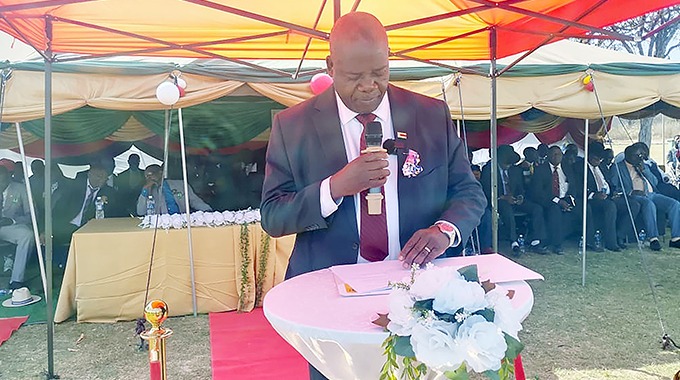
Sikhumbuzo Moyo in Hwange
AN education system that fails to produce citizens capable of creating goods and services for the country is of little value, hence the Government is moving in to strengthen the Heritage-Based Curriculum (HBC) and make indigenous languages compulsory for all learners from next year.
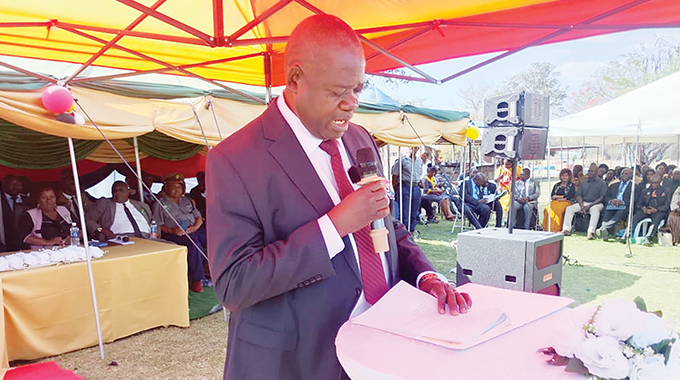
Primary and Secondary Education Minister Torerayi Moyo said this, emphasising that education must have a transformative impact on communities and contribute directly to Zimbabwe’s economic development and the attainment of the country’s Vision 2030.
He was addressing school heads from Matabeleland North province at Coalfields Primary School in Hwange on Friday.
“Education that does not produce goods and services for our people is useless,” said Minister Moyo.
He said Vision 2030 should not remain a policy aspiration contained in national documents, but must be reflected in classrooms, workshops, laboratories, farms, sporting fields, innovation hubs and community projects.
“The school is one of the principal sites at which the human capital that is required for national transformation is developed,” he said.
Minister Moyo said the Government had aligned the curriculum with the national vision of achieving an empowered and prosperous upper-middle-income society by 2030.
“For us to achieve the vision of the President, that can only happen through the power of education. Education is a driver of economic growth and a driver of economic development,” he said.
Minister Moyo said the implementation of the National Development Strategy 2 (NDS2) further reinforced the responsibility of schools to produce human capital, strengthen productive capacity and promote innovation.
He said the Ministry’s Strategic Plan for 2026 to 2030, with its emphasis on access, quality, equity, inclusion and effective governance, required school leadership that was strategic, evidence-driven and accountable.
“Our schools must respond to the realities of their communities whilst simultaneously preparing learners for participation in a modern, knowledge-based and increasingly technological economy,” Minister Moyo said.
He said this was also the thinking behind the introduction of school-based projects, where learners are expected to identify societal problems, conduct research and develop solutions.
“A learner should identify a societal challenge and come up with a topic. The research objectives are guided by that topic to address a problem.
If you carry out research on an area where there is no problem, there is no need for you to do that research. Research should address the problems and provide solutions,” said Minister Moyo.
He told school heads that Government had adjusted its initial position on the full implementation of the Heritage-Based Curriculum following concerns over the potential burden on learners studying under different examination systems.
Initially, Government wanted all schools to introduce HBC in its totality, but Minister Moyo said this could have resulted in some learners having to sit nine ZIMSEC subjects and another nine Cambridge subjects.
“We had to reform,” he said.
However, he said Government remained committed to implementing a unified curriculum framework in line with the country’s laws.
“We have softened a little bit and we are saying that coming next year every child in this country must do a vernacular language,” he said.
Minister Moyo said learners would be required to study an indigenous language such as Nambya, Tonga, Shona, Ndebele or Ndau, among others.
The languages will be examined at Grade Seven and Ordinary Level.
He said the requirement would also apply to learners following the Cambridge examination system.
“This means the students who are going to sit for the Grade Seven examinations in 2028, it is now compulsory for those students, even those who are doing the Cambridge examination. They are going to write a vernacular language,” he said.
Minister Moyo said the move was part of efforts to ensure that learners remained connected to Zimbabwe’s heritage, identity and communities while acquiring skills necessary for participation in the modern economy.
He said school heads had a critical role to play in translating national education policies into tangible outcomes for learners.
“Vision 2030 cannot remain a policy aspiration contained in national documents. It must become visible in our classrooms, workshops, laboratories, farms, sporting fields, innovation hubs and community projects,” he said.
Minister Moyo also commended teachers and school heads for demonstrating resilience, professionalism, diligence and commitment despite challenges facing the education sector.