

 admin
admin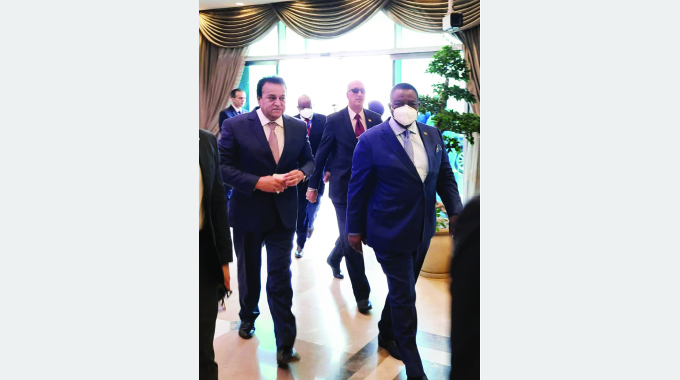
Mukudzei Chingwere in CAIRO, Egypt
Government is impressed and will seek to duplicate the Egyptian health care model that guarantees quality service care to all, through a three-pronged funding system.
Vice President Constantino Chiwenga, who is also Minister of Health and Child Care, yesterday met Egypt’s acting Minister of Health Khalid Ghaffar on the sidelines of the African Health Exhibition and Conference where they discussed critical health matters.
Zimbabwe is on a drive to improve its service delivery and social safety nets in line with President Mnangagwa’s Vision 2030.
The health sector has been identified as one of the sectors in need of a retooling.
VP Chiwenga took advantage of the African Health ExCon to discuss areas of collaboration with the Egyptians whose progress in health provision has attracted international attention.
Egypt’s progress is anchored on a highly plural system with public and private health care providers financed and managed through the state, parastatals, and the private sector.
At its base, the model guarantees quality healthcare to the entire citizenry and those in need of even better quality can go on to choose the parastatals or the private sector route, albeit at a cost.
According to the World Bank — under this model, the Egyptian population has gotten healthier in the last 20 years and overall life expectancy increased from 64, 5 years to 70, 5 years.
“This (National Health Insurance Scheme), is a game changer indeed. Zimbabwe is in the process of establishing a similar fund,” said VP Chiwenga after being briefed on the model.
“A significant proportion of our people are facing serious challenges in paying for health care. In most instances, the majority are being impoverished. Our cooperation in health financing reforms is most welcome.
“As we seek to strengthen our health systems in Africa, we look forward to the full operationalisation of the Africa Centre Diseases Control and the soon to be established African Medicines Agency which will assure us of sustained availability of effective medicines to combat any future pandemics and limit their impact on our economies and people,” he said.
The two also discussed on modalities along jointly capacitating their respective pharmaceutical industries, itself a key enabler for any thriving healthcare system, as well as progress made towards the signing of a Memorandum of Understanding on healthcare.
“My Ministry has considered and reviewed the MOU (Memorandum of Understanding),” said VP Chiwenga, “We are in agreement and looking forward to this cooperation. Capacitating our pharmaceutical industry and strengthening its regulation is critical in ensuring availability of medicines to our population.
“The MOU will remove barriers in registration and procurement of medicines between our two countries. To that end, our Medicines Control Authority of Zimbabwe is ready to engage and implement the MOU together with their counterparts in Egypt.
“The MOU will be ready for signature by August 2022 or earlier. I have my legal team here to finalise negotiations,” he said.
Zimbabwe has challenged its local pharmaceutical companies to look beyond their largely retail role and invest in the production of medical consumables as the Government looks to boost production.
This is being done through the pharmaceutical manufacturing strategy for Zimbabwe 2021-2025.
Prior to the strategy local pharmaceuticals were producing just 12 percent of the country’s total medical consumables, a threshold which is at variance with the country’s industrialisation strategy.
The Egyptian Minister is also the Secretary General of the Egyptian Agency of Partnership for Development (EAPD).
Minister Ghaffar said the two countries are working on cooperation in the field of health and medicine as well as on training of doctors.


 Online Reporter