admin
admin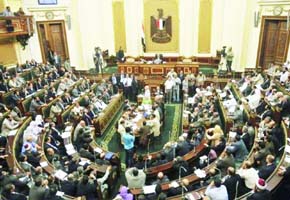
Parliament speaker Saad al-Katatni, who like Morsi hails from the Muslim Brotherhood, which has the biggest bloc in parliament, opened the session with a speech aired live on state television yesterday.
“We are gathered today to review the court rulings, the ruling of the Supreme Constitutional Court,” which ordered the court invalid, Katatni said.
“I want to stress, we are not contradicting the ruling, but looking at a mechanism for the implementation of the ruling of the respected court. There is no other agenda today,” he added.
The lawmakers then approved by a show of hand Katatni’s proposal that the house seek legal advice from a high appeals court on how to implement the supreme court’s ruling. He then adjourned the session, which lasted about five minutes.
He said he would advise lawmakers in due course of the date of the next session.
The Supreme Constitutional Court rebuked Morsi on Monday, meeting in a special session to assert that the president had to abide the court’s decision, which found the manner of the parliamentary election unconstitutional.
The Supreme Council of the Armed Forces (SCAF), in a statement on Monday, said that its order to dissolve parliament in June “represented the implementation” of the court’s decision.
Sherine Tadros, reporting from outside parliament in Cairo, said that not all the MPs attended yesterday’s session.
“Most of the parliamentarians that boycotted the session belong to liberal and secular parties have decided to boycott his mornings sessions,” our correspondent said.
“They were not too upset when the parliament was dissolved last month, because the power balance was not really in their favour.”
Our correspondent said that the legal affairs committee was expected to get a second opinion from the appeals court.
“This appeals court is one that has a history of challenging the Supreme Court decisions,” Tadros said.
“It was a very clever move — what you see happening now is a very public struggle for power between the President and the military.”
Katatni and Morsi are both members of the Muslim Brother-hood, which won nearly half of the parliament, and the ongoing political conflict between the military and Egypt’s elected officials is seen by many liberal and secular politicians as a battle to determine the Brother-hood’s post-revolution political powers.
Morsi, through his spokesman Yasser Ali, insisted his decision to reconvene the 508-seat chamber was an “assertion of the popular will”.
Morsi’s presidential decree also called for new parliamentary elections after a new constitution is adopted, something that is not expected before the end of the year — in effect according legitimacy to a legislature the country’s highest court ruled to be invalid.
Analysts believe that the military council and state institutions still packed with old regime loyalists have attempted to constrain the Brotherhood in the months since their parliamentary gains.
In its ruling last month, the supreme court determined that a third of parliament’s members were illegally elected under a law that allowed candidates from political parties to compete for seats that had been set aside for independents.
Days after the court dissolved parliament, and just minutes after polls closed in the presidential election, the military issued a unilateral package of constitutional amendments stripping the president of his role as commander-in-chief, asserting autonomy over their budget and affairs, and assuming the power to legislate until a new parliament could be elected. — Al Jazeera.



 Online Reporter