Chronicle Editor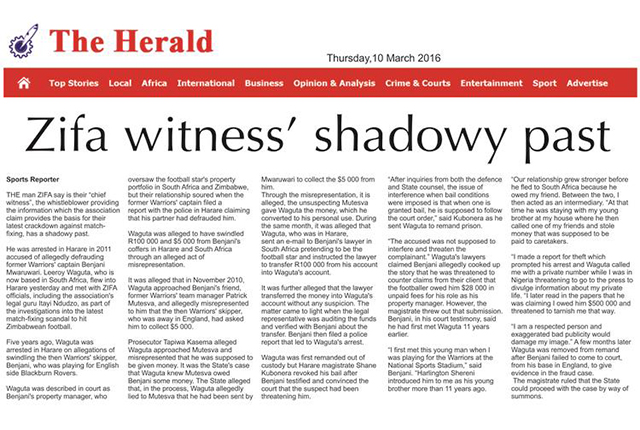
Sports Reporter—
IN March this year, The Herald issued a chilling warning that the whistleblower ZIFA were banking on in their crackdown on the Limpopogate match-fixing scandal was a questionable character with a shadowy past whose evidence needed to be treated with caution.Although the Association had not named their star witness, in the infancy of that investigation, this newspaper was informed about his identity and we became the first publication to reveal his name.
We warned the ZIFA leadership, in an article published on March 10 this year, they were dining with a questionable character whose material needed to be handled with caution.
Some people fiercely criticised us, suggesting we were trying to rubbish the reputation of a key figure in the investigation, to protect those who had been implicated — former ZIFA chief executive Henrietta Rushwaya, ZIFA board member Edzai Kasinauyo, former Warriors coach Ian Gorowa and the team’s assistant coach Nation Dube.
But, after this week’s dramatic events, when the criminal case against Rushwaya, Kasinauyo and Dube sensationally collapsed with Harare Regional magistrate Lucy Mungwari freeing the trio before they had even been put to their defence, the fears we raised in March came to pass.
Mungwari said the State failed to prove a prima-facie case against the trio and there was no evidence linking them to the scandal.
The magistrate also slammed the State and its witnesses for lack of seriousness.
“This is a case which should have not seen the doors of this court. There was lack of seriousness on the part of both the State and the witnesses,” she said.
“There is no iota of evidence linking the accused persons to the offence. The law is clear that where there is no evidence linking accused persons to an offence, the court has no discretion, it ought to acquit.
“The State has not proved a prima-facie case and accordingly, the accused persons are discharged and found not guilty.”
Mungwari discredited the witnesses’ testimonies, especially the “star witness” Waguta, who told the court he was a match-fixer.
“Waguta proved he is not a reliable witness. His testimony was full of inconsistencies. At one point, he said the meetings were attended by two people and, on the other, he said it was attended by three people, a clear sign of untruthfulness,” the magistrate ruled.
“The court is of view that Waguta can do anything for money and what motivated him to come and testify against the accused will remain unknown. The court wonders if there were no unforeseen forces behind. Unfortunately, for the State, this was their star witness.
“Evidence of accomplices must be approached with extreme caution. The court expected that he (Warriors coach Callisto Pasuwa) would bring the messages which were forwarded to him by Waguta in which the alleged match-fixing scandal was being discussed.
“However, he professed ignorance and said he did not believe the messages and left every other question to the author of the messages, who is Waguta. He had nothing to offer to the State or incriminating evidence.”
On March 16, The Herald published an article, under the headline “ZIFA WITNESS’ SHADOWY PAST”, which questioned Waguta’s credibility and advised that his input should be dealt with caution.
“The man ZIFA say is their ‘chief witness’, the whistleblower providing the information which the Association claim provides the basis for their latest crackdown against match-fixing, has a shadowy past,” this newspaper warned in that article.
“He was arrested in Harare in 2011 accused of allegedly defrauding former Warriors’ captain Benjani Mwaruwari.
“Leeroy Waguta, who is now based in South Africa, flew into Harare yesterday and met with ZIFA officials, including the Association’s legal guru Itayi Ndudzo, as part of the investigations into the latest match-fixing scandal to hit Zimbabwean football.
“Five years ago, Waguta was arrested in Harare on allegations of swindling the then Warriors’ skipper, Benjani, who was playing for English side Blackburn Rovers.
“Waguta was described in court as Benjani’s property manager, who oversaw the football star’s property portfolio in South Africa and Zimbabwe, but their relationship soured when the former Warriors’ captain filed a report with the police in Harare claiming that his partner had defrauded him.
“Waguta was alleged to have swindled R100 000 and $5 000 from Benjani’s coffers in Harare and South Africa through an alleged act of misrepresentation. It was alleged that in November 2010, Waguta approached Benjani’s friend, former Warriors’ team manager Patrick Mutesva, and allegedly misrepresented to him that the then Warriors’ skipper, who was away in England, had asked him to collect $5 000.
“Prosecutor Tapiwa Kasema alleged Waguta approached Mutesva and misrepresented that he was supposed to be given money. The State alleged that, in the process, Waguta allegedly lied to Mutesva that he had been sent by Mwaruwari to collect the $5 000 from him.
“Through the misrepresentation, it is alleged, the unsuspecting Mutesva gave Waguta the money, which he converted to his personal use. During the same month, it was alleged that Waguta, who was in Harare, sent an e-mail to Benjani’s lawyer in South Africa pretending to be the football star and instructed the lawyer to transfer R100 000 from his account into Waguta’s account.
“It was further alleged that the lawyer transferred the money into Waguta’s account without any suspicion. The matter came to light when the legal representative was auditing the funds and verified with Benjani about the transfer.
“Benjani then filed a police report that led to Waguta’s arrest.”
The newspaper recalled that Waguta was first remanded out of custody, but magistrate Shane Kubonera revoked his bail after Benjani testified and convinced the court that the suspect had been threatening him.
Waguta’s lawyers claimed Benjani, who said he first let Waguta 11 years earlier, allegedly cooked up the story that he was threatened to counter claims from their client that the footballer owed him $28 000 in unpaid fees for his role as his property manager.
“I first met this young man when I was playing for the Warriors at the National Sports Stadium,” Benjani told the court. “Harlington Shereni introduced him to me as his young brother more than 11 years ago.
“Our relationship grew stronger before he fled to South Africa because he owed my friend. Between the two, I then acted as an intermediary.
“At that time he was staying with my young brother at my house where he then called one of my friends and stole money that was supposed to be paid to caretakers.
“I made a report for theft which prompted his arrest and Waguta called me with a private number while I was in Nigeria threatening to go to the press to divulge information about my private life.
“I later read in the papers that he was claiming I owed him $500 000 and threatened to tarnish me that way. I am a respected person and exaggerated bad publicity would damage my image.”
A few months later Waguta was removed from remand after Benjani failed to come to court, from his base in England, to give evidence in the fraud case.
The magistrate ruled the State could proceed with the case by way of summons.


 Online Reporter