

 admin
admin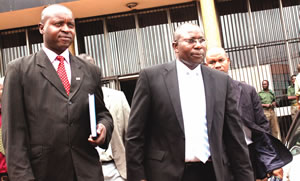
five million litres of diesel from a South African company without going to tender – was yesterday acquitted of criminal abuse of office charges.
Mangoma had denied the charges of misusing his office in the fuel purchase contract with NOOA Petroleum, arguing that his prosecution was politically galvanised.
High Court judge Justice Chinembiri Bhunu handed down his judgment yesterday and cleared Minister Mangoma of the charges at the close of the State’s case.
The judge – in his ruling – accepted the defence submissions and said there was no reason to put Minister Mangoma on his defence for lack of incriminating evidence.
Wild scenes of celebration engulfed the courtroom following the acquittal and people in the public gallery clapped hands and hugged before the judge left the room.
TRIAL REPORTS
- Judgment date for Mangoma set
- Mangoma seeks discharge
- Mangoma’s trial resumes
- Mangoma trial: Expired list given
Justice Bhunu ruled that the minister only acted in a bid to avoid a serious fuel shortage considering that all traditionally-registered fuel suppliers had no fuel at the time.
He also indicated that section 30 (2) of the Procurement Act provided for the purchase of fuel without going to tender in cases of emergency.
“It is clear that Section 30 (2) of the Procurement Act was meant to provide a safety valve to enable State Procurement entities to procure commodities expeditiously for the benefit of the State and nation at large in times of dire need and emergency without following cumbersome normal tender procedures.
“The advice given to the accused person by his permanent secretary and director of petroleum to the effect that any purchase of fuel had to be done through the normal tender procedure, was incorrect and bad at law.
“It is amazing that both the permanent secretary and the acting chief executive for Petrotrade responsible for the procurement of fuel were ignorant of this vital provision of the law meant to facilitate the procurement of fuel in times of emergency and dire need,” said Justice Bhunu.
The judge said no reasonable court would convict under the given circumstances.
He said it was common cause that when Minister Mangoma issued the directive, it was in times of extreme emergency and every witness confirmed that.
“Strategic fuel reserves were down to less than a day’s supply and there was no fuel from traditional suppliers. Queues were beginning to form at fuel outlets and the situation called for extraordinary measures to avert the emergency.
“It is difficult to blame the accused for directing the purchase of fuel from NOOA Petroleum when it was the only supplier of fuel at that time,” he said.
It was illogical, he said, to suggest that the fuel price was high when there were no other suppliers with fuel at that time.
Justice Bhunu said the State had failed to prove a case against the Minister.
“For the foregoing reasons, we were of the unanimous view that on the evidence presented before us, the State has failed at the closure of the State’s case, to establish a prima-facie case upon which a reasonable court might convict.
“The court has no option, but to discharge the accused at the closure of the prosecution’s case. The accused is therefore found not guilty and acquitted on both counts,” ruled Justice Bhunu.
After the acquittal, Minister Mangoma bemoaned the level of ignorance exhibited by his subordinates.
“I realised that I have subordinates who are ignorant.
“You can imagine how difficult it is when you are working with people who do not know their job operations,” he said.
Minister Mangoma accused the State of persecuting the MDC leadership adding that the party was expecting that from them.
He said they were even expecting more persecution.
The minister was being accused of directing Petrotrade acting chief executive Mr Griefshaw Revanewako to procure 5 000 litres of diesel from NOOA Petroleum company that was not on the approved list of suppliers.
The purchase was done at a time when the country was facing an acute diesel shortage between January 1 and 21 this year.
It was the State’s contention that the minister abused his duties as a public officer by disregarding laid down tender procedures.



 Online Reporter