

 admin
admin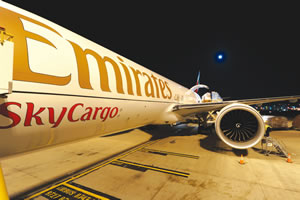
cargo-only Boeing 777 aircraft will arrive in Harare from Dubai every Friday and will return to Dubai via Johannesburg.
The SkyCargo airplane has the capacity to carry 103 tonnes of freight, adding to the existing weekly cargo capacity of 160 tonnes on Emirates’ scheduled five-time-a-week passenger service.
SkyCargo’s weekly cargo capacity into and out of the continent is already more 6 000 tonnes since the launch of the airline’s passenger service to Harare and Lusaka on February 1.
According to the airline, the new gateway means its SkyCargo can connect businesses in 22 countries across Africa to its network of more than 100 destinations.
This also provides increased opportunities for key trading partners such as China and Japan.
South Africa has a weekly capacity of more than 1 500 tonnes spread across the belly-hold of 84 passenger flights serving Johannesburg, Cape Town and Durban, as well as two dedicated Johannesburg freighters.
It is the Emirates SkyCargo’s key trading point on the continent.
Dedicated freighters also operate to Eldoret and Lilongwe, while the other points on Emirates SkyCargo’s African network include Abidjan, Addis Ababa, Accra, Cairo, Casablanca, Dakar, Dar es Salaam, Entebbe, Khartoum, Lagos, Luanda, Nairobi, Tripoli and Tunis.
These are served using either the belly-hold of wide-body passenger aircraft, or a combination of the belly-hold and freighters.
Emirates’ divisional senior vice-president (cargo) Mr Ram Menen said: “With such a comprehensive service now in place, we are in a good position to help sustain Africa’s continued economic development by facilitating international trade with its business partners and opening it up to new markets on our ever-expanding network.”
SkyCargo is transporting commodities such as garments, computer parts and pharmaceuticals to Zimbabwe — from the likes of the Far East, Australasia, the Indian subcontinent, Middle East, Europe and North America.
Fresh flowers, fruit and vegetables will be among the main commodities shipped in the other direction, while trade is also expected to be generated by neighbouring countries.
In the 2010-11 financial year, Emirates SkyCargo carried 1,8 million tonnes of cargo across its network, contributing 17,4 percent to US$2,4 billion of the airline’s total transport revenue.
Flying out of Dubai International Airport, its US$327 million, 43 600 square metre Cargo Mega Terminal is designed to handle 1,2 million tonnes of cargo a year.
Emirates’ 168-strong fleet — including eight freighters (three Boeing 747-400Fs, two 747-400ERFs and three 777Fs) — is one of the youngest in the skies.
Following the launch of the Lusaka-Harare service, Emirates SkyCargo now serves a global route network that spans 120 points in 72 countries, including 11 cargo-only destinations, while more than 50 of the locations Emirates SkyCargo serves are e-freight compliant.



 Online Reporter