admin
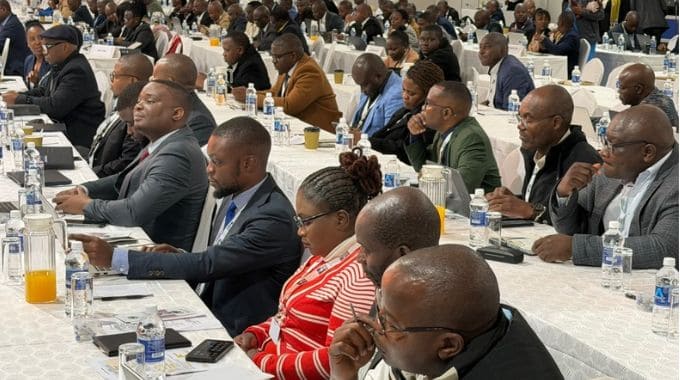
adminAddressing delegates at the recent Hospitality Association of Zimbabwe annual congress in Gweru, Dr Munyeza said Government should, among other strategies, come up with deliberate programmes that empower women and youths in the mining and agricultural sector for the country to realise growth.
He said the State needed to adopt a model in the agricultural sector that allowed for the creation of youth farms for most youths who are pumped out of the country’s colleges yearly but fail to be absorbed by industry.
Dr Munyeza said Government should give youths leases for the farms to help bring vibrancy to agriculture.
“We need to be deliberate on our youth and women. Companies are not absorbing most of the youths that are coming out of our colleges, the cultural dimension. The Government should give leases of farms to youths and create youth farms. This will help turn around agriculture and make it vibrant. Africa’s problem is not because we do not work hard, in fact, we are the world’s hardest workers!
“The major source of our problem is how we treat women and children. The majority of the women are concentrated in the rural areas, peasant farming, with much of their time spent on fending for themselves rather than being productive, completely removed from access to capital and credit to produce beyond their needs for trade. No wonder why even in tourism our junior ranks are occupied by women and men are at the top,” he said.
Dr Munyeza said Zimbabwe in particular and Africa in general, should shift from just exporting raw materials to processing and exporting finished goods.
Zimbabwe, he said, was an exporter of raw materials and this stifled job-creation growth.
“We don’t finish off our products. Our cotton is sold as it is yet there is a lot of by-products from the white crop that when processed, would help create more jobs. The same with our tobacco. If we process our raw materials before exporting, we certainly draw a lot of benefits, employment creation included.
“Globalisation and globality is here to stay so we have to embrace technology and good governance to have a competitive edge. We are capital thirsty so we need to be capital sensitive in our policies and processes. The needs of young people and women have to be prioritised if we are to compete globally,” said Dr Munyeza.
He said tourism was a net exporter and therefore there was need to clearly put the product and its attractions on the map.
Dr Munyeza said Zimbabwe’s co-hosting of the UNWTO General Assembly with Zambia next year placed the country on the world spotlight.
“Being on the world spotlight means we need to have a competitive advantage in People, Product and Processes. The challenge is not simply identifying the conditions for growth — ‘what to do?’ — but rather developing answers to the most difficult question: ‘how to do it?’ What we need to seek is long-term, job-intensive growth, because at a basic level people need sustainable jobs. In 2011, tourism employed 42 500 people directly and 93 500 indirectly, compared to Singapore which employed 128 000 and 266 500 respectively. We should push our investment drive to levels that will allow us to employ more of our people,” he said.
The African Sun boss said the continent had no more than a 10 percent share of the world travel and tourism market yet it still had all the virgin natural attractions.
“The cost of our internal trade barriers and inefficiencies are key to the lost opportunities. In 1990, Africans held up to $360 billion outside the region equivalent to 40 percent of their wealth or 90 percent of GDP.
This is compared to 6 percent and 10 percent respectively for Asian and Latin American wealth held abroad. The same applied to human capital. Many Africans have lost over a third of their skilled professionals to emigration and this number is more for Zimbabwe. This has been because governments have not been proactive in making conditions in public sector and parastatals conducive for the bulk of professionals to stay within their borders. The irony is that most of our people leave the country to work for governments in foreign lands,” he said.
Dr Munyeza said a number of elements, like macroeconomic and political stability, skills development, transparency and rule of law would have to be ensured first before the economy can register growth.
“We should ensure that basics are in place. These include skills development. At the moment, we have a shortage of culinary skills in the country, among other skills, after nearly two decades of skills flight to the diaspora. Transparency is also needed.
“Shortages, patronage and ineffective bureaucratic processes have given birth to institutionalised corruption. Corruption is everywhere, it’s cancerous. It is in the church, public and private sector. Little is being done to deal with the problem of corruption. This can only make our destination and product less competitive. Why do we still not have a fully operational Air Zimbabwe to service our domestic routes?
“As for the rule of law, the issue has to do more with security of tenure and ownership rights and recently we have had our own fair share of confusion in this regard,” he said.
Dr Munyeza said inefficiency in certain Government departments was also costing the country.
He said it takes the hospitality industry about three weeks to clear capital goods for refurbishment, and there was still confusion on what was dutiable and non-dutiable in spite of the statutory instrument being very clear.
“The delays at Beitbridge border for example, are costing us millions. Compare with Singapore. The success story of Singapore is that they clear over one million containers a day on their ports with connectivity to over 600 ports globally.
“We need to liberalise access for both trade and people. But we cannot compete using our human capital advantage without opening up access for both trade and people. The costs of trade are not just about tariffs but also the costs of delays at border posts. What does it take to ensure goods and people are cleared at the same pace as containers are cleared in Singapore? We need to once again inculcate an environment of integrity in our dealings as a sector, because this breeds trust and profitability,” he said.
He said there was need for the sector to have harmonious relationship with trade unions ahead of the hosting on the UNWTO general assembly in Victoria Falls next year.
Dr Munyeza said unions should stop making shocking demands at a time when businesses were facing closure. He said Africa’s developmental problems were compounded by scarcity of skills and investment capital.
“A levy on mineral revenue should be dedicated to infrastructural development. Why is rail transport dysfunctional when the world over it is the cheapest mode of transport? Our curse has been due to the abundance of resources. There is need to finalise the indigenisation policy on tourism which the minister (Walter Mzembi) said would be next. This lack of policy clarity has hindered new international players and brands to enter the market,” he said.



 Online Reporter