

 admin
admin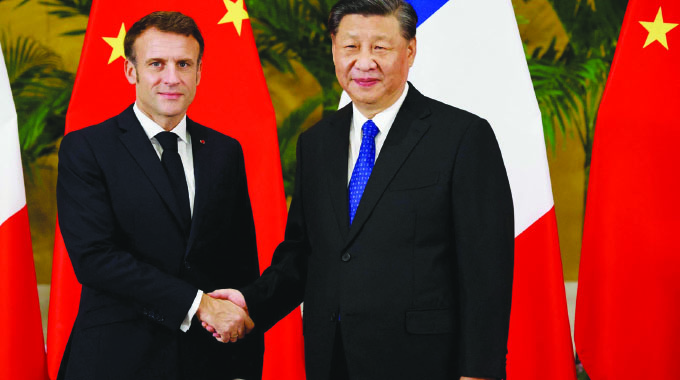
Mukachana Hanyani
Correspondent
Since the end of the Second World War, the United States dominated other states in almost every sphere of life using her currency, the US dollar becoming an important international reserve currency which displaced the United Kingdom’s pound sterling.
According to Minerva.defense.gov, the devastating costs of World War I sapped Britain of its financial dominance while its military defeats in France in May 1940 and the fall of Singapore in February 1942 sealed the end to Britain’s global dominance.
The US dollar was agreed to be an international reserve currency after the formation of the Bretton Woods institutions which facilitated the coming in of the World Bank (WB) and the International Monetary Fund (IMF).
Having the US dollar as the international reserve currency has been in existence since then with most countries benchmarking the performance of their economies against it.
During the days of the Cold War when the US was competing with the Union of Soviet Socialist Republics (USSR) for political and economic dominance, the US dollar remained the international reserve currency.
For that reason, the US started using the power of the US dollar to impose economic sanctions on all countries which she viewed as stifling its political, economic, social and cultural interests.
For example, in 1963, Cuba was put under an economic blockade after it hosted nuclear weapons from USSR.
USSR was then competing with the US on all fronts; hence the placement of nuclear weapons on Cuban soil was interpreted as provocation and a declaration of nuclear war against the US by the USSR at that time.
A lot of countries which were thought or suspected to be stifling US interests were put under economic sanctions.
Apart from Cuba, other countries and territories that were placed under US economic sanctions for various reasons and at different times included Afghanistan, the Balkans, Belarus, Burma, Central African Republic (CAR), the Democratic Republic of Congo (DRC), Ethiopia, Hong Kong, Iran, Iraq, Lebanon, Libya, Mali, Nicaragua, North Korea, Russia, Somalia, Sudan, South Sudan, Syria, Ukraine, Venezuela, Yemen and Zimbabwe.
The effect of the punitive measures on the targeted countries was that their economies were stifled by the use of the US dollar which the US government used as a weapon to destroy their economies.
This has seen some countries beginning to question the logic of continuing to use the US dollar as an international reserve currency.
Some countries questioned whether it was sustainable to continue having the US dollar as an international reserve currency when the US has been using it to destroy other countries’ economies through imposition of sanctions against them.
This was further prompted by Russia when the US imposed sanctions on her following the Russo-Ukraine conflict which started in February last year.
The US and her allies imposed sanctions on Russia as they viewed the conflict as an invasion of Ukraine by Russia. This resulted in Russia’s large sums of money which was kept in US dollar reserves being frozen in a bid to cripple its economy.
Russia responded by looking to China for economic and political backing.
China and Russia agreed to use their local currencies in business transactions involving their countries, thereby dumping the use of the US dollar in their dealings.
As if the Russo-Chinese agreement on the use of their local currencies was not enough, on 28 March, 2023, the Association of Southeast Asian Nations (ASEAN) finance ministers met in Indonesia and resolved that the bloc should reduce dependence on the US dollar, Euro, Yen and British Pound for financial transactions and adopt to settle their transactions in local currencies.
On the other hand, the Brazil, Russia, India, China and South Africa (BRICS) bloc countries are also planning to dump dependence on the US dollar for their financial transactions in favour of their local currencies.
Such plans would also be on the agenda when the bloc meets in South Africa next August.
BRICS members are expected to use the meeting to deliberate and agree on which currency to use going forward.
In 2015, the BRICS bloc formed the New Development Bank (NDB), which is aimed at mobilising resources for infrastructure and sustainable development projects.
This was meant to reduce dependence on WB and IMF, which are both US-dominated institutions, for such developmental projects.
On the political front, the US and its allies have been facing challenges from some countries that steadfastly refused to be forced to denounce Russia for the Russo-Ukraine conflict and support the sanctions imposed against it.
Countries such as Argentina, Brazil, China, India, Indonesia, Mexico, Saudi Arabia, South Africa and Turkey have refused to be bullied into condemning Russia, thereby putting US dominance in all spheres under spotlight.
The situation that is prevailing in the international community where countries are beginning to challenge US dominance in all areas shows that the multi-polar system is gradually taking centre stage.
Some few weeks ago, Chinese President, Xi Jinping successfully brought Saudi Arabia and Iran to the negotiating table ending decades of hostilities between the two countries.
The peace that was brokered by President Xi between the then US ally Saudi Arabia, and the US enemy, Iran, brought surprises to the current world order.
This also saw Saudi Arabia, which was hitherto an ally to the US, accommodating countries viewed as enemies by the Western powers.
The US dominance is also under threat from even European countries. When French President Emmanuel Macron visited Chinese President Xi in Beijing last month, he came out of the meeting urging European nations to reduce dependence on the US assistance and anything associated with that country.
Given the current global scenario where countries are beginning to call the US out for abusing the power of her dollar by imposing sanctions on other countries, soon the US dollar will cease to be an international reserve currency.
The writing is on the wall. The US’ days as a super power are numbered.
The US deserves everything that is coming to it. Its unenviable circumstances are not out of hatred.
The Joe Biden regime is trying to counter China and Russia’s influence in Africa, but it is unlikely to succeed.
Where China fosters peace as it did between Saudi Arabia and Iran, the US is a belligerent war monger. When Zimbabweans were in the middle of fighting the Ian Smith regime, the US was partnering the South African apartheid government to bust the United Nations (UN) sanctions imposed on the Rhodesian government.
Instead of supping with the devil, China and Russia chose to assist South Africans and Zimbabweans by providing them with arms and other supplies to fight apartheid and colonialism respectively.
Given this scenario, it would be naïve of the US to expect South Africa and Zimbabwe to support it on any matter against China and Russia.
And there are many South Africans and Zimbabweans across the world who remember the US more for its evil than for any good deed.
That is why many countries are not hesitating to dump the US currency and the attendant hegemony.
The US should get used to the reality of surrendering global dominance to the East the same way the United Kingdom (UK) surrendered global power to the US.
If anything, the global economic and political rug has already shifted from under the US’ feet and it will not be long before Uncle Sam will be clutching helplessly at tufts of air.
It has to accept the fact that it cannot dominate the world forever.



 Online Reporter