Chronicle Editor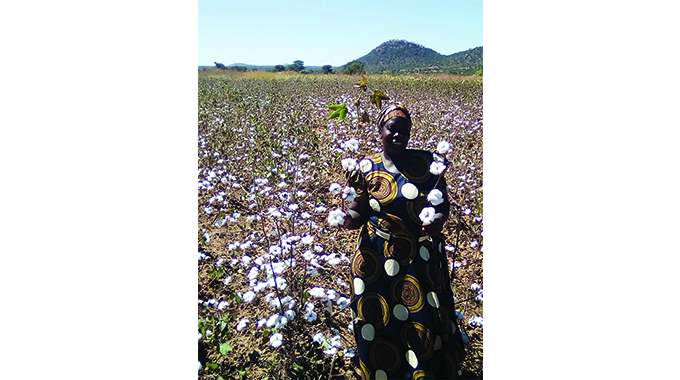
Hazel Marimbiza
Zimbabwe’s Women in Agriculture has commended Ms Lercy Sori of Mutoko South for excelling in cotton farming despite several farmers turning away from the crop.
Ms Sori is a small scale farmer who diversified into commercial cotton hybrid production in partnership with Cotton Company of Zimbabwe (Cottco).
Last year she had a bumper cotton harvest with a yield above two tonnes per hectare under dry land conditions up from the traditional 600kg/hectare.
However, like many cotton farmers she has faced many obstacles which have negatively impacted the cotton sector.
One of the top challenges that has affected the cotton industry is the non- payment of farmers.
“Getting paid in time would ensure that cotton farmers have decent livelihoods,” said Ms Sori.
While Ms Sori has stayed on and is doing well, some like Ms Similo Ndlovu have ditched cotton.
Ms Ndlovu of Gokwe Centre revealed that her life now hinged on selling used clothes and small grocery items as she is not benefitting from farming the crop.
“Cotton marketers have let us down. Cotton prices are not encouraging and we can only hope for a better ending but still with this business that I have ventured into things are not looking good,” said Ms Ndlovu.
Cotton Producers and Marketers Association chairman, Mr Stewart Mubonderi recently said they were going to meet as cotton growers to map the way forward and were considering approaching higher authorities for intervention.
“We are disappointed as farmers. Authorities assured us that they were aware of our plight but the payment is taking long. We are going to meet as an executive so we can approach higher authorities. We are afraid we may get to another marketing season before we get our money,” he said.
Responding to farmers’ grievances, Lands, Agriculture, Fisheries, Water and Rural Resettlement Deputy Minister, Vangelis Haritatos, recently told our sister paper, The Herald, that farmers payments would be made soon.
“The issue of Government subsidy to cotton farmers has been escalated to our ministry as well as the Ministry of Finance and Economic Development. We are confident that the outstanding balance will be paid soon as it has been a priority for the Government to do so,” he said.
Besides the complaints by farmers over non-payments, another challenge crippling the sector is that now farmers generally regard cotton production as a venture with a poor risk-to-reward proposition, especially if they grow the cotton under contract farming arrangements with ginners. For example, it is estimated that a farmer can produce about 500kg of seed cotton per hectare, for which he/she will earn about a total of about US$250.
“Taking into account the cost of land preparation, planting, weeding and harvesting, the farmer would have incurred a loss,” said Ms Ndlovu.
About 1, 3 million people in Zimbabwe derive their livelihoods from cotton farming with more than 75 percent of household incomes in these areas derived from cotton.
The cotton industry provides employment to approximately 50 000 individuals employed in ginneries, spinning, transportation and logistics services.
Cotton contributes on average 10 percent of agricultural Gross Domestic Product (GDP) and annual export of about US$103, 2 million.
The sector is thus considered among key commodities in the agricultural sector and the economy of Zimbabwe at large. About a decade ago cotton was the crop of choice for farmers. Not only did cotton thrive, it had a ready market that brought the much needed cash to the people. As such, cotton was then christened Zimbabwe’s ‘white gold’.
But in recent years, production has been very unstable ranging between 351,000metric tons in 2011/2012 and 28,000metric tons in 2015/16 seasons according to the statistics provided by the Agricultural Marketing Authority (AMA).
According to the International Cotton Advisory Committee, Africa’s share of the exports in 2015/16 was about seven percent while Zimbabwe was among the top seven exporters of cotton in Africa.
However, the decline in production and processing of cotton in the country also implied the decline in benefits accruing from the sector to the economy.
With all these challenges threatening the sector Government has made some efforts to revive it which cannot be ignored. The introduction of Presidential Inputs Scheme has contributed in sustaining the industry.
Dr Tony Monda a researcher in Agronomy, Farming and Veterinary epidemiology commended the introduction of Presidential Inputs Scheme and deregulation of cotton marketing introduced by the Government as it has resulted in a surge in production, especially by small-scale indigenous growers.
“In 2020 the cotton production was estimated at 101 000 tons, an increase of 32 percent from 77 000 tons produced in 2019,” said Dr Monda.
“This was due to increased coverage of the Presidential Inputs scheme. The scheme was introduced in 2015 after Government moved in to revive the cotton industry.”
Southern Cotton CEO Mr Caos Nzenze also applauded the Government inputs scheme saying their company had shut down in 2013 due to low production amid low international market prices and side marketing but when the inputs scheme was introduced they managed to reopen.
“We re-opened in 2017, thanks to our Government who introduced the cotton Presidential free inputs scheme in 2015 that saw a lot of farmers benefitting from it and went back into the fields to grow cotton. We applaud our Government for coming up with the cotton free Presidential input scheme which was implemented with the motive of boosting cotton production in the country and also reach out the marginalised farmers alongside private sector cotton credit inputs schemes,” said Mr Nzenze.
Although Government’s efforts have kept the industry going, a lot still needs to be done for the industry to excel. Researchers have said that, in order to counter the existing challenges and to help Government fully revive the industry there is a need to reform the sector to enhance competitiveness.
A 2020 research by Ms Jacqueline Mutambara and Mr Kingstone Mujeyi, titled ‘Enhancing competitiveness of Zimbabwe’s cotton production’, revealed that farmers need to be aware of contractual issues to understand what they sign to avoid the uncertainty and mistrust among value chain actors as this has resulted in contractors strategising on capturing as much seed cotton from farmers as possible through the contract but shying away from contributing meaningfully towards supportive services that will see successful production of seed cotton.
The study further pointed out that although Government has initiated efforts to hedge farmers against depressed producer prices through announcing a minimum price of seed cotton post production this has been met with skepticism from cotton merchants.
The uncertainty aroused by delayed and complex price negotiation processes, policy inconsistencies, termination of historically acclaimed grading systems and decline in production capacities led to low investor confidence in the industry.
As such, the study proposed a more comprehensive analysis of the competiveness of cotton value chain at all stages in the chain of activities from input supply to delivery of products.
“All stakeholders in the cotton industry must understand and uphold the stipulations of industrial behaviour. Alternatively, reforms could be channelled towards modalities for independent funding of cotton production and strengthening the competitive nature of the system by establishing or supporting more transparent price discovery mechanisms, combined with efforts to move toward increased competition.
“Still the role of public entities such as AMA and agricultural extension services will need to be reinforced to ensure that information, extension and research services are provided for economic actors to make informed decisions,” indicated the research.



 Online Reporter