admin
admin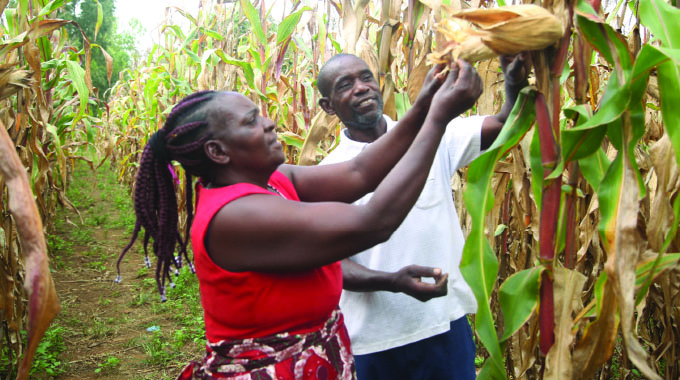
Elita Chikwati Snr Agriculture Reporter
Most smallholder farmers especially those in communal areas have benefited from Government’s initiatives targeted at improving livelihoods.
These projects have been inclusive as they are tailor-made for different sectors including those into livestock production, horticulture and irrigation, among others.
This is meant not only to empower families to be food and nutrition self-sufficient, but also to commercialise agriculture and ensure farmers earn an income from their produce.
Pfumvudza/Intwasa is one of the programmes that was started by Government to climate-proof agriculture and ensure smallholder farmers achieve high yields even under low rainfall conditions.
The conservation programme has been an eye opener to most food producers who are now testifying on the benefits of the technique.
Pfumvudza has offered a solution to most farmers who lost livestock to tick-borne diseases as they can always prepare land and have significant yields.
Actually, Pfumvudza is a cheaper way of preparing land for farming.
Pfumvudza promotes adoption of conservation farming techniques and involves the utilisation of small pieces of land and applying the correct agronomic practices for higher returns.
The Pfumvudza/Intwasa programme is now being spearheaded under the Presidential Inputs Programme.
Under this programme farmers are given free inputs, fertilisers and chemicals and also offered technical advisory services by Agritex extension officers.
Mr Benjamin Shambare of Mutimumwe Village in Chikwaka, Goromonzi is one of the beneficiaries of the Pfumvudza/Intwasa programme.
The farmer has realised the benefits of the programme and has vowed to continue utilising the method even if there are other tillage services available.
“This is my second time applying the Pfumvudza concept. I work closely with the Agritex extension officer Ms Lucy Hamadziripi at every stage and follow her advice religiously.
“Now I keep records and it helps me track on whether I am making a profit or loss. In my farm diary, I note the dates of land preparation, planting, applying mulch fertiliser application. Before Pfumvudza, I never kept records.
“Pfumvudza is good because it does not cause erosion as there is minimum disturbance of soil. For instance, this year we had heavy rains and some soils were washed away, but this did not happen to the Pfumvudza fields,” he said.
Mr Shambare said Pfumvudza was also a better way of cutting production costs as there is no need of hiring a tractor or oxen for tillage. The land preparation is done manually.
“We have been wasting resources as we applied large amounts of fertiliser and manure, but still got low yields. The extension officers have taught us to measure the fertiliser.
“This season is planted long season variety of maize. A variety I thought would not perform under rain-fed agriculture. But I am expecting high yields from my plots,” he said.
Mr Shambare said preparing planting holes was not labour intensive as the process should be done soon after harvesting.
Once the holes are dug they are renewed every season and there is no need to dig new basins.
“We start digging the holes after harvesting when the ground is still moist. We do it bit-by-bit and there is no need to hire labour for that. By the time the rains come we would have finished applying mulch.”
He said he never knew the benefits of mulching until the time he got to know about the Pfumvudza concept.
The farmers are using grass, and stover from the previous season for mulching.
The mulch will decompose and manure thereby improving the soil structure.
According to Mr Shambare when applied accordingly, the mulch will prevent the emergence of weeds and thus there is no need for weeding or spraying chemicals.
“This season we have experienced long season dry spells, but still we have a healthy crop. The maize did not wilt because of the mulch which conserved moisture,” he said.
Mr Shambare, however, said he had to come in with irrigation in one of his plots.
“It was easy for me to irrigate the crop because the plots are small. It is difficult to irrigate a whole field using a bucket, but for Pfumvudza you just apply a cup of water per basin and crops will not suffer from moisture stress,” he said.
Goromonzi Agritex Officer, Mrs Hamadziripi said in Chikwaka few farmers were facing food shortages as most who undertook the Pfumvudza programme were assured of better yields.
“Farmers used to shun the Pfumvudza concept, but now that they have seen the benefits especially this year when the rainfall season was characterised by dry spells. They are adopting the technique.
“There is a huge difference between the crop produced using the conventional method and that produced under Pfumvudza. The Pfumvudza maize was more tolerant to the dry weather than the conventional crop.
“Some farmers in this area will sell surplus to the Grain Marketing Board and get an income; so Pfumvudza is not only benefiting them on being food and nutrition secure but they are now also getting money from it,” she said.
Pfumvudza was first applied to maize and traditional grains and later expanded to oil seeds and cotton.
Under this programme, farmers are given inputs package of a standardised crop input package for maize, sorghum, pearl millet, soya beans, sunflower, groundnuts, vegetables and cow peas per household.
This season 342 860 hectares of maize were planted under The area planted under maize representing 18 percent of the total area planted.


 Online Reporter