Chronicle Editor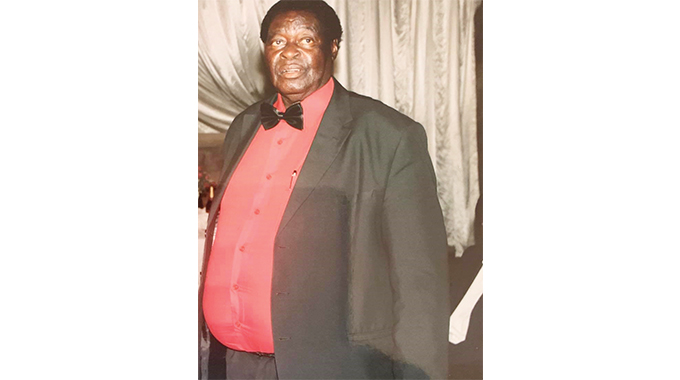
Innocent Batsani
My father in law, Enock Ncube AKA Fearless, who died recently aged 72, was a man of all seasons. A freedom fighter, an educator, community leader, sports administrator and doting family man. Fearless, was one of the less recognised and yet ubiquitous personalities who strode the Matabeleland socio-political terrain like a colossus.
If one were to choose only two things which defined him, then surely it will be courage and the gift of the garb. Courage because he was an epitome of physical and mental bravery and his motto was ungesabi! This is why he got the moniker Fearless. The gift of the garb because the man was a prolific extemporaneous speaker who commanded the stage with aplomb. In this eulogy, I trace and celebrate the life journey of Comrade Fearless by paying special attention to his formative years, liberation war participation, service to the education sector, community and family leadership.
Fearless was born and spent his formative years in the unremarkable environs of Tshelanyemba in Matobo district (Matabeleland South province) but through indefatigable determination and force of conviction, he established himself on the national terra firma. He was the first born and only boy in a family of three which also consisted his two younger sisters, Beauty and Nokuthula. His thirst for education was nurtured at a young age when he started off at the local Mazwi Primary and then graduated to the Salvation Army-run Tshelanyemba boarding school for his Standard 4-6 education. He enrolled at the Howard Institute in Bindura and acquired his Certificate in Primary Teacher Lower. His service in the colonial education system brought him face-to-face with the bigoted discriminatory injustices of the time. For example, around 1976-7 at a Heads of Schools meeting in Domboshava, a Mr J Smith then serving as the Secretary of Native Education disparaged the African head teachers by calling them “baboons”.
In his trademark Ungesabi mode, Fearless registered his displeasure on the spot, much to the chagrin of the colonial administrator. Knowing the inevitable backlash that would ensue, he decided to head to exile and equip himself as a freedom fighter.
Although Fearless trained as a guerrilla, he would find his metier in shaping the formative education of thousands of young people who had left Zimbabwe to seek succour under the Zimbabwe African People’s Union (Zapu). But first, his journey to Zambia.
In the early part of 1977, Fearless, accompanied by his cousin young brother and lifelong confidante, the late liberation hero, Ephraim “Juju” Ncube, crossed into Botswana, reported at the Dukwe Camp from where he was transferred to Selibe Pikwe to await his turn aboard the chartered flights arranged by Zapu that were collecting guerrilla recruits and sending them for military training in Zambia. His first port of call in Zambia was at the Nampundu orientation and receiving camp for men.
He was then sent to the Freedom Camp to receive his initial military training and later was transferred to MTD for further training. Subsequently he was deployed to Solwezi and it was during this time that a “guerrilla career threatening” injury to his right foot saw him being hospitalised and upon his convalescence he was re-assigned to the staff of the secondary school that was being run by Zapu.
His overt job was being an English Language Instructor, but his broader duties included ensuring the safety and welfare of the children given the incessant air raids that were being conducted by the illegitimate regime in Rhodesia. To keep the morale high, he initiated and co-ordinated a number of extra-curricular activities including forming a choir that distilled Zapu/ Zipra ideology into lyrical and inspiring revolutionary songs.
Notwithstanding his numerous close shaves during the early years of post-independent Zimbabwe, he was to survive this painful era and live to consolidate his mark in the education sector where he dedicated over 30 years of service. He taught at, and administered a number of primary schools in Bulawayo and Matabeleland South. Some of these schools include Amaswazi, Emakhandeni, Gohole, Matopo Research and St Sebastian to mention a few.
His Ungesabi dictum saw him being thrust into various leadership responsibilities by colleagues. For example, he is arguably the only person to have been elected chairperson of two provinces in their career. He chaired the Matabeleland South and Bulawayo provincial committees of the National Association of Primary School Heads (Naph).
As Naph Bulawayo chair, he pioneered the establishment of speech, debate and spelling bee programme to develop the next generation of public speakers. Furthermore, he was instrumental in expanding sporting opportunities for girls and community youths. In 2013 he served as the General Manager of the National Youth Games, a role that he acquitted with distinction. He was also a reliable union leader who galvanised the teaching “shop floor”. He served in various capacities in the largest and oldest teachers union — the Zimbabwe Teachers Association (Zimta). He was also instrumental in the setting up of a Zimta credit co-operative union (ZCCU).
Upon retirement, Fearless turned his attention to the passion of his youth- politics and community advocacy. He spent significant time doing political work with his comrades, the veterans of the war of liberation. As a natural leader, he was elected District Secretary General of the Zimbabwe National Liberation War Veterans Association (ZNLWVA). Serving in ZNLWVA was not a new experience to him as he had been one of the critical players in its formation during the Chenjerai Hunzvi years.
Specifically, he had served in the initial constitution making sub-committee which was tasked with producing the Association’s first constitutive document. Concurrent to his role in the veteran’s association, he also participated in local Zanu-PF politics. He served in the party’s Emakhandeni district and participated in internal candidate selection processes. Moreover, the party recognised his expertise in political communication and appointed him as a provincial level instructor of the Herbert Chitepo School of ideology. From 2019 up to the onset of the Covid-19 pandemic he had trained over 200 party cadres in this process.
However, beyond party politics, Fearless was an acknowledged community leader from whom many sought advice. This ranged from the mundane to the bizarre. An example of the bizarre, is when a parent came to seek help from him to discipline her errant son. Fearless gave the young man a real tongue lashing and followed that with corporal punishment by way of leather belt lashes. The news spread like veld fire, and soon neighbours were making a beeline at his house seeking his assistance in disciplining their children!
While Enock was the “Fearless” to the world beyond his household, in it we affectionately referred to him as “Knox”, uBaba, usaPatie, uMdala or Ukhulu. In the household we knew him as a jovial and gentle giant whose seat in the lounge was strategically located so that he could be the first to see people approaching the house — in classic Kalanga style. We knew him too as a devoted meat eater and a great advocate and facilitator of family braais.
He dearly loved his wife Enelia who survives him. Together they raised four vivacious and worldly daughters. Patience is a nursing administrator, Nomvelo is a hospitality guru, Zanele is a strategic communication consultant and Buhle is an agricultural economist. He is also survived by grandchildren who include Ashley, Thando, Nadia, Minenhle, Bryson, Bryce and Ariella. Whether the public Fearless or the home Knox, this is a man who lived according to his rules. A man who had a heart of a lion but the compassion of a monk.
He lived and died on his terms! We will pick up the spear, because by his Ungesabi maxim, asisoze sesabe! May his dear soul rest in eternal peace.


 Online Reporter