admin
admin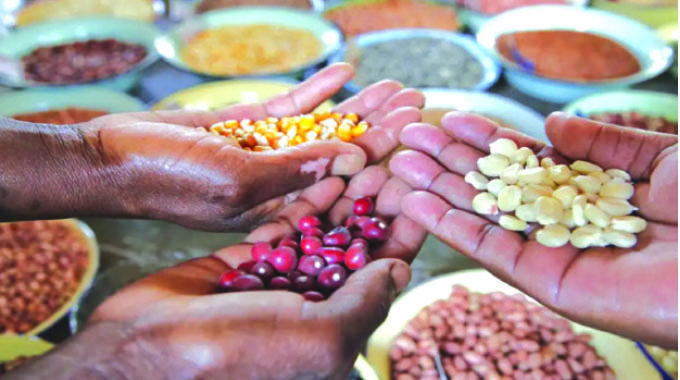
Obert Chifamba-Agri-Insight
IN its report on the country’s state of preparedness for the 2023/24 cropping season, Government recently indicated that there is enough seed for traditional grains and legumes with focus now concentrated on increasing productivity en route to ensuring that production grows by 10 percent for major crops.
The Lands, Agriculture, Fisheries and Water and Rural Development Ministry subsequently revealed that the increase in seed production towards attaining self-sufficiency had been a result of policy decisions to expand the production of traditional grains, as a way of climate proofing Zimbabwe’s agriculture.
The promotion of the traditional grains and different pulses is being done to promote diversification of diets for nutritional security, observed the Ministry.
Government is targeting cereal production of 3 775 72 tonnes — with maize accounting for 3 060 000 tonnes and 715 728 tonnes of traditional grains, which is enough for human cereal consumption requirements, as well as industrial use and livestock feeds.
From the report, it was also highlighted that something in the region of 45 000 tonnes of seed was required to cover 1, 8 million hectares of maize that are targeted for the next season while 4 180 tonnes of seed was needed to cover 418 000 hectares of sorghum with 1 600 tonnes of seed sufficing for 275 000 hectares of pearl millet and 138 tonnes for 27 500 hectares of finger millet.
Essentially, this will guarantee national food and nutrition security, as well as adequate household nourishment with some left overs for sale.
This announcement by the Government comes at a time when farmers will naturally be very busy trying to build stocks of all the inputs they need for a new season, chief among them, seed.
This is usually the time when anxiety marks the order of the day for most farmers, as they painstakingly mobilise the inputs against a depleted resource base.
This confirmation on seed availability by the Government will put paid to speculation that there will be shortages, which in most cases leaves the farmers vulnerable to unscrupulous traders capitalising on the desperate situation to come up with dubious schemes. Farmers usually turn gullible and easily fall for any forms of chicanery, as they search for easy ways out of a possible dilemma.
Naturally, such a message sets the stage for serious preparations and informed planning for a season, as farmers can easily calculate potential hectarages for given crops versus seed stocks they will be targeting to acquire. For now, the process is made easier by the fact that inputs from Government support programmes come with specific hectarages, which allows farmers to make projections on what their eventual hectarages will look like.
In most cases, it is also easy for authorities to reach the conclusion that there is adequate seed when there is also sufficient seed from farmers’ own saved stocks, social networks, in local markets and the formal seed sector to meet seed needs of local households.
Resourceful farmers always use the correct storage measures for preserving left-over seed for the next season. In this case there are also Government input support programmes that are availing seed to farmers, which means all is set for the novel season.
What remains is for the farmers to demonstrate that they are organised enough to put the seed to good use through meeting planting deadlines and observing the correct agronomic practices.
It will not be a pleasing outcome for the seed to be used and not leave a mark on the food security graph as well as the socio-economic reality of the farmers.
The farmers need to always remember that it is no longer business as usual in the agriculture industry but that everything is transitioning towards commercial agricultural production that is business oriented.
The good thing about this recent confirmation of a stable seed base is that it lessens the farmers’ burden and frees some resources for deployment in other critical areas of production. One other important observation is that when the Government confirms availability of inputs, it always makes sure they will be in reasonable proximity to the farmer and be available in time for planting.
It does not require rocket science to realise that agriculture begins with seed and without seed, there can be no crops and no food production ultimately.
The availability of seed brings with it hopes for a successful season, which is a critical ingredient in the attainment of food security and successful livelihoods.
Other than the seed that will be available through support schemes, seed houses will also contribute to easy seed accessibility through retail sales while they can always import extras to cover shortages for different crops, should there be any.
This is the assurance that farmers need each time they approach a new season.
Of course the availability of seed in retail outlets comes with another worry for the farmer — the pricing regimes.
Prices have to be within their reach to allow them to supplement what they would have secured from other sources especially if they intend to expand hectarages. With the current drive to make agriculture a serious business, production volumes have also become important because it is from surplus yields that farmers get their incomes after selling.
It is also exciting to note that some agro-dealer shops in Harare seem to have heard the farmers’ daily prayers for affordable prices of inputs and have duly reduced prices for fertilisers and maize seed.
A random survey done by The Herald recently established that a 50kg bag of Ammonium Nitrate (AN) was going for a price of between US$37 and US$40 while Compound C and D are priced at US$30. A 10kg maize seed is pack is going for US$30.
This should come as sweet news to the farmer considering that fertiliser prices, for instance, had reached a high of US$70 or more for a bag of AN while Compound C and D were selling at between US$55 and US$65 at some point.
The recent drop in prices will ensure affordability of inputs to communal farmers who form the bulk of the players in agricultural production matrix.
This will allow them to augment what they would have received from support programmes and broaden their production base, which is a plus for the drive to boost food security, as well as avail raw materials for the agro-processing industry.
Farmers intending to plant larger hectarages than what they would have received from the Government programmes can cover when they need more seed should use this time to buy their extra requirements and capitalise on the affordable prices. In recent times it has become very difficult to plan around a particular price for inputs because the prices are changing every now and then either for the good or bad. It is also wise to mobilise inputs just after selling produce given that most farmers are still getting incomes once a year because they get incomes once a year yet they have a lot of expenses to meet from those earnings.
The biggest undoing in most cases is that they are not yet capacitated to do all-year-round production that can guarantee them of incomes that come in regularly and throughout the year as well.



 Online Reporter