Online Reporter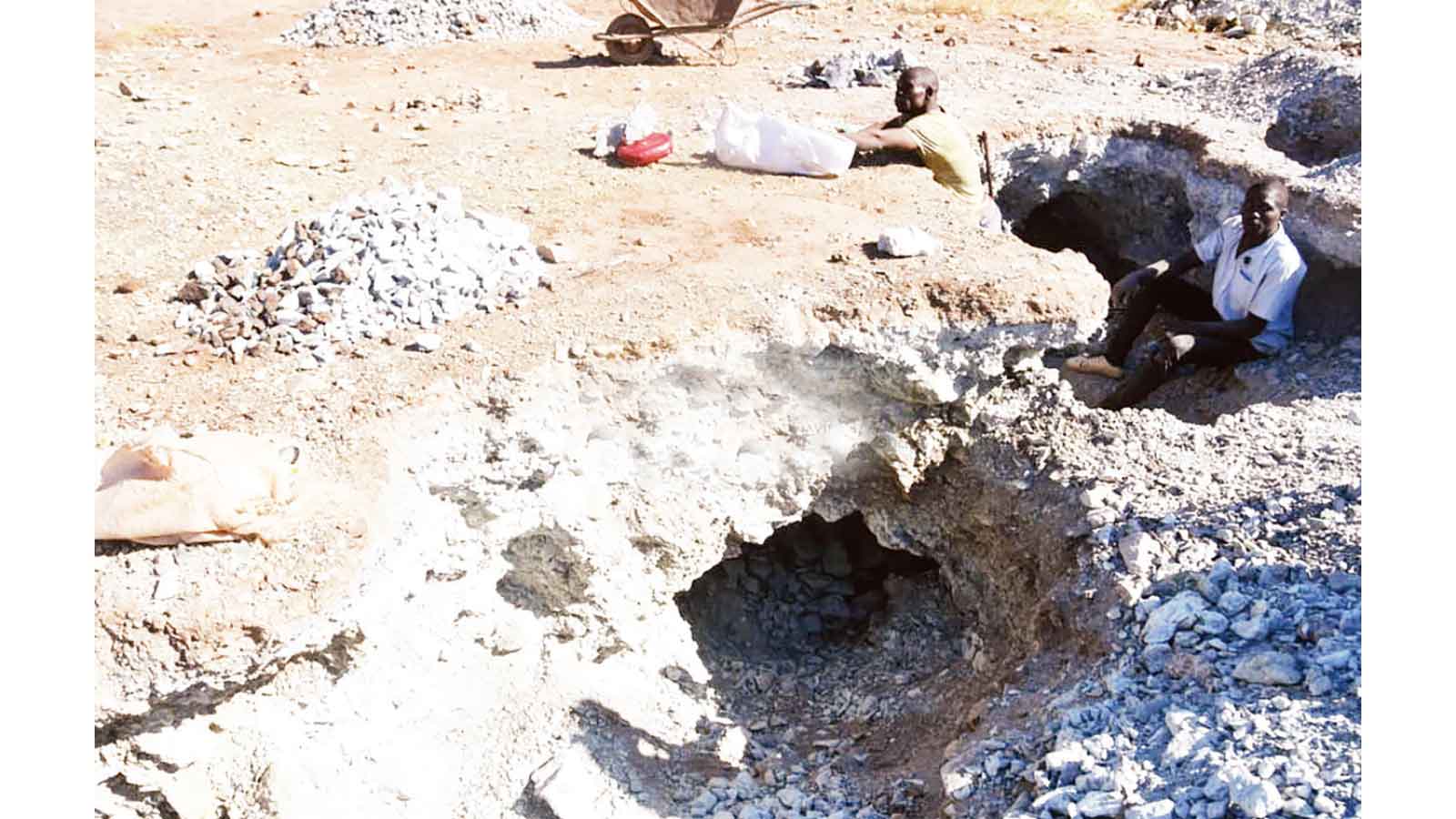
Theseus Mauruki Shambare
Features Writer
THE cattle disappeared into the bowels of the earth. For two weeks, retired teacher Jabulani Ncube searched for his two beasts after they went missing during the dry season.
The search ended inside an abandoned, uncovered chrome-mining pit. Both cattle were dead.
“I lost two of my beasts last year to pit falls. They went missing for two weeks during the dry season only to find them in a decomposed state in an abandoned uncovered pit used by small-scale chrome miners,” Ncube said recently.
For Ncube, the pit was a direct threat to a livelihood built around the land. Then came another blow.
He says miners clearing land lost control of a veld fire that reached his homestead, killing his goats and burning irrigation pipes.
“My goats were killed by veld fires during the night. They were in a wood pole kraal and the miners were clearing the land using fire, they lost control of it and ended up at my homestead,” he said.
“They fled and never returned, but I was left counting losses. It did not end there. My irrigation poly-pipes were also burnt. It was really a setback since I am now surviving from my horticulture operations having retired from teaching.”
Ncube’s experience captures the contradiction at the heart of mineral-rich Mberengwa.
Gold and chrome extraction bring employment, investment and infrastructure into communities where formal economic opportunities remain limited.
But extraction can also leave open pits, degraded land, damaged grazing areas, silted waterways, dust and disrupted livelihoods.
The harder question is who bears the cost when the mineral eventually runs out.
For miner and entrepreneur Anderson Tsikira, mining should contribute to the communities that host it.
Across his six mining operation centres, Tsikira said he employs almost 348 workers, including about 300 people in gold-mining operations.
At one operation, 15 people are employed full-time, while about 60 others work casually.
“As long as a young person is capable of doing the work required, I don’t turn them away,” Tsikira said.
He said mining has supported Neta Secondary School with construction materials, community halls and roads, as well as police equipment and fuel.
Tsikira said he had drilled about six community boreholes serving households and institutions around Neta and Gavakava.
“As you know, water is a major challenge here in Mberengwa. So, as part of supporting the community, I have drilled several boreholes. So far, I think we have drilled about six boreholes,” he said.
“Our view is that mining should not only create jobs, but should also contribute to the development and improvement of the communities where we operate,” he said.
A 28-year-old machine operator at one of Tsikira’s sites said mining has provided him with the best remuneration.
“My life has changed since I started working here at the mine.
“I have been moving from one casual job to another until I got employed here,” Maruta said.
Mai Shumba, who has lived in the area since 2004, describes mining’s impact as “half-half”.
She acknowledges the jobs, but worries about dust, water sources and livestock.
“Some people have died, and I believe it was because of the dust. There is too much dust in the area where we live,” she said.
She said livestock have fallen into pits and grazing areas have been affected.
“For the coming generation, I do not see much benefit because almost everywhere has been damaged,” she said.
That concern now has an official environmental dimension.
Environmental Management Agency environmental education and publicity manager Ms Amkela Sidange said EMA conducts regular surveys and inspections in chrome-mining areas across Midlands Province to assess mining’s effects on the biophysical environment and compliance with environmental regulations.
“The major finding was extensive land degradation due to mining, with rehabilitation of the mined pits lagging behind,” Sidange said.
She said EMA had issued environmental protection orders requiring progressive rehabilitation as mining continues.
“Mining induced land degradation is perpetrated by both small-scale artisanal miners and large-scale mining operations,” Sidange said.
According to Sidange, illegal small-scale miners targeting alluvial gold deposits in waterways have affected the Dohwe, Mtshingwe, Mundi, Ngezi and Mwenezi river ecosystems.
“The open cast mining operations by big companies are also affecting grazing lands,” she said.
Mberengwa has four ambient water sampling points along Mtshingwe River, Mundi River, Mwenezi River and Gambure Dam. Samples are collected monthly whenever there is flow and sent to laboratories.
“Generally, findings indicated mostly elevated suspended solids mostly from silt due to increased mining along the river ecosystem,” Sidange said.
The finding gives scientific weight to concerns over siltation, although it does not establish disease causation.
Dust pollution is subject to industry self-monitoring and EMA verification.
“Every mining project developer is mandated by law to do self-monitoring of dust emission through an accredited consultant on a quarterly basis and submit a report to the agency,” Sidange said.
“The agency may carry out its own tests to verify the submitted air pollution results.”
“In any case, if the pollution level exceeds permissible limits, the polluter is penalised and ordered to take corrective action,” Sidange said.
EMA conducted 1 413 cumulative inspections involving 181 mining operations, resulting in 151 tickets for implementing mining projects without valid Environmental and Social Impact Assessment certificates or breaching ESIA conditions.
A further 107 orders were issued for rehabilitation of mining-degraded areas.
There were 115 tickets for failure to obtain hazardous-storage and use licences or breaches of licence conditions, while 93 tickets were issued for lacking effluent and solid-waste disposal licences or disposing of effluent in a manner causing pollution.
Another 15 tickets were issued for failure to put dust-abatement measures in place.
“Unsustainable extraction of minerals carries significant environmental costs, making it essential that all mining projects integrate environmental management into all stages of the project cycle,” Sidange said.
Yet Mberengwa also offers an example of what compliance can look like.
At Jumbo Blocks Mine near Mberengwa Business Centre, small-scale miner David Kilpin said his operation responded to environmental guidance by reclaiming and backfilling open pits and fencing the mining perimeter to protect residents and livestock.
“We believe we have a good relationship with the local community. To avoid conflicts, we are putting up fencing as guided by EMA,” Kilpin said.
He said the mine, operating in Village 5 for about 13 years, employs more than 120 people and plans to support construction of a primary school for about 450 pupils.
The issue is whether fencing, progressive rehabilitation and monitoring become standard across the sector.
The question is especially timely this week, as ActionAid’s Global Week of Action, running from September 14 to 20, places climate justice and accountability for environmental harm in the spotlight.
For ActionAid Zimbabwe Country Director Dr Selina Pasirayi, that accountability must extend beyond the language of “polluter pays”.
“The campaign challenges the notion that green minerals are automatically ‘clean’ simply because they support electric vehicles, renewable energy and low-carbon technologies,” Pasirayi said.
“Our campaign emphasises that a Just Energy Transition must go beyond simply shifting from fossil fuels to renewables. It must also shift the power dynamics.”
“A transition cannot be considered ‘just’ if the environmental and social costs are merely relocated to mining communities,” she said.
“Environmental offenders should be legally required to cover the full costs of pollution assessment, clean-up, ecosystem restoration, livelihood recovery and compensation, not merely pay an administrative fine,” she said.
She said SI 92 of 2026 on environmental liability and the polluter-pays principle provides an important basis, but implementation, institutional responsibilities and community-accessible enforcement mechanisms must be operationalised and monitored.
“Mining companies should lodge rehabilitation bonds, environmental insurance or ring-fenced financial guarantees before operations begin,” Pasirayi said.
“Polluter pays must mean ‘polluter restores and repairs’.”
For Ncube, rehabilitation is not a distant policy debate. It is two cattle decomposing in an abandoned pit, goats lost to fire and irrigation infrastructure reduced to ashes.
Mberengwa needs jobs, investment, roads, water infrastructure, schools and opportunities for its young people.
The challenge is ensuring that communities hosting that wealth do not inherit only the environmental debt left behind, because the gold will eventually run out. The chrome will run out and the machinery will move elsewhere.
But the pits, degraded land, silted waterways and memories of lost livelihoods can remain for generations.
So perhaps the true test of Mberengwa’s mineral wealth is not how much gold or chrome leaves the ground. It is what remains after the digging stops.
Will the land still sustain the people who live on it — or will they inherit only the scars?