Online Reporter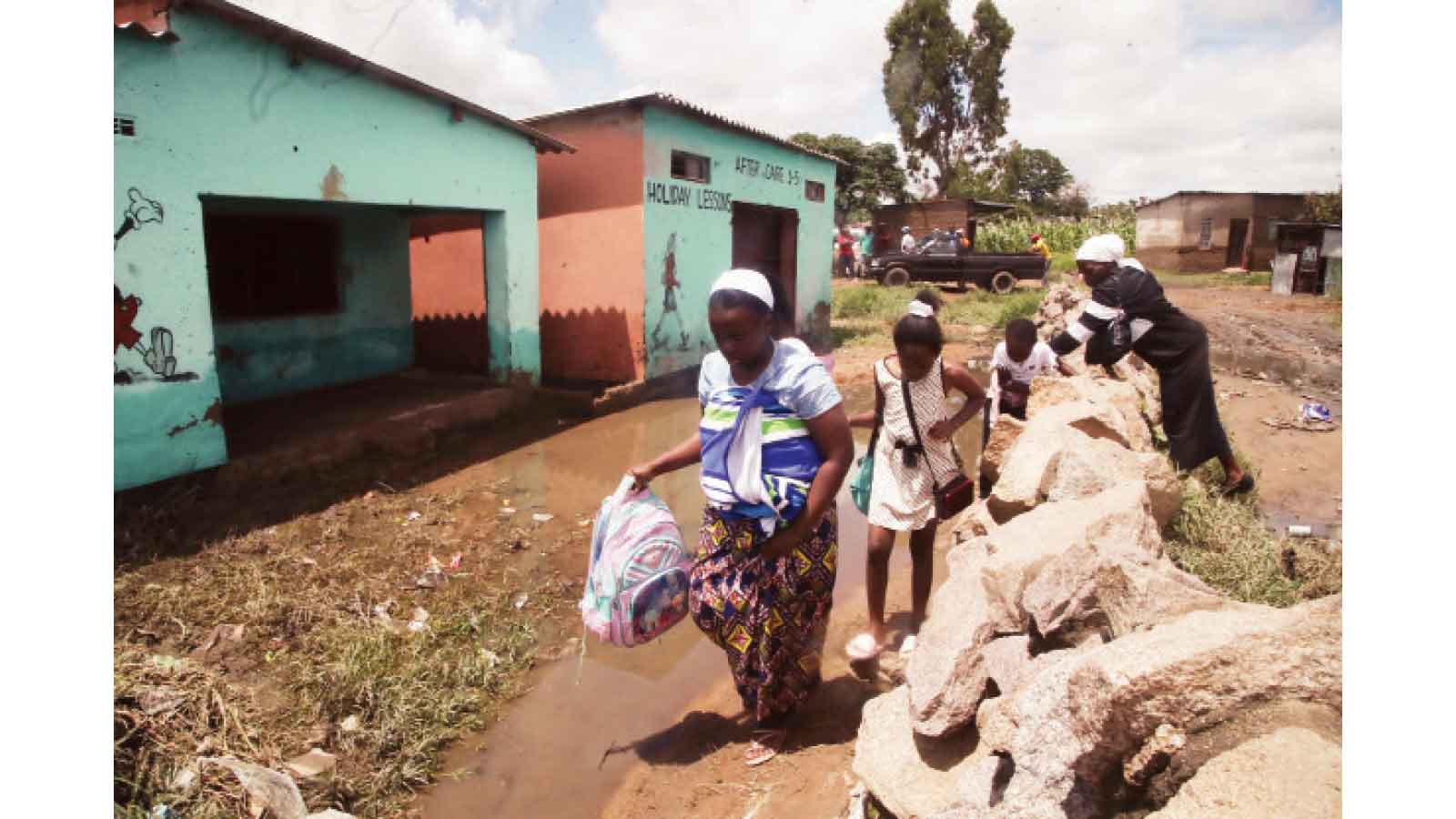
Theseus Shambare-Features Writer
FOR Tafirenyika Chigudu, the rain did not stop when the storm passed, but it continued inside his head long after the Jacha River burst its banks, tearing through Epworth, on the outskirts of Harare, where he has lived for eight years.
By afternoon, the one-roomed house he inherited from his late parents was gone — swallowed by water, mud and silence.
Vainly, he tried to save his house using hands.
“We received a heavy downpour. I thought, like all the past years, nothing would happen. But the run-off water started to rise and the huge flood came from the close-by tributary and invaded my stand.
“In no time, the water forced its way through the door. I tried using buckets but I was overwhelmed,” he said.
Desperately, Mr Chigudu drilled a hole at the back of his house to allow the water to have a passage through.
This didn’t work because the water increased force and the walls gave in.
“I escaped when the walls collapsed,” he said softly.
Scattered bricks and roofing sheets marked what had once been his home.
Mr Chigudu is one of 19 families displaced after torrential rains pounded Epworth, causing Jacha River to overflow and sweep away houses built perilously close to its course.
At another house, three children were swept away after the backside gave in to flooding water. Fortunately, neighbours assisted to retrieve them.
By dawn, survivors were evacuated to Epworth High School, where classrooms were turned into temporary shelters and desks into beds.
Like many before them, the families watched helplessly as the river reclaimed ground long occupied by human settlement.
Residents in Ward 5 gathered to mend the bridge with readily available materials just for access.
As the waters rose, panic spread quickly through the settlement. Some residents fled with children wrapped in blankets. Others returned repeatedly, hoping to rescue household goods, clothes or schoolbooks before the current grew too strong.
“It happened so fast.
“We thought the water would stop like it always does,” said one elderly woman, Ms Enert Jichichi, a resident since 2000.
It did not.
Entire structures gave way, collapsing into the river as the flood surged through narrow passages that once served as footpaths. What remained was a stretch of devastation — broken walls, uprooted toilets and household property strewn across the mud.
Even an unregistered school along the river was not spared.
Most of the affected homes stood on land never designated for housing development, part of a wider pattern of informal settlement that has taken root along Harare’s waterways as the city struggles to absorb growing demand for accommodation.
Minister of State for Provincial Affairs and Devolution for Harare Metropolitan Province, Charles Tavengwa, said the Government has requested more land for Epworth and Chitungwiza to resettle people who illegally settled on wetlands.
“The council is working to regularise these settlements and move people to areas meant for proper residency, but cooperation from residents is key,” he said.
Epworth South legislator, Honour Taedzwa Mutana, urged private players and non-governmental organisations to come on board to assist the affected communities.
“The time is now for all stakeholders to join hands with the Government and provide support to these vulnerable communities. Let us work together to build resilience and ensure that no one is left behind,” he said.
For years, warnings have been issued about the dangers of settling along rivers and wetlands.
Headlines have spoken of drainage crises, irregular settlements and a fragile urban future. Yet on the ground, little has changed for families with nowhere else to go.
Residents say many acquired their stands through informal arrangements, often reassured that regularisation would follow.
Others say they knew the risks, but lacked alternatives.
“Rent is too high,” said a father of four sheltering at Epworth High School. We built our house here because it was the only place we could afford.”
Such decisions, born of necessity, now leave families exposed to the full force of extreme weather.
Climate experts warn that rainfall patterns are becoming intense and unpredictable, increasing the likelihood of flash floods.
In settlements like Epworth, where drainage is poor and riverbanks have been encroached upon, the danger is amplified.
“With climate change at play, we must brace for the worst shocks. We are bound to receive extreme weather patterns. It’s either drought due to flooding or lack of water,” said Dr Walter Svinurai, a weather expert and lecturer at the University of Zimbabwe,
The destruction in Epworth came just days after nine people lost their lives in Insiza District, Matabeleland South, when a vehicle was swept off a flooded low-lying bridge — a stark reminder that flood risk spans both rural and urban Zimbabwe.
Authorities continue to urge citizens to avoid crossing flooded rivers and heed weather warnings, while emergency teams move in swiftly when disaster strikes.
In Epworth, assessments and relief efforts are ongoing as officials consider longer-term interventions for families living in high-risk zones.
Beyond Harare’s informal suburbs lies a network of settlements where services are limited and vulnerability is high.
Clean water is scarce, and sanitation is inadequate. Houses are often constructed incrementally, offering little protection against heavy rains. Yet these communities endure.
At Epworth High School, children chased each other between classrooms, momentarily escaping the trauma of the night before. Mothers pondered on what to cook, while fathers discussed whether rebuilding was possible — or wise.
For now, the displaced families wait. Some hope the river will retreat and allow them to return, while others fear that rebuilding along its banks would be an invitation to the next disaster.
What unites them is uncertainty — and the knowledge that the land they occupied was never truly theirs to begin with. As the rainy season continues, the destruction along Jacha River lays bare a truth long documented but rarely resolved.
And when the river comes for homes, it is always those living on the edge who are swept away first.
Feedback: X @TheseusShambare