

 Chronicle Editor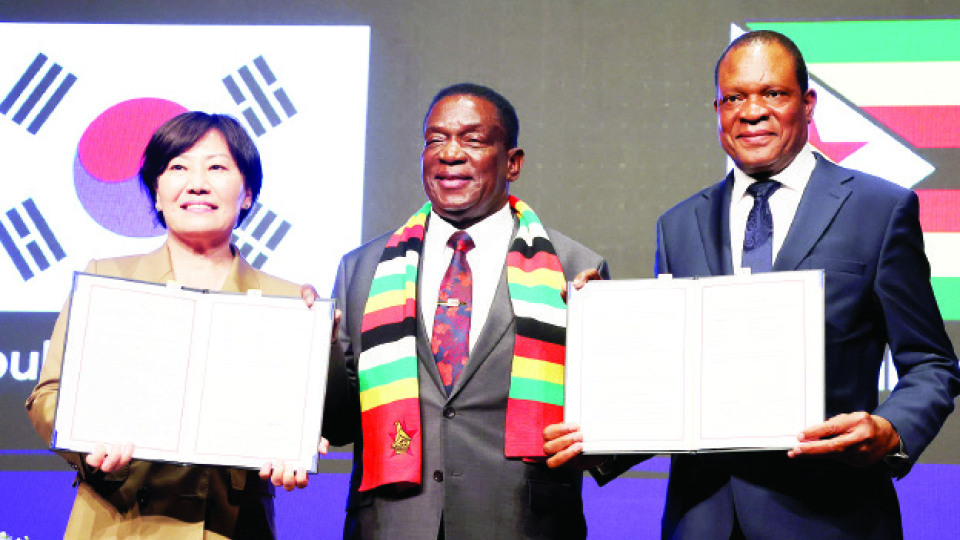
Hebert Zharare in SEOUL, South Korea
PRESIDENT Mnangagwa yesterday laid a firm foundation for Africa’s economic development agenda — emphasising the need for the continent to be accorded “due status” of equal partner in the current global mineral extraction and beneficiation matrix as well as derive rewards from lucrative global agriculture value chains.
President Mnangagwa revealed this during his captivating presentations in separate conferences — one themed, “Strengthening Food and Mineral Security in Africa” and another one on “Agriculture Productivity and Regional Development” that were part of the two-day South Korea — Africa summit that ended here yesterday.
During the agriculture conference, the Minister of Lands, Agriculture, Water and Rural Resettlement, Dr Anxious Masuka and his South Korean counterpart, Song Mi-ryung signed a Memorandum of Understanding (MoU) on the K-Rice Initiative that was witnessed by President Mnangagwa.
The South Korean Government yesterday also entered into the K-Rice Initiative agreement with Angola, Madagascar and Malawi during the summit that was attended by 48 Heads of State and Government. The thrust of the initiative is to produce up to 10 000 tonnes of rice in Africa per year by 2027, up from the current 2 000 tonnes. During the business conference that also marked the close of the summit and attended by hundreds of South Korean business executives, President Mnangagwa said through the African mining vision, the continent was angling for modernisation and industrialisation leveraging on diverse resources of the mining sector.
“With regards to minerals security, partnerships and investment from the Republic of South Korea should be scaled up to ensure that maximum value is realised, first and foremost, for the benefit of the resource rich African communities. The abundant sub-soil assets of Africa should drive sustainable development and economic prosperity of the continent. Transparency, fairness and accountability remain key to strengthening mineral security in Africa. “Mining contracts must be fairly negotiated and revenues from the mineral resources distributed for the transformation of African economies. A skewed situation where Africa has nothing but deep pits and degraded land to show for its rich resources is neither attainable nor sustainable,” he said. President Mnagwagwa said in the case of Zimbabwe, the mining sector contributed over 60 percent of the total national exports, with the sector growing from a US$2,7 billion industry in 2017 to a staggering US$12 billion in 2023. He said Zimbabwe was committed to attaining mineral security by unlocking the full potential of its mineral resource through sustainable mining practices, use of advanced technology and effective regulatory frameworks.
“By ensuring efficient and transparent mining operations, my country has managed to attract Foreign Direct Investment in the mining sector from across the globe, establish a gold-backed local currency (The Zimbabwe Gold), create jobs, especially for young people and attain high levels of economic growth. My country is committed to the mineral value chain through the promotion of value addition and beneficiation of our resources to realise maximum value.
“In this regard, we welcome partnerships with South Korean firms to establish beneficiation plants and technology transfer initiatives in Zimbabwe and on the rest of the continent. The continent is keen on forging partnerships with the Republic of South Korea leveraging on Korea’s renowned expertise and rich experience in agriculture and mining development. We are confident that together, we can achieve mineral and food security, improve livelihoods and build a prosperous and sustainable future for South Korea and Africa,” he said.
President Mnangagwa said according to the 2023 Africa — Regional Overview of Food Security and Nutrition, the situation in Africa called for decisive action on strengthening food security.
The report estimated that in 2022, approximately 868 million people in Africa experienced food insecurity with 342 million of them suffering from severe food insecurity.
“The irony of the food security challenges we face is that Africa is home to 60 percent of the world’s arable land and the continent has the potential to be the breadbasket of the world. It is unfortunate that due to wide factors, including the illegal and unjustified sanctions, in the case of Zimbabwe, Africa has been constrained from realising its full capabilities. The current crop of African leaders is determined to address this anomaly,” President Mnangagwa said.
He said South Korea and Africa should create co-operation and partnerships in agriculture to ensure efficient and effective utilisation of vast swathes of land on the continent sufficient to attain food security.
The President said Zimbabwe was therefore committed to achieved food security through strategies that “leave no one and no place behind.”
“This has seen us domesticate the Sustainable Development Goals, the Africa Agenda 2063, the Comprehensive Africa Agriculture Development Programme and the Sadc and Comesa policy frameworks.
“Our robust and responsive agriculture food system and rural transformation strategy is informed by the reality that Zimbabwe, like many African countries, has more than 67 percent of its population deriving their livelihoods from agriculture. As such, we are promoting climate-resilient agriculture, investing in and supporting small holder farmers, particularly women and youths, fostering regional trade and market access and leveraging technology transfer and innovation to enhance productivity and efficiency,” President Mnangagwa said.
Zimbabwe’s experience is that a deliberate focus on dam construction and mechanisation among other aspects to agriculture development, is a necessary condition for rural industrialisation and poverty alleviation.
In his address during the agriculture conference, President Mnangagwa said the role of agriculture in regional development could not be overemphasised especially given that more than two thirds of the African population lived in rural areas. In Zimbabwe, approximately 67 percent of the population survive on farming while the sector contributes 24 percent to the GDP.
“To date, Zimbabwe continues to experience unprecedented increases in agriculture production and productivity throughout all categories of the agriculture sub-sectors. This has been as a result of my Government’s investments in modern farming techniques, increased access to quality seeds and fertilisers for our farmers as well as the conservation agriculture — Pfumvudza / Intwasa model.
“Additionally, water availability and irrigation development, mechanisation and enhanced availability of tillage services, all supported by requisite research and extension services, have been the empowerment tool of Zimbabwean farmers,” he said, adding that the sector was now valued at US$9,8 billion.
President Mnangagwa said a thriving agricultural sector and agricultural development-stimulated rural industrialisation led to rural development.
The accelerated development of rural communities, he said, was envisaged to ultimately facilitate the speedy realisation of a prosperous and empowered upper middle-income society, in line with the national Vision 2030.
“As part of Zimbabwe’s multi-pronged agriculture development revolution, my Government is establishing rural agri-village business units throughout the country’s 35 000 villages. These complement our flagship Pfumvudza /Intwasa climate-proofing conservation agriculture model which guarantees household food security.
“The rural agri-village business units are designed to climate proof our communities, guarantee food and nutrition security as well as incomes right at the village level.”
The model entailed that each village is supported with solar powered boreholes and drip irrigated agriculture plots as well as tapped water. The solar driven intensive agriculture production and productivity units are linked to aggregation, value addition and beneficiation centres.
Each agri-village business unit is a registered company with the surrounding communities employed by the firm and receiving a dividend.
To ensure that no place and no one is left behind, similar agri-business units are also being replicated in schools and vocational training centres. Despite this encouraging progress, Zimbabwe remains vulnerable to climate change, President Mnangagwa said.
Along with the rest of the Southern African region, the climate change induced El Nino drought had left some of the communities in Zimbabwe vulnerable.
“Although Zimbabwe is ordinarily food secure, the ongoing drought has subdued cereals production. Going forward, we have introduced a wheat-based food security strategy leveraging on our favourable conditions that support wheat production in the winter season. We are one of the few countries in Africa to realise wheat self-sufficiency,” said President Mnangagwa.
To mitigate the ever-looming risk of the climate change induced extreme weather patterns, he said Zimbabwe incorporated a sovereign insurance scheme to protect rural communities in the event of drought.
“To further complement self-sufficiency within our respective countries and riding on our competitive advantages, support for cross border infrastructure projects is critically important to guarantee regional food-self sufficiency and development,” President Mnangagwa said.
He said the African Continental Free Trade Area provided an opportunity to increase intra-Africa trade, adding that the current situation where Africa imported over US$80 billion worth of food was not sustainable.
“In today’s interconnected world, Africa needs collaboration and synergies to address global challenges such as climate change. The partnership between Africa and South Korea presents a unique opportunity to exchange knowledge, expertise and technology in the field of agriculture. Korea’s advancement in agricultural innovation can complement Africa’s rich agricultural heritage, leading to mutual benefits for both regions”.
Meanwhile, President Mnangagwa, who had an engagement with Zimbabweans based in South Korea yesterday, some working in various companies and others who are studying in different fields mainly technical, is expected to leave South Korea for Russia today for another engagement.



 Online Reporter