Vusumuzi Dube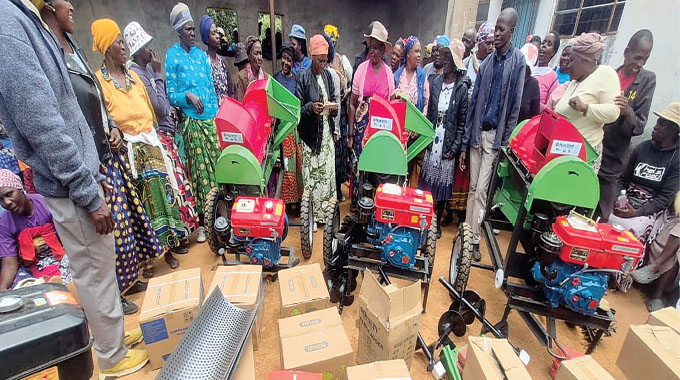
Mthabisi Tshuma, [email protected]
BULILIMA villagers have received a major boost following the distribution of farming equipment aimed at strengthening community resilience and restoring local ecosystems. The equipment, sourced through the Adaptation Fund Project led by the Environmental Management Agency (EMA) and executed by ORAP, is expected to improve productivity and enhance food security.
The project targets Wards 2 (Gwambe), 4 (Nyele) and 20 (Dombodema), where beneficiaries are receiving auger wheelers, water tanks, threshers and feed millers to support livestock farmers.
ORAP is currently active in five provinces — Matabeleland South (Insiza, Matobo, Mangwe, Bulilima and Umzingwane districts), Matabeleland North (Bubi, Tsholotsho, Lupane, Nkayi and Umguza districts), Midlands (Mberengwa district), as well as Bulawayo and Harare.
These districts span rural, peri-urban and urban communities, reflecting ORAP’s flexible, community-driven development model.
One of the beneficiaries, identified only as MaMoyo, said the equipment would significantly improve their agricultural output.
“For years, production at our fields has seen dwindling figures because we faced drought and our ox-drawn farming method was hard-hit by the death of cows and donkeys. Receiving such equipment will surely set us up for better agricultural yields,” said MaMoyo.
ORAP Chairman of the Governing Board, Mr Memezi Nyoni, said as an implementing partner, their long-term strategy is to gradually reduce reliance on external facilitation by strengthening community governance and transferring management responsibilities to local committees and associations.
“We prioritise embedding skills, knowledge, and leadership locally and ensuring that communities control assets, decision-making, and monitoring. The ultimate goal is for communities to sustain and evolve initiatives with ORAP as a long-term ally, not a permanent implementer.
“ORAP does not directly fund projects. Instead, ORAP mobilises, manages, and accounts for resources provided by external funding partners while ensuring alignment with community priorities,” said Mr Nyoni.
He said ORAP’s role is largely facilitative and co-ordinated through community structures and local authorities.
“We ensure that all projects start with SMART targets and indicators which guide our work and keep us accountable to the communities, our donors and partners, including the government. We invest in ensuring that all project activities are community-led, which is key to sustainability. This means that successful activities produce functional community committees that manage infrastructure and enterprises.
“Our work promotes Community-Led Monitoring and Evaluation (CLME), which provides objective determination of success by assessing rates of adoption of interventions, and how the work we have done is impacting the communities. Ultimately, we see success as enhanced self-sufficiency, specifically in terms of communities planning and prioritising their own activities, as well as managing to mobilise their own resources and leadership. As ORAP, we are poised to link communities with the resources they identify in their community visioning processes,” he said.
Mr Nyoni said climate change and related shocks remain ongoing challenges, and ORAP is preparing communities to adapt.
“As such, we continue to prioritise climate-sensitive initiatives, and enhancing the integration of indigenous knowledge both for anticipatory action and appropriate responses to shocks. As our work seeks to transform economic participation and independence for the communities we serve, economic instability locally and globally also adds to the challenges we try to address. This is done primarily through the promotion of diversified livelihoods and linking communities to formal financial systems to strengthen their growth and sustainability efforts. “Over the past year, the uncertainty of funding has presented a challenge for ORAP as an organisation, as well as the communities that we are serving. We continue to invest in adaptive operational approaches that allow for learning and swift pivoting when it’s needed. In all our activities, we ensure that we are strongly grounded in the communities, and well-supported by strategic partnerships with relevant Government departments and technical partners,” said Mr Nyoni.
Follow on X: @mthabis_mthire



 Online Reporter