Vusumuzi Dube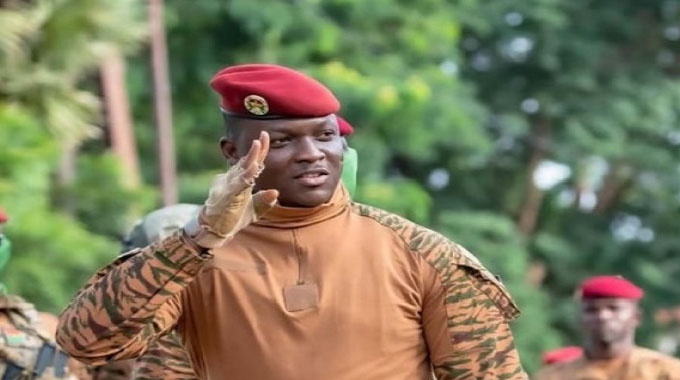
Joyce Mavengahama and Febbie Nyasulu
IN the heart of the Sahel, a thirty-seven-year-old military officer in a red beret has transformed himself from a captain in the Burkinabè army into one of Africa’s most controversial and closely watched leaders.
Captain Ibrahim Traoré rose to power in September 2022 following a military coup that removed Lieutenant Colonel Paul Henri Damiba amid escalating insecurity and deepening dissatisfaction with the fight against jihadist insurgencies.
Since taking office, Traoré has done far more than govern; he has embarked on a deliberate campaign to dismantle what he considers the lingering architecture of French influence in Burkina Faso. Under his leadership, the country has positioned itself at the centre of what he portrays as a “second independence,” signalling a clear rejection of Western dependency while presenting Burkina Faso as a bold laboratory for Pan-African self-reliance.
For decades, institutions such as the International Monetary Fund (IMF) and the World Bank have played dominant roles in shaping economic governance across the Global South. Critics have long argued that their structural adjustment programmes entrenched debt dependency and restrictive policy conditions.
Traoré has publicly likened the IMF to a “doctor whose medicine kills the patient,” underscoring his administration’s deep scepticism towards externally dictated economic models. In early 2025, his government announced that it had cleared approximately US$4,7 billion in external debt — news that sent ripples through global markets. In this context, rejecting foreign aid was not merely symbolic but marked a strategic shift towards mobilising domestic resources and asserting fiscal sovereignty. For Traoré, economic independence is an essential foundation for political independence.
Perhaps the most assertive example of his defiance of Western dominance has been the state’s move to renegotiate mining contracts while expanding the role of SOPAMIB, the state-owned mining company.
His government has initiated plans for a domestic gold refinery, insisting that Burkina Faso will no longer export raw bullion only to re-import refined gold at a higher cost. This policy reflects a broader approach to economic nationalism, aimed at retaining value addition within national borders.
Traoré frames the gold sector as a driver of redistributive development, arguing that its revenues should be used to strengthen education, healthcare, and other essential public services. In this regard, the mining reforms represent not only economic adjustments but also ideological assertions of resource sovereignty.
Traoré presents his leadership as a continuation of Thomas Sankara’s revolutionary vision of the 1980s. Drawing upon Sankara’s doctrine of “endogenous development,” he champions the idea that Africa must rely on its own natural and human resources if it is to resist Western influence. This ideological orientation is evident in the
“Agriculture Offensive” launched in 2023, which sought to achieve food self-sufficiency. The government invested billions of CFA francs in tractors, improved seeds, irrigation systems, and mechanised farming initiatives. By 2024 and 2025, Burkina Faso reported a significant grain surplus, nearing six million tonnes of cereals. Achieving food sovereignty reduces vulnerability to external shocks and dependence on foreign aid, further reinforcing national autonomy.
On the regional stage, one of Traoré’s boldest geopolitical moves was the creation of the Alliance of Sahel States (AES) alongside Mali and Niger. This alliance emerged after ECOWAS imposed severe sanctions, which Traoré condemned as being influenced by Western interests. The formation of the AES marked a significant realignment in West Africa, signalling a move away from traditional regional blocs perceived as externally aligned. The alliance emphasises mutual defence, collective security, and sovereign decision-making free from external interference. This regional restructuring reflects a broader recalibration of power dynamics across the Sahel.
Traoré has also challenged the system widely known as “Françafrique,” the post-colonial network that maintained political, economic, and military ties between France and its former colonies. In January 2023, his government demanded the withdrawal of French troops stationed in Ouagadougou, bringing an end to France’s military presence in the country. Relations soured further in April 2024 when three French diplomats were expelled and declared persona non grata for alleged subversive activities. These actions underscored a decisive break with France and symbolised a reassertion of sovereignty over national security and diplomatic affairs.
Beyond economic and military matters, Traoré’s decolonisation project extends into the cultural and linguistic realms. He has advocated for the adoption of Kiswahili as a national language alongside indigenous languages such as Mooré and Bissa, challenging the dominance of French. Formalised through a bill in December 2023 and ratified in 2024, this initiative was presented as a step towards breaking from colonial linguistic dependence. Traoré argued that continuing to use French as a national language reflected ongoing colonisation, stating that it is “illogical” to rely on the language of those who “exploited” the nation’s resources. The government has also replaced several colonial-era regional names with traditional titles in a bid to decolonise public spaces. However, despite these symbolic and legislative reforms, French remains the primary language of instruction in most formal schools, highlighting the practical constraints of rapid linguistic transformation.
The path Captain Ibrahim Traoré has chosen is neither straightforward nor without risk. His policies challenge long-established geopolitical and economic frameworks that have historically benefited Western states.
While his leadership positions itself as a liberation project dedicated to freeing Africa from the grip of neo-colonial dependency, a broader question endures: can an African state fully flourish while completely disengaging from Western economic and political systems?
Traoré’s experiment in sovereignty, resource nationalism, and regional realignment presents a significant case study for scholars of international relations examining post colonial statecraft, strategic autonomy, and the shifting contours of the global order.
*Joyce Mavengahama and Febbie Nyasulu are students at Africa University majoring in International Relations.



 Online Reporter