Chronicle Editor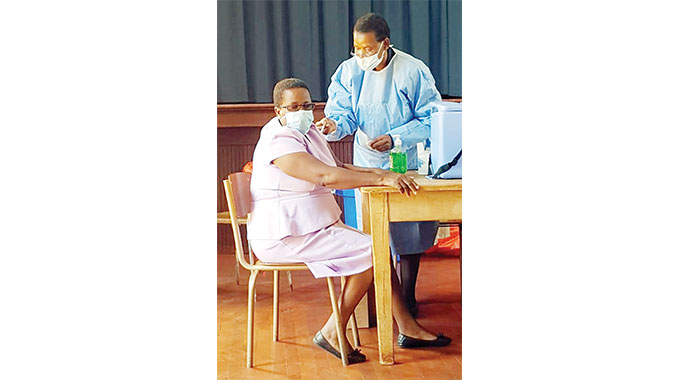
Chronicle Reporters
THE Covid-19 vaccination programme is spreading in the Midlands and Matabeleland provinces with teachers, lecturers and people in rural areas being inoculated.
The vaccination exercise entered the second phase this week, with teachers and lecturers getting their jabs.
Frontline workers who attended the first phase of the vaccination programme have started receiving their second jab.
President Mnangagwa got his first dose in Victoria Falls on Wednesday last week when he a launched the country’s second phase of vaccination programme targeting security service personnel, Judicial Services Commission staff, teachers and those who are chronically ill.
The development comes at a time when the country is receiving more vaccines.
Bulawayo provincial medical director Dr Welcome Mlilo said phase two of the programme kicked off this week and it was received with a lot of enthusiasm.
“The second phase has seen teachers, lecturers, judicial service members and those with chronic conditions begin to access the vaccine. Yesterday, for example, saw the number of those getting dose 1 of the vaccine go beyond 1 000 people in just one day,” Dr Mlilo.
“There are several vaccination centres in schools e.g Milton High where teachers are presenting for vaccination. We also received additional doses of both Sinopharm and Sinovac vaccines yesterday.”
Dr Mlilo said the vaccination exercise is gathering steam as more people can now access the vaccine.
“I do not have permission to share with you how many people have been vaccinated so far in Bulawayo and cannot readily share our targets,” he added.
Speaking on the sidelines after receiving her jab at Milton High School on Monday, Bulawayo provincial education director Mrs Olicah Kaira said the development had brought a lot of excitement to teachers and pupils.
“We are experiencing a very good turnout; people are very excited about being vaccinated. We are grateful for this and we trust that as it continues being rolled out our children’s parents and teachers will be protected from the deadly virus as schools have opened,” she said.
At the Small City Hall yesterday, Mr Adam Omar a frontline worker who works at a city laboratory said it was important for members of the public to understand the importance of vaccination.
“I have just received my second jab. I did this so that I am immune to the virus but not only for myself but the people I meet, the vulnerable and the general public. It’s important for the public to understand the importance of vaccination so that country can achieve the herd immunity,” he said.
A nurse, Gugu Simango from who works at Population Services International, said people must overcome the fear which is even prevalent amongst frontline workers.
“I was receiving my second jab. There are so many myths and conceptions about the vaccines, even amongst us frontline workers. I was afraid for the first time. After taking the first dose I had some reactions like headaches and fever for three days but I believe that was the immune response. It then disappeared,” she said
The nurse said vaccinating is the way to go as many new strains are coming and no one knows when this will end.
Mr Danisa Dube, a security guard with Bulawayo City Council who was in the observation area after receiving the jab, said vaccination was crucial in his line of work.
“This is my first jab, I took this decision just to protect myself. This is a worldwide action so I cannot be left behind. I work with people every day and the risk is high. I urge members of the public to make use of the opportunity given now since its free,” he said.
In Matabeleland South, the vaccination programme has reached some rural areas.
Among rural dwellers vaccinated are those who work in shops that have been operational even during the strict lockdown imposed at the start of the year.
As of last week, on Friday, the province had managed to vaccinate 2 442 people against a target of inoculating 5 283 frontline workers in the first phase.
The first phase of the vaccination programme ended on March 25 in the province while the second phase started on Monday.
According to the provincial vaccination statistics as of March 25, Beitbridge vaccinated 468 against a target of 1 402, Bulilima vaccinated 198 from a against of 198, Gwanda vaccinated 503 against a target of 1 702, while Insiza vaccinated 324 against a target of 462. Mangwe inoculated 293 against a target of 586, Matobo 351 against 582, while Umzingwane vaccinated 305 against 367.
In Manama, most health workers received their jabs at Manama Hospital.
A number of teachers from Manama High School and those who work in shops at Manama Business Centre also took their first jabs.
A businessman from Manama Business Centre,only identified as Bangane, who had taken his first jab said he took it as a responsible citizen.
“I decided take the vaccine because I am a responsible head of the family and also a business person.
“I and my family mingle with different customers on a daily basis and that shows us the need to play out part in fighting the spread of Covid-19,” said Bangane.
A shop attendee, who spoke on condition of anonymity, rubbished claims that the vaccine is unsafe as she said hours after taking it, she has had no complications.
“Unlike the stories that we hear from some people that the vaccine is not safe and causes too much side effects, I would like to say that this is all untrue.
“I have received my first vaccine and I am feeling normal and even more energetic than I woke up,” she said.
Matabeleland South provincial maternal, neonatal and child health officer Dr Nobert Sengeni, who is the acting Matabeleland South provincial medical director, said vaccination will help eradicate the spread of Covid-19.
“Well, the low uptake up to now could point out to unknown fears and myths by health workers which need to be addressed. As such, I appeal to them to come forward using our different platforms to relay their concerns about the vaccination exercise.
“It’s now a month since we started this vaccination campaign and the good news is, we haven’t had adverse events following immunisation.
This can also be a wake-up call even to the doubting Thomas that the vaccine is safe. I still encourage front line workers to get them vaccinated so that we reach the critical mass for herd-immunity quickly. Some teachers it’s possible they have started to be vaccinated under phase one mop up of vaccine since the uptake was still low.”
In Victoria Falls more than 17 000 people had received the first dose of Sinopharm by Monday.
The Victoria Falls population is estimated around 40 000, up from 33 000 recorded in 2012 when the last census was held.
Minors below the age of 18 as well as pregnant women and breastfeeding mothers are not being vaccinated.
Those who are chronically ill also have to be checked by medical personnel before being jabbed.
Government is rolling out the mass vaccination of all eligible residents of the country’s prime resort city on Monday last week, and eight days later, 17 452 had been vaccinated.
This includes 9 528 males and 7 924 females.
The mass vaccination is being done at static sites namely Victoria Falls Hospital, Chinotimba Clinic, Zimbabwe Aids Project (ZAP) Clinic, ZRP Camp Clinic and Truck Stop Clinic.
There are also mobile sites at hotels, companies and on the streets in the city centre.
In Victoria Falls, the mass vaccination programme targets all eligible residents regardless of profession or social status as Government seeks to ensure health safety so as to boost confidence in travelers to visit Zimbabwe.
Matabeleland North provincial medical director Dr Munekai Padingani said the mass vaccination was confined to Victoria Falls residents only for now, while those being vaccinated in surrounding rural areas are frontline workers targeted in the country’s second phase.
“The mass vaccination is for now being done in Victoria Falls for anyone who is willing and eligible. Uptake has been very good so far as we see numbers growing. The programme is still on and the cumulative number as of Monday was 17 452. We continue to encourage all eligible people to come and get vaccinated against Covid-19,” said Dr Padingani.
He said there have been no incidents of people complaining of side effects so far.
“This only confirms that Government cannot go all out to bring a wrong vaccine to its people,” said Dr Padingani.
He said vaccination sites remain open for the exercise to continue and mobile teams will be available on request from respective companies.
Between Monday and Friday last week, both static and mobile sites were open and there were long winding queues as people sought to get jabbed despite the negative campaign from some sections of social media denouncing the vaccine.
In the Midlands, acting Midlands provincial medical director Dr Reginald Mhene said they had received more doses and were distributing the vaccine to districts across the province.
He could not immediately give statistics on the programme.
“We have been distributing the doses to all eight districts in the province to necessitate the vaccination of those who fall under the phase two of the vaccination programme. Besides the first dose, we are also giving a second dose to those who received their first dose,” he said.
Dr Mhene said they have increased the number of sites unlike the first time where only outreach groups were vaccinating people.
“We have also ensured that clinics and other health facilities can also be used as vaccination centres unlike the first time,” said Dr Mhene.
The Ministry’s director of communications and advocacy Mr Taungana Ndoro commended Government for extending the vaccination exercise to teachers.
“The Ministry of Primary and Secondary Education is pleased with Government efforts that have seen the vaccination programme being extended to teachers. It started with the permanent secretary who took her vaccine in Harare together with several teachers union representatives showing collective prudence,” said Mr Ndoro.
“We expect that as more vaccines keep coming, more teachers will come on board in order to prevent and manage the spread of Covid-19 in the country.”



 Online Reporter