Online Reporter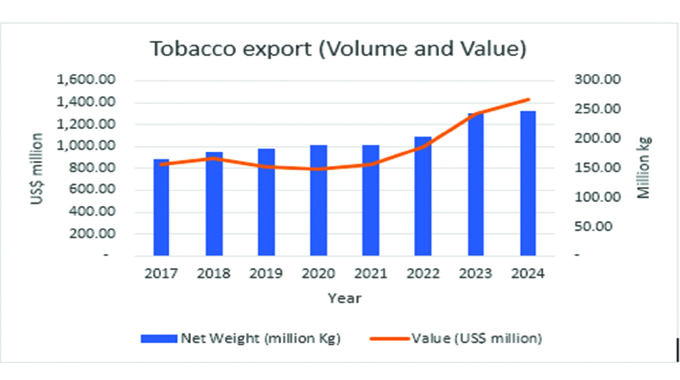
Edgar Vhera
Specialist Writer — Agribusiness
THE three-week reprieve given to tobacco growers to clear their fields of tobacco stalks and roots ended on June 5 and Government is now monitoring compliance with offenders being fined to protect the industry.
Department of Research and Specialist Services (DR&SS) chief director Dr Dumisani Kutywayo said the Plant Quarantine Services Institute (PQSI) and Agricultural and Rural Development Advisory Services (ARDAS) had a monitoring programme to ensure that stalk destruction is done.
“In the event of non-compliance, some fines are imposed as per regulations,” he said.
Announcing the extension last month Lands, Agriculture, Fisheries, Water and Rural Development Minister, Dr Anxious Masuka said contravening the stalk destruction regulations attracted a fine not exceeding US$100 for each hectare or part thereof in respect of which the offence is committed or imprisonment for a period not exceeding one year or both fine and imprisonment for the first offence.
“A second or subsequent conviction will attract a fine not exceeding US$200 for each hectare or part thereof in respect of which the offence is committed or to imprisonment for a period not exceeding two years or both fine and imprisonment,” he added.
The extension was granted from May 15 to June 5 only for the 2024/25 season to cater for the late planted crop due to the delayed start of the season.
The Minister said all growers were required to adhere to all other dates to prevent the carryover of pests and diseases. However, those who are not able to meet this stipulated deadline are requested to apply for an extension to keep their tobacco in the fields.
This should be addressed to chief director responsible for the National Plant Protection Organisation of Zimbabwe prior to the cutoff date.
The Plant Pests and Diseases (Tobacco) Regulations Statutory Instrument (SI) 711 of 1979 as amended, was created to reduce incidences of pests and diseases in tobacco crops, especially the viruses that are vectored by aphids, white flies and thrips.
These viruses may result in the production of poor-quality leaf. The insect vectors transmit the viruses during their feeding from one crop to another and from one season to another.
The viral diseases of importance include tobacco bushy top virus (TBTV), tobacco streak virus (TSV), potato virus Y (PVY), tobacco leaf curl virus (TLCV), tomato spotted wilt virus (TSWV) and cucumber mosaic virus (CMV).
The wide host range of such diseases like TLCV, CMV and TSWV ensures numerous natural hosts of the virus in which the virus survives and from which it can be spread by the vectors.
Depriving the insect vectors of their host (tobacco) is the most effective way of controlling their multiplication.
The tobacco value chain contributes significantly to the agriculture gross domestic product (GDP) and export revenues thereby aiding national economic growth. Tobacco production supports up to 160 000 households and accounts for more than 50 percent of agricultural exports and between 14 and 20 percent of the agriculture GDP.
Statistics from Zimbabwe National Statistics Agency (ZimStats) showing that tobacco export earnings rose from US$1 297 280 021 in 2023 to US$1 427 109 343 last year.
In order to safeguard the country’s lucrative market, tobacco stakeholders are required to observe the tobacco regulations, as this is the basic measure required to meet phytosanitary requirements for market access and trade of the commodity.
Pest-infected tobacco products are not marketable and hence the observation of these phytosanitary measures is critical for the country’s market access, trade and the protection of the industry from pests and diseases.