


 admin
admin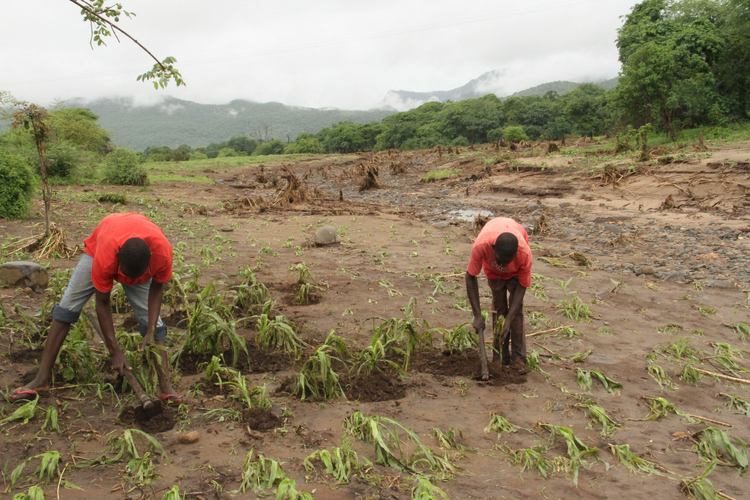

Despite these close shaves with death, the villagers whose lives are at the mercy of the floods, are not entertaining thoughts of one day abandoning their homes and finding a much safer place.
The Mavuradonha Mountains, which are located some 180 kilometres north of Harare, are a well-known tourist attraction.
Famed for the cool, moist weather, elephants, zebras, lions and eland, among other animal species, freely roam the wild, rugged terrain.
Several bird species also call this heavily-wooded and scenic area home.
Hiking, mountain climbing, bird watching, camping and scenic walking are some of the activities that can be undertaken.
Until recently, most parts of the mountain range were not inhabited since the area was declared a game reserve.
In 2010, however, close to 30 families illegally settled themselves on the foothills of the mountain range at a place which is adjacent the Muzarabani Growth Point.
The illegal settlement, now known as Chitimbe Village, is a hamlet which is located at the confluence of the Mukorodzi and Musengezi rivers.
Since the villagers parcelled land for themselves, they have had sleepless nights as they struggle to keep away the marauding wild animals. And they have been attacked and maimed by the wild animals.
Recently, a villager was viciously attacked by a crocodile as he tried to cross the Musengesi River.
Apart from the wild animals, the risk of flooding always haunts the villagers.
Early this year, a local villager, Weston Nyadimbo, his two wives and 10 children were, for close to 10 hours, marooned on the banks of the flooded Musengezi River. The family was forced to spend the better part of the night clutching onto tree branches as the river’s rising waters threatened to sweep away the entire family.
Although the villagers’ homes are located on higher ground and, therefore, not subjected to flooding, the villagers plant their crops on the river banks, where they spent most of their time.
The two rivers have their sources in Mvurwi and whenever heavy rains fall upstream, the rivers often burst their banks, subjecting the villagers tending the fields to severe flash floods.
For the better part of the rainy season, the fields are often cut off from the rest of the other villages.
Without shops, clinics and other basic social services, villagers are often forced to swim across the flooded rivers, often resulting in drowning and crocodile attacks. Close to 20 hectares of the villagers’ fields were swept away by floods in January and are now part of the river bed.
During school days, the few children that go to school will temporarily leave their parents and live with friends and relatives at the growth point.
Over the years, the Civil Protection Unit has often sent helicopters to rescue some of the villagers who would have been marooned on the river banks. The villagers have scoffed suggestions by the Government to allocate them land elsewhere.
Despite these close shaves with death, the villagers whose lives are at the mercy of the floods, are not entertaining thoughts of one day abandoning their homes and finding a much safer place.
Mr Lameck Adhaki, a professional hunter who has rescued some of the villagers from animal attacks, is puzzled by the villagers’ resilience.
“Lives have been lost as the villagers grapple with animals. Some have drowned whilst crossing the flooded rivers. Despite the tragedies, the villagers still want to stay here,” Mr Adhaki said.
Locals believe that the land is sacred and have vowed to stay.
“This land used to be the headquarters of such spirit mediums as Mbuya Nehanda, Chidyamauyu, Chiwawa and Mkombwe. We are the guardians of the spirit mediums and we settled here to safeguard the medium spirits. We cannot simply run away from our heritage,” said Alfred Takamanikwa, one of the villagers.
Mrs Edna Kajengo, another Chitimbe villager, concurred with Mr Takamanikwa.
“This is the land of our forefathers and this area is sacred. We cannot separate ourselves from this land. Come what may, we will not leave this place,” Mrs Kajengo declared.
According to Mrs Kajengo, a spirit medium, Watigere, was the first to settle at the confluence of the rivers well before the beginning of the liberation struggle. Mrs Kajengo said misfortune befell the spirit medium whom she said abandoned his home and trekked south to Chadereka village.
The villagers claim that they were instructed by their ancestors to return to Chitimbe.
Interviews with some of the villagers, however, indicated that the majority of them are attracted to the area by the rich alluvial soils that constitute the two rivers’ flood plains.
Each time the rivers burst its banks, rich top soil from such upstream areas as Mvurwi and Centenary are deposited into the villagers’ fields, making them very fertile.
“I was once tempted to relocate to this village. The soils are rich and one is assured of a bumper harvest. However, after considering the fact that the area is mostly inaccessible and does not have shops and clinics, I decided against the idea,” said Mr John Maramba, who lives in nearby Kuchera village.
Most crops thrive in this area and some of the farmers are now putting their crops under irrigation. Stream bank cultivation is practised throughout the world as farmers are attracted by the rich soils.
Historically, the world’s first great civilisations arose in the fertile flood plains of the Nile in Egypt, the Indus in southern Asia, the Tigris and the Euphrates in the Middle East, and the Huang (Yellow) in China.



 Online Reporter