Online Reporter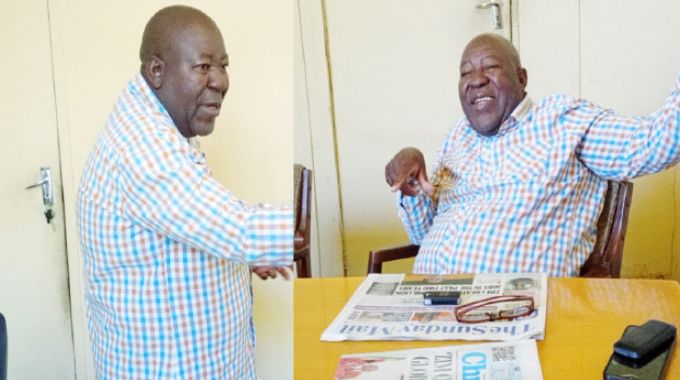
IN the history of Zimbabwe’s armed struggle against the rebel Ian Smith regime, few families stand out quite like the Petshu family. Rooted in the Gwatemba farming area of Insiza District in Matabeleland South Province, the family made a rare and remarkable contribution to the liberation struggle by providing fighters to both of the country’s nationalist military wings, ZPRA and ZANLA.
The brothers sired by Petshu Sibanda, a respected businessman, farmer, transport operator and cattle rancher, sent four sons into the liberation war. Two crossed into Zambia to join ZPRA, while the other two went to Mozambique to fight under ZANLA. Last Thursday, our Assistant Editor, Mkhululi Sibanda (MS), spoke to one of the brothers, Cde Jabulani Petshu Sibanda, a household name in Matabeleland South politics and the self-styled leader of farm occupations during the height of the land reform programme at the turn of the millennium. Cde Sibanda, who served in ZAPU’s intelligence wing, the National Security Organisation (NSO), headed by the late National Hero Cde Dumiso Dabengwa, spoke candidly about his family background and the events that pushed the four brothers into the armed struggle.
However, whenever the conversation turned to his father, the usually tough and outspoken former freedom fighter revealed a softer side. At times he appeared close to breaking down as he recounted the sacrifices made by his father in supporting both ZANLA and ZPRA fighters. In June 1979, armed men abducted his father from the family home at night. He was never seen again. Despite years of searching, the family has never located his grave.
Below are excerpts from the interview:
MS: As is customary, let us begin with your background, Cde Sibanda.
Cde Petshu Sibanda: I was born on 6 August 1957 in Gwatemba, Filabusi, in Matabeleland South Province. My father, Petshu Sibanda, was a successful businessman in Gwatemba. The area was part of the African Purchase Areas which was medium commercial farming territories, where black Zimbabweans who could afford it bought land during the colonial era. Another well-known African Purchase Area was Somnene in Bulilima District. Without boasting, my father was a wealthy man. He operated shops and grinding mills in both Insiza District and neighbouring Mberengwa District, then known as Belingwe. Besides that, he owned a bus company called Thembalethulinye. He was also involved in cattle ranching and regularly transported cattle to Bulawayo for sale. In his cattle business, he worked closely with prominent businessman Cde Sivako Nleya, who operated butcheries in Bulawayo.
MS: During an interview I conducted a few years ago, war veteran and former Zanu-PF Director-General Cde Dickson Dzora spoke highly of your father. He said he was fully committed to the liberation struggle and supported guerrilla fighters.
Cde Petshu Sibanda: That is true. Besides supporting the struggle, my family contributed four sons to the war. My elder brother Douglas and I joined ZPRA, while my other brothers, Kipro and Ndabaningi, joined ZANLA. Sadly, Ndabaningi was killed in Mozambique during a Rhodesian raid. Ours must be one of the few families that contributed equally to both liberation movements.
Despite all his efforts, my father was abducted in June 1979 by armed men who arrived at our home at night. Some reportedly spoke iSiNdebele while others spoke ChiShona. We have tried everything possible to locate his grave, but without success. To this day, we do not know who killed him, whether it was ZPRA or ZANLA guerrillas. However, there is a strong possibility that those people were Selous Scouts.
MS: That was very unfortunate Cde Sibanda, sorry about it. Before we proceed, let us return briefly to your early life.
Cde Petshu Sibanda: I began my schooling at Zvishavane Primary School, where I went up to Grade Five. Zvishavane Primary School was located within the Gwatemba area. I later moved to Bungwe for Grades Six and Seven.
For Form One, I came to Bulawayo and attended City Tutorial College, which was headed by a white man, Mr Skews. Most of the staff there were also white. While in Bulawayo, I stayed in Pelandaba, where my father owned a house. We were neighbours to Joshua Nkomo, Stephen Nkomo and Joseph Msika. In fact, my father was close to those nationalist leaders. At the time, Pelandaba commonly known as Number Six — was home to many members of the black elite. Social life revolved around places such as Ikhwezi Cocktail Bar, where patrons were expected to dress formally in jackets and ties. After my secondary education, my father, who was also friends with P. Hall of the famous Shue-Shine Bus Services, encouraged me to study motor maintenance. He wanted his sons to participate in the family business.
I later did my apprenticeship at Mr Kidd’s garage in Zvishavane before joining the family business in Gwatemba in 1974.
MS: Take us through how you became involved in the armed struggle. You were obviously exposed to nationalist politics through your father.
Cde Petshu Sibanda: In Gwatemba we were neighbours to prominent farming families such as the Khutshwekhayas. I am referring to the family of the late National Hero, former Bulawayo Mayor and Zanu-PF Politburo member, Cde Naison Khutshwekhaya Ndlovu. Naison and the father of the well-known ZPRA instructor Tennyson Ndlovu, popularly known as Thambolenyoka, were brothers. From that family came five boys who participated in the armed struggle, Thambolenyoka, Taizen, Charles, Mitsho and Major.
Like us, they were relatively privileged, having grown up in the African Purchase Areas with access to better life and opportunities. However, they also came from a politically conscious and militant family. What really influenced us was my uncle, Lithern Sibanda, who joined the armed struggle and was later deployed to Mozambique from Zambia as part of a ZPRA contingent attached to the Zimbabwe People’s Army (ZIPA), a joint ZPRA-ZANLA military structure. When the arrangement collapsed and ZPRA withdrew, Lithern and his unit, which included the famous Nicholas Nkomo, also known as Gilbert Khumalo, who now lives in Kezi, travelled back through the country en route to Zambia via Botswana. Around Zvishavane, near Chief Mafala’s area, they engaged Rhodesian forces in a fierce battle. Although the guerrilla unit comprised only about six fighters, they resisted bravely. The Rhodesians even deployed helicopters in an attempt to pin them down, but they managed to break through. During the battle, Lithern was shot in the leg, which became a serious problem. Because of his family connections, the unit sought refuge at the Khutshwekhaya farm, where they also left some of their war material. That incident brought severe repercussions upon the Khutshwekhaya family and attracted the wrath of the colonial authorities. Such experiences opened our eyes and convinced us that we too had to join the armed struggle.
ν To be continued next week as Cde Petshu Sibanda recounts how he joined the armed struggle, his arrival in Botswana, and how he escaped a Rhodesian raid that resulted in the capture of ZPRA Southern Front commander Cde Makepesi Tshuma and some NSO operatives.