happiness Chikwanha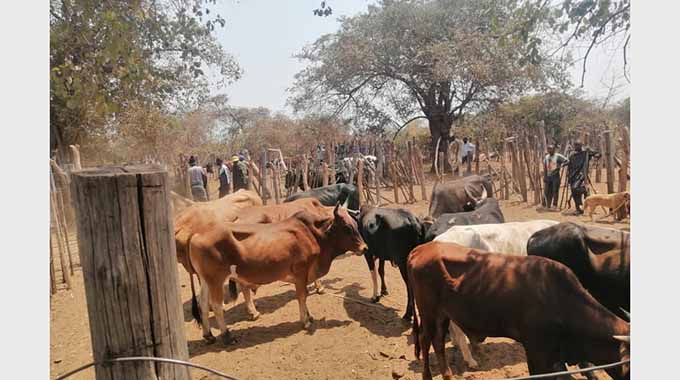
Edgar Vhera Agriculture Specialist Writer
FOLLOWING recent reports that 2 392 head of cattle had died in the western and southern regions of the country due to the El Nino-induced drought, the Food and Agriculture Organisation of the United Nations (FAO) has moved to partner Government in instituting measures to control the problem.
Most of the animals succumbed to malnutrition due to depleted grazing and diminished water resources.
The Government has since moved in to drill boreholes in affected areas, increase delivery of temporary water resources to most hit areas through bowsers and enhance supply bales of wheat stalks to food insecure areas among other measures.
FAO communications specialist Mr Donald Chidoori said his organisation, under the European Union (EU) funded enhanced resilience for vulnerable households in Zimbabwe (ERVHIZ) project, was equipping farmers with skills and tools to prepare animal feeds well in advance by producing fodder crops, on-farm feed formulation and stock up on hay and crop residues.
He said they were training farmers on how to increase the nitrogen content and nutritive value of low-protein roughages using urea treatment and supplementation, which allows animals to use the energy more readily in existing food, as well as through adding molasses and salt.
“More than 17 000 farmers in six districts of Matabeleland South are being trained to produce, collect and conserve available materials of fodder crops including velvet beans, leucaena, and lablab. Farmers are also being encouraged to produce adequate grain crops for their livestock, like sorghum and maize, based on their livestock numbers and feeding plans,” he said.
FAO currently has 731 functional fodder demonstration plots most of which have completed land preparation for the 2023/24 season. At least 288 male and 443 female farmers are managing the plots jointly.
“These demos have supported and continue to support 17 125 farmers who accessed fodder seed in the 2021/22 season. Lablab and velvet beans seed was accessed by 6 927 farmers with 4 640 of them receiving forage sorghum seed. Amongst these, 685 lead farmers received seed of all types,” Mr Chidoori added.
There has been an overall 35 percent increase in fodder production from 10 percent as a result of these initiatives with Mangwe leading at 61 percent followed by Bulilima at 41, he said.
A total of 3 682, 70 tonnes of fodder with the capacity to feed 5 114 cattle for two months, using an average of 12 kilogrammes per bale were produced and baled for 2022/23. Lablab constituted 78 percent of the total fodder bales with velvet beans constituting 21 while sorghum had one.
The ERVHIZ programme seeks to see 6 000 farmers getting lablab seed in the 2023/24 season. Velvet beans, lucerne, and lablab are high in protein, which is often deficient in dried-out veld grazing in the dry season. During this time, the crude protein content can be as low as 2,50 percent versus a minimal requirement of around 7 percent for grazing animals to maintain good body condition.
Fodder crops are a cost-effective source of nutrients for animals. They are easy to digest, help with weight gain, increase life expectancy, especially with dairy cows, and increase the hoof health of the animal, which generally benefits the overall health of the animal.
FAO’s feed formulation interventions are not only contributing to the Government’s strategy for livestock development but a key intervention in ensuring that farmers save livestock from drought-induced starvation.
To help farmers find alternative materials for livestock feed, ERVHIZ is promoting agro-pastoral field schools (APFS) for range-land management and fodder production, processing and marketing.
Sixty extension officers facilitated the establishment of 93 livestock farmer field schools (FFS) in which 2 059 farmers (1 341 females) and 272 community-based facilitators (CBFs) and lead farmers (178 females) are participating.



 Online Reporter