Online Reporter
PATRICK CHITUMBA, [email protected]
FACED with the relentless onslaught of the African armyworm ravaging parts of the Midlands Province, Lingiwe Ravasingadi, a forward-thinking farmer from Kwekwe, has turned to a sophisticated weapon — drone technology.
Drone technology, also known as unmanned aerial vehicle (UAV) technology, utilises remotely controlled or autonomous flying devices equipped with advanced sensors, cameras and sprayers to monitor and manage crops.
In pest control, drone technology enables farmers to efficiently and precisely spray pesticides or insecticides on affected areas. Equipped with GPS navigation and advanced sprayer systems, drones can fly over fields, detecting and targeting specific areas infested with pests such as the African armyworm.
This targeted approach minimises chemical usage, reduces environmental impact, and optimises pest control.
Despite the challenges posed by the pest, Ravasingadi remains optimistic about achieving significant yields per hectare. Meanwhile, the persistent heavy rains nationwide have provided a welcome boost, enhancing prospects for a bountiful harvest.
Ravasingadi expects an impressive average yield of 10 tonnes per hectare from her 120-hectare maize crop, now at the milking stage. Her success is attributed to the adoption of best farming practices, with drone technology proving a game-changer in effectively controlling the persistent fall armyworm infestation, thus safeguarding her crop.
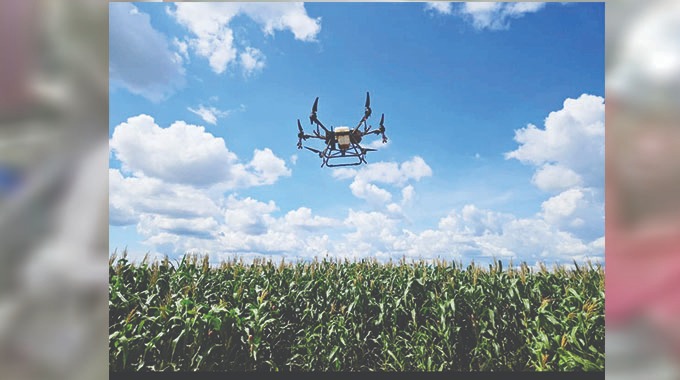
“In a bid to fight pests such as the African armyworm, we decided to use drones so that we effectively cover the 120 hectares which are under the maize crop. The crop has reached the milking stage and if we successfully deal with the armyworm, we are expecting an average yield of 10 tonnes per hectare,” she said.
Ravasingadi attributed the positive outlook to the implementation of sound agronomic practices, with drone technology playing a crucial role in managing the persistent fall African armyworm threat.
“The drone is very effective in dealing with pests. Our crop had grown so much that the boom spray was no longer viable to use. However, with the use of drone technology, we have managed to deal with the problem of the armyworm as it managed to penetrate the plants. We are happy with the good bill of health being presented by our crop at the moment,” she said.
Ravasingadi said the company they are using for drones is quite reasonable, charging US$20 per hectare.
“This is reasonable if we compare to what we would have spent if we had sprayed with a tractor and boom spray. The drone is also faster. The drone company we are using is from Harare as there are none in Kwekwe,” she said.
Ravasingadi said other than the 120 ha under maize, this season, they also have half-a-hectare of Proteas flowers.
She said she started taking farming as a business three years ago and has been realising substantial returns from the venture.
“At the moment we only have 30 employees and if we grow, there is potential to employ more thereby benefiting the local community,” she said.
The acting chief director of Agriculture and Rural Advisory Services, Leonard Munamati, encouraged farmers to embrace the use of technology to derive maximum benefits from their crops.
“We now encourage other farmers to use drone technology to control pests as this is very effective,” he said.
The Government has since acquired 10 drones, which were distributed countrywide to fight pests as the Second Republic continues to capacitate farmers to guarantee food security.
Midlands Provincial Director Ardas, Busiso Olga Mavankeni, said they have received reports of an outbreak of African armyworm in three districts.
“We have received reports of African armyworm outbreak in Chirumhanzu, Zvishavane and Mberengwa,” she said.