Theseus Mauruki Shambare-Features Writer
WHEN Clever Matutu graduated from Chibero Agricultural College and arrived at a farm in Lalapansi, near Gweru, Midlands Province, in 1995, he had little more than farming knowledge, ambition and an opportunity to build a career.
Employed as a farm manager by the previous owner, Nigel Shaw, the young graduate could hardly have imagined that the fields he was entrusted to manage would eventually become the foundation of his own agricultural enterprise.
Three decades later, Matutu, now 56, is still on the same farm, but his circumstances have changed considerably.
Through the Government’s Land Reform Programme, he secured the farm he had spent years managing, transforming himself from an employee into a beneficiary of land reform and an established commercial farmer.
His 31-year journey has been one of perseverance, resilience and reinvention, with agriculture providing the means to build wealth, acquire properties and educate his children.
In 1995, however, he was simply a young graduate taking his first steps into the agricultural sector.
“I was managing this farm from 1995 after graduating from college. I got a job here,” he recalled during an interview recently at his farm.
His journey took a major turn in 2008 when Shaw decided to relocate to Australia.
The farm had two sections, and both men subsequently obtained Government offer letters for their respective portions, although they continued operating as one farming unit.
For Matutu, the development presented an opportunity to move beyond managing someone else’s agricultural operations and establish himself as a farmer in his own right.
Rather than abandoning the profession he had spent more than a decade learning, he chose to remain on the land and build his future through agriculture.
Today, his farming operations revolve around wheat, soya beans and maize, with crop rotation helping him manage the different demands of production.
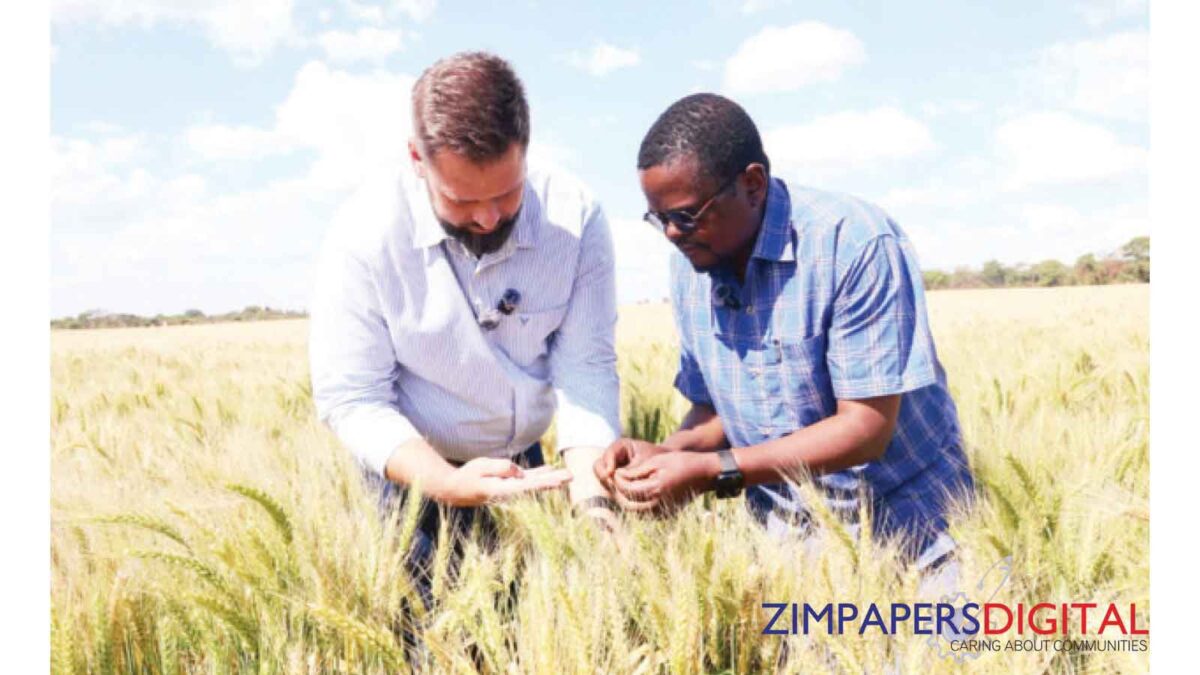
His latest winter wheat crop occupies 50 hectares, with expectations of harvesting at least eight tonnes per hectare.
Although this is an ambitious target, Matutu has established a production record of at least six tonnes per hectare, demonstrating the potential of his farming operation.
The promising crop is a product of deliberate planning rather than chance.
Following the harvesting of soya beans, he adopted minimum tillage, spreading wheat seed and cereal blend fertiliser before using disc harrows and a roller to prepare the field.
“We applied 120 kilogrammes of seed and 500 kilogrammes of cereal blend fertiliser per hectare, with rolling intended to improve seed-to-soil contact and promote uniform germination,” he said.
Water security is another important component of his operations.
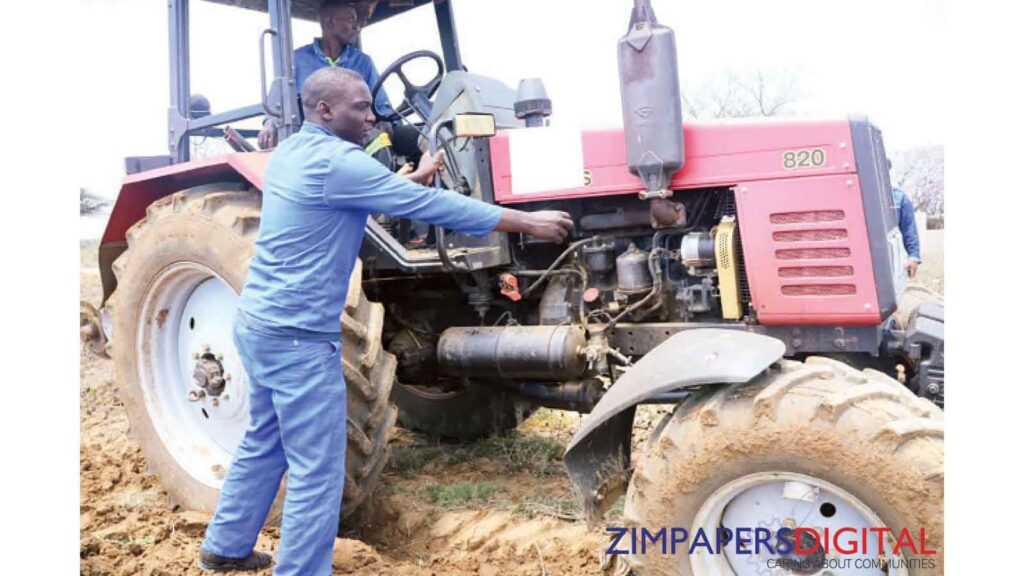
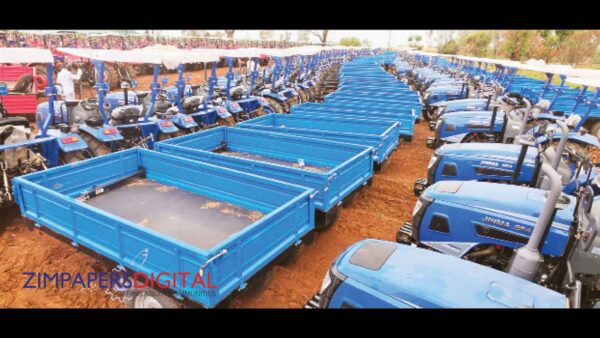
Mr Clever Matutu is also a beneficially of the 2 000 Belarus tractors under the agricultural mechanisation programme, which includes more than 90 combine harvesters that were deployed around the country.
A dam located approximately 1,5 kilometres from the fields supplies water through a gravity-fed system before it is pumped in two stages, first into a reservoir and then under pressure into the centre pivots.
Such investments infrastructure, coupled with mechanisation and careful crop management, have helped sustain his agricultural enterprise.
But Matutu’s experience also illustrates the importance of access to agricultural equipment in building productive farming businesses.
He credits the Belarus-Zimbabwe agricultural mechanisation programme with improving farmers’ access to machinery that would otherwise be difficult to acquire.
“It is a wonderful deal. It is a dream come true for farmers. We have been praying for a deal like this so that we have enough equipment,” he said.
“It is not easy to be able to afford a new tractor, but through the deal signed by President Mnangagwa and the Belarusian Government, we have got these Belarus tractors, which are quite good, powerful and dependable.”
His remarks come as more than 2 000 Belarus tractors have been supplied under the three phases of the agricultural mechanisation programme, alongside more than 90 combine harvesters deployed around the country.
For farmers working on substantial hectarages, access to reliable machinery can make a significant difference to land preparation, planting and harvesting schedules.
For Bison Agro Machinery marketing director Andrei Kleinov, the real measure of the Belarus-Zimbabwe partnership lies in what the equipment is helping farmers achieve in the fields.
While the cooperation is often discussed in terms of diplomatic relations, machinery deliveries and service infrastructure, he believes its practical results are increasingly visible on Zimbabwean farms.
“When I visit the farms where Belarus tractors are working and see this type of wheat that has been grown and is still growing with the help of Belarus equipment, I understand that all we are talking about is not only about politics or conversations, but also real results we can see in real Zimbabwean farms,” he said while assessing the golden-coloured crop ripe for harvest.
Kleinov’s observations provide another perspective on the relationship between agricultural mechanisation and production, with farmers such as Matutu demonstrating how access to equipment can complement irrigation, technical knowledge and sound farming practices.
Yet, beyond the machinery and promising wheat crop, Matutu measures his success through what agriculture has enabled him to achieve away from the fields.
Over the years, he has acquired a fleet of six vehicles, built two houses in Gweru and purchased another 20-hectare property along Gweru Road.
He has also invested in his rural roots, constructing a home in Mberengwa, where he was born and raised.
For someone who began his career as an employee, these investments represent more than material possessions. They are tangible reminders of what three decades of commitment to agriculture have made possible.
Perhaps his greatest source of pride is the education of his children. One is an accountant, another a computer scientist, while his daughter is pursuing medical studies in Zambia.
“I have managed to send my children to school. I can say I have achieved quite several things through farming,” he said. “I did not go into mining or anything else. I have been a full-time farmer.”
But while Matutu has built his life around agriculture, the question of whether his children would follow in his footsteps has remained an important consideration.
Initially, none appeared particularly inclined towards farming, with each pursuing different professional interests.
His son Collin, an accountant, however, is beginning to reconsider the possibilities offered by agriculture after witnessing what his father has achieved.
“It was long back that I used to think bad about farming. But through what I am seeing through my father, I am realising that farming is now the way to go,” he said.
“Agriculture is a business and a high-paying one. Zimbabwe is an agri-based economy.”
Collin’s changing perception offers a glimpse into the potential for intergenerational agricultural transformation, where the experiences of established farmers can inspire younger people to reconsider agriculture as a viable commercial enterprise.
For Matutu, this is precisely the kind of development he would like to see. He admits he would have loved at least one of his children to learn farming from an early age and eventually follow in his footsteps.
However, he has allowed them the freedom to pursue their ambitions, while hoping that his experience will inspire a different appreciation of agriculture. His message to young people is that farming requires more than simply acquiring land or machinery.
It demands commitment, resilience, passion, and a willingness to learn.
“Farming is not for the faint-hearted. You need to be very strong, have a passion for farming, and be dedicated to it full-time. It is not a part-time job,” he said.
“To youths, I would say, we should catch them young so that they can get all the basics. By the time they grow older, they will have learnt quite a lot.”
At 56, Matutu has no immediate plans to abandon the profession that has sustained him for 31 years.
He lives and works on the farm, describing agriculture as a full-time commitment that demands his presence and dedication.
“I stay here, I sleep here, I play here, I work here,” he said.
From a young Chibero Agricultural College graduate employed as a farm manager in 1995 to a land reform beneficiary who has built assets and educated his children through agriculture, Matutu’s journey illustrates the possibilities farming can offer when combined with persistence, knowledge and investment.
And perhaps the most significant measure of his success is not simply the land he farms, the properties he has acquired or the harvests he produces, but the changing attitude of the next generation.
For a son who once looked down on farming, the fields that sustained his father for more than three decades are increasingly beginning to look like an opportunity of his own.
In Lalapansi, the story of a young graduate who once managed a farm for someone else has become a story of personal transformation — and a reminder that the seeds of the next generation’s ambitions can sometimes be planted by the achievements of the one before it.