

 Chronicle Editor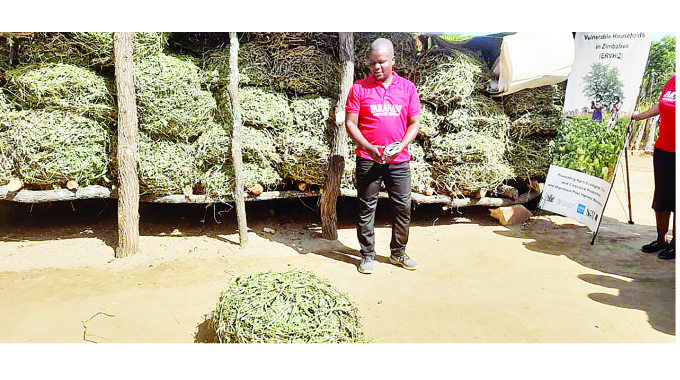
Yoliswa Dube-Moyo, Matabeleland South Bureau Chief
MORE than 2 000 farmers in Matabeleland South Province are set to benefit from a training programme on fodder bank and grazing land reinforcement.
The programme, which is being implemented by the Food and Agriculture Organisation in partnership with Unicef, is under the Enhanced Resilience for Vulnerable Households in Zimbabwe (ERVHIZ) initiative.
Some of the fodder crops to be grown include velvet beans and lablab as an alternative feed.
Through ERVHIZ, rural households’ resilience to food crises and climate change is enhanced as the programme is expected to contribute to the well-being of households in vulnerable situations in the face of economic and climate induced shocks and stresses.
In a report, FAO noted that a combination of underlying socio-economic constraints as well as the impact of external factors such as climate change and the Covid-19 pandemic are stretching the livelihood resilience of Zimbabwean communities. “FAO and Unicef are implementing an integrated project focusing on adopting principles of agro-ecology, access to local markets and community water, sanitation and hygiene (WASH) and nutrition interventions. This is envisaged to alleviate a “long term” crisis of chronic malnutrition (stunting), whose national average is 26,8 percent, the short-term problem of wasting which is at 3,6 percent (2019 Zimvac), inadequate or unimproved basic WASH services for rural households as well as building households’ resilience to climate change and economic shocks,” read the report.
The report also highlighted that the performance of irrigation can be viewed with regards to the efficiency of the management process within the organisation in charge of providing irrigation and drainage services and the allocative and productive efficiency of resources employed in irrigated agriculture.
Recurrent droughts due to climate change have in recent years left most communal farmers exposed to risks of losing livestock due to depleting pastures.
This has seen most smallholder farmers, especially in the southern region of the country, grappling with the grim effects of losing their only source of wealth as herds continue to be wiped out.
In the context of rising costs of stockfeed in the formal markets, there have been growing calls to build capacity and resilience of smallholder farmers to preserve the national herd.
Insiza District is one of the livestock hubs in the province but has suffered reduced pastures over the years, especially in the communal southern parts while the north, which is made up of large commercial farmland, has an abundance of grassland.
Matabeleland South acting provincial agricultural officer, Mr Mkhunjulelwa Ndlovu said fodder production reduces costs, poverty death and improves the condition of livestock.
“We’re looking at the cost and resilience aspects. Stockfeed is very expensive. We’re saying if the smallholder farmer can produce their own fodder, they’ll cut on production costs. If the farmer is relying on rain-fed farming, fodder production becomes seasonal. He/she only grows fodder during the rainy season. The farmer will be trying to cut down on costs, reduce poverty death, improve the condition of livestock and increase stockfeed during the dry season.
“The farmer will also be improving on the nutrition aspect of all classes of animals. If the farmer is into breeding, he/she has to maintain the breeding stock, the bull, the heifers and the cows. If he’s into dairy, he’ll be more interested in milk production and in order to get more yields in terms of milk, you have to give your animal the right feed,” said Mr Ndlovu.
He noted that relying on commercial feed alone increases the cost of production.
“You end up not realising any business at all. But if you produce your own fodder, prepare it and feed your animal, you’re increasing your revenue and reducing costs of production. If you’re into irrigation, you can do fodder production throughout the year. That’s a climate smart approach to farming, especially for livestock production. You can also do pen fattening using the natural fodder or the irrigated pastures,” said Mr Ndlovu.
He said one of the advantages of growing fodder is that the farmer can keep a large herd on a small area.
“This is because you’ll be producing more biomass for your livestock so there’s high production in a small unit area. With fodder, you can harvest it, let it rejuvenate, harvest again and then preserve it. You can play around with security management and species that produce high biomass so you can get high yields,” said Mr Ndlovu. – @Yolisswa.



 Blessing Chizhande
 Online Reporter