Chronicle Editor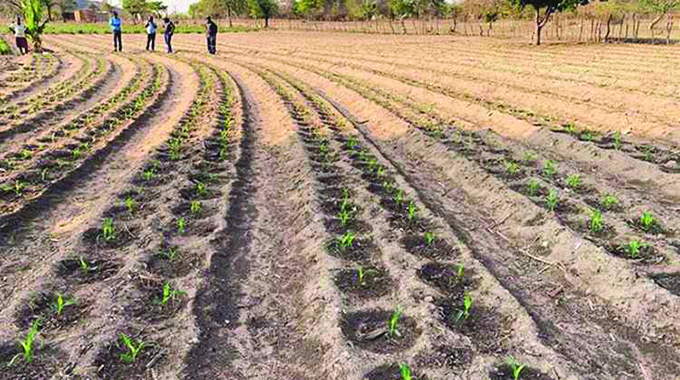
Sikhumbuzo Moyo, [email protected]
FARMERS have been urged to consider conserving water for the 2023/24 farming season as weather experts are predicting low rainfall over that period.
Government has already set its target of 3,7 million tonnes for cereals in line with the current push to ensure the country is food secure while there is also excess for industrial consumption.
The country’s agro-industries thrive on the availability of agricultural products to function at full capacity.
Climate change has affected the agriculture sector with calls for a return to traditional agriculture methods hinged on environmentally friendly farming practices which saw Government introducing the climate-proofed Presidential Inputs Scheme, popularly known as Intwasa/Pfumvudza.
The climate-proofed smart agriculture is an initiative of the Government’s green revolution agenda that seeks to build on the capacity of the country’s food systems to withstand the effects of climate change.
Intwasa/Pfumvudza is designed mainly for small-scale farmers and is benefitting households in the communal A1, small-scale commercial farming, and old resettlement sectors.
Intwasa is a concept aimed at climate-proofing agriculture by adopting conservation farming techniques and involves use of small plots and applying the correct agronomic practices for higher returns. The programme will support five Intwasa/Pfumvudza plots of 39m x 16m for each household with a standardised crop input package drawn from maize, sorghum, pearl millet, soya beans, sunflower, groundnuts, vegetables and cow peas.
In low potential areas, the five plots comprise three maize plots, one for family food and two to produce grain for sale, one plot on soya beans, and another plot under either sugar beans, groundnuts or cow peas. In low rainfall agro-ecological regions, three plots are put under cereals maize, sorghum and pearl millet.
The maize plot is for household food and the other two plots under traditional grains for sale. In the last farming season, the Pfumvudza/Intwasa programme benefited 3,5 million households, including a special smaller pack for 500 000 urban farmers.
Acting provincial director for agricultural rural development services for Bulawayo and Matabeleland North provinces Mr Dumisani Nyoni said with the onset of the farming season, farmers should dig planting holes and cover them with grass for them to hold moisture once it starts raining.
He assured farmers that Government is still committed to assisting them with inputs such as seeds and fertilizer.
“It’s time for early preparations for farming as we also project the rainfall patterns for the 2023/24 farming season. Our projections are that we are likely to have low rainfall, and farmers are therefore encouraged to harvest and conserve water,” said Mr Nyoni.
“Let’s dig small holes and cover them up using grass and once rains come, we then plant our crops. What I can promise our urban farmers is that Government is still committed to assisting farmers with inputs such as seeds and fertiliser.”
In the previous season, Bulawayo farmers harvested 5 000 tonnes of maize under the Intwasa/Pfumvudza programme.
Mr Nyoni urged urban farmers to plant their crops in designated areas.
Permanent Secretary in the Ministry of Lands, Agriculture, Fisheries, Water and Rural Resettlement Dr John Basera said Government has always been alive to the effects of climate change hence the deliberate and well-calculated thrust of climate-proofed agriculture benchmarked on irrigation and dam construction across the country.
He said prior to 2020, the country had 150 000 hectares under irrigation with 350 000 being the set target by 2025.
“As a country and as an agricultural economy we are on the point of promoting the climate proofing agenda especially climate proofing the food production climate space and agriculture as a whole which is very vulnerable to climate change effects and vulnerabilities,” said Dr Basera.
“Usually in two or three seasons, we are hit by drought and that is the reason why we are putting in concerted efforts and resources in terms of irrigation and rehabilitation and development. Prior to 2020, we had about 150 000 hectares under irrigation in the country, our target is to have 350 000 hectares under irrigation by 2025.”
Dr Basera said as of January 2023, about 203 000 hectares of land were under irrigation, and a number of programmes on climate-proofing food production sub-space aimed at ensuring food security with a slant towards food self-sufficiency and food sovereignty have been set up.
“We have Maka Resources 80 000 hectares facility which is targeting A2 farmers and 10 key programmes which are funded under the PSIP programming (Public Sector Investment Programme) which is intended to support and upscale efforts in terms of climate proofing thrust in the smallholder sector and those programmes are paying dividends,” he said.
“So far since 2020 we have developed and rehabilitated about 54 000 hectares under irrigation. Since 2019 we have invested US$2 billion in dam construction, water harvesting and irrigation development in the country.”
The Ministry of Lands, Agriculture, Fisheries and Water and Rural Development’s report on the country’s state of preparedness for the 2023/24 season indicates that this year’s focus was on increased productivity with the target areas for the major crops meant to grow 10 percent.
The thrust is to increase production per unit area, and not to drastically expand the cultivated area, the report said.
The report said that a target cereal production of 3 775 72 tonnes, with 3 060 00 tonnes of maize and 715 728 tonnes of traditional grains would be enough to meet the human cereal consumption requirement as well as the requirement of industrial uses and livestock feeds.
These projections can easily fail to materialise if producers do not plan and prepare properly with special attention being paid to what is happening globally both economically and in terms of climate.
Planning ahead of the season will also mean that farmers will not miss important deadlines, for instance, in planting that will allow their crop to utilise important basic requirements such as heat units that are abundantly available at the start of the season and recede as it progresses.


 Online Reporter