


 malvernmugadzikwa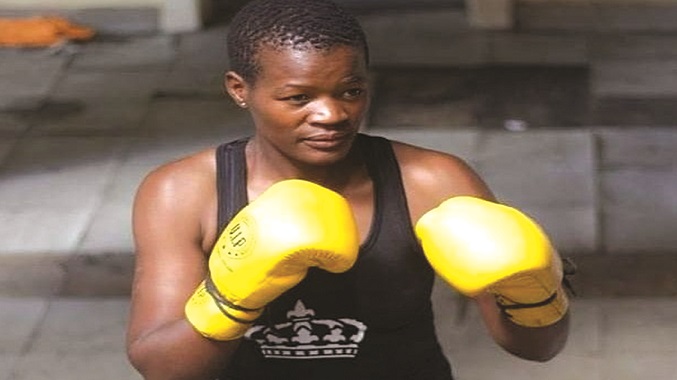
AT the age 40, Zimbabwe’s first female professional boxer, Monalisa Sibanda (pictured), who is nicknamed “Queen of the Jungle”, says she has lived a tough life to merit that moniker.
The jungle in her much younger life was in the form of an abusive stepfather, who treated her mother as a punching bag.
“He would come home drunk every night, beat our mother up terribly and because we were young, all we could do was scream for help, which sometimes took ages to come,” she said.
As a result of the abuse, Sibanda was robbed of the care she desperately needed.
She later turned to boxing to get even with her mother’s abuser.
“That’s what drove me to want to be a boxer; all in the hope that when I became experienced in the art of fighting, I would seek revenge for my mother by beating up her abuser.
“However, fate had other plans and that never happened. But I still went on to take boxing, anyway, and here I am, making a little living out of it, though I feel things could have been a lot better.”
Her second jungle was her own short-lived marriage. It was cut short after her best friend snatched her husband. It meant the mother of four had to fend for her kids.
Discrimination
To blaze the trail as the country’s first female professional boxer, particularly in a country that has produced a number of continental and world champions of the opposite sex, Sibanda has had to survive through the jungle of a discriminatory piece of law that governs the sport.
Officially, Zimbabwe does not recognise female boxers.
The Boxing and Wrestling Control Act, Chapter 25:02, was crafted in 1956. Although it was amended in 1959, 1962, 1964, 1972 and 2001, it still does not recognise female boxers as professional athletes.
According to Section 8 (c) (ii) of the Act, the Zimbabwe National Boxing and Wrestling Control Board is mandated to register and certify boxers, “provided that it shall not register any person as a boxer or wrestler who is not of the male sex”.
Thus far, only baby strides have been made to review the Act.
A waiver has been granted at ministerial level to allow female boxers to participate at professional level, but stakeholders believe there is need for a binding legal instrument.
Sibanda is the current holder of the Women International Boxing Association inter-continental belt in the middleweight division and, more recently, Kudakwashe “Take Money” Chiwandire also made history by becoming Zimbabwe’s first female world champion.
Chiwandire won and held onto the World Boxing Council interim world title for a year, before losing it to a Mexican opponent.
History has been made
Female boxers who have done well inside domestic and foreign rings include Zvikomborero Danzwa, Revai Madondo, Netsai Bondai, Sehli Nhliziyo, Monica Mkandla, Chiedza Homakoma and Talent Nyagura.
Boxing authorities are aware of the effects the current discriminatory law has had on the girl child.
The Constitution of Zimbabwe provides for the need for gender equality. In Zambia, female boxers have also excelled.
Esther Phiri, a five-time world champion, boasts several properties and has endorsements with a number of financial institutions and corporates. Ironically, Phiri carved her career by having her first two fights — winning one and losing the other — against Sibanda.
Catherine Phiri, another idolised pugilist from Zambia, has been given a job in the Zambia Air Force.
Lolita Muzeya, yet another Zambian, who turned professional just six years ago, has already had the chance to fight for the WBC silver title in the United Kingdom.
Though she lost in the second round, her huge paycheque of US$60 000 was enough to buy her a house and a new car.
“For someone who grew up in the care of her grandmother, and survived by growing and selling vegetables, I am grateful for this life.
“It is because of boxing . . . that I am who I am today,” Muzeya said in a recent interview in Lusaka.
Yet Sibanda still commutes to town from Stoneridge because the boxing legislation in Zimbabwe restricts her from gunning for the mega fights that could have changed her life a long time ago.
In Malawi, 22-year-old pugilist Anisha Basheel has been appointed a United Nations Ambassador for the Girl Child.
This was after she won the Commonwealth Boxing Council lightweight title in London.
Apart from being hosted at a State banquet by the Malawian president, Basheel was attested into the army.
Time to change the law
Prominent Zimbabwe boxing promoter Stalin Mau Mau believes lawmakers have not been fair to female boxers.
“For years, we have fought to have the Act reviewed but we are yet to see that done.
“That legislation is as colonial in its structure as the Witchcraft Suppression Act and must be treated with the contempt it deserves,” Mau Mau said.
Veteran referee and judge Patrick Mukondiwa is appalled by the time it has taken for female boxers to be legally recognised.
“It is like we exist in a vacuum,” he said.
“It’s time our leaders rose to the occasion to do what is right — giving the girl child a lifeline, as has been done in many other sectors.”
In comparison, Boxing South Africa has specific programmes aimed at uplifting the girl child.
For example, an annual budget is set aside for promoters to organise tournaments featuring women boxers against opponents from the region.
The latest such event, dubbed “Rise of Women in Boxing”, was hosted at Voda World, Midrand, Gauteng province, on September 30, with Sibanda fighting and winning against South Africa super-middleweight pro-boxer Ritta Mrebwi.
On the same card were other pugilists from Malawi, Zambia and the DRC, as well as two Zimbabweans — Patience Mastara and Cecilia Pitiseni.
Local promoter Prosper Chibaya intends to stage a similar tournament as a way of motivating women boxers.
“But I have to make sure it’s an investment that does not end up going down the drain.
“Let’s have the Act attended to first and we will certainly come to the party,” Chibaya said.
But there is hope on the horizon.
Sports, Recreation, Arts and Culture Minister Kirsty Coventry indicated that steps are being taken to amend the controversial law.
“As a ministry, we are solidly behind efforts to develop boxing in this country and I am happy to report that efforts to have the amendment of the Boxing and Wrestling Control Act are now being pushed forward through the sport and recreation department, and the legal department of the ministry,” she said.
“Once the Act has been promulgated, it is our expectation that some of the challenges the sport of boxing currently faces will be ameliorated.”
She also told The Sunday Mail Sport that she wanted boxing to build on the rich legacy it has established in the country.
“These past achievements should motivate us to accept that, as a nation, we have talent in wrestling and boxing, in both males and females, that needs to be harnessed and supported.
“I further reiterate that efforts to have the sport policy approved by Cabinet are now at an advanced stage.
“This policy will complement the Constitution, which obligates the Government to ensure that sport and recreation are made available to the masses, regardless of one’s gender.”


 Bongani Ndlovu