

 Chronicle Editor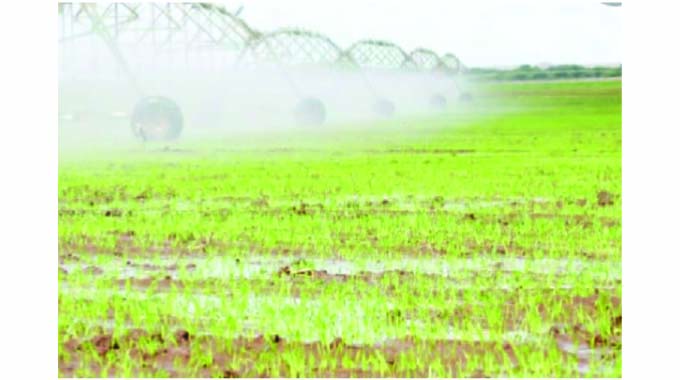
Yoliswa Dube-Moyo, Matabeleland South Bureau Chief
THE capacitation of farmers and agricultural extension officers is key in ensuring that Matabeleland South province maintains its momentum on agricultural revival.
Eighteen irrigation schemes across Matabeleland South are operating above 60 percent capacity with more set to be revitalised as the province moves towards improving food security and nutrition.
Government, working with various partners, is rehabilitating irrigation schemes that have been lying idle and establishing new ones to improve food security and nutrition to ensure the attainment of Vision 2030.
There is a target to rehabilitate and develop 350 000 hectares of land by 2025 to safeguard the country against the negative effects of climate change and ensure food security.
The Second Republic is prioritising the revival of the agricultural sector with a number of irrigation schemes that have been lying idle in the province having been revived while some that were being underutilised have been capacitated and expanded.
Government is also rolling out various agricultural schemes meant to transform subsistence agriculture at household level into commercial agriculture.
Managers have also been deployed to irrigation schemes across the country to maximise production.
Matabeleland South provincial agricultural officer Mr Mkhunjulelwa Ndlovu said to keep the momentum, farmers and agricultural extension officers needed to be continually capacitated.
“Our staff have now been motorised and can access farmers easily. The trainings underway encourage farmers to get into farming as a business on a higher scale. Everyone is keen to contribute something towards food and nutrition security,” said Mr Ndlovu.
He said the uptake for winter wheat was high this season and farmers put in extra effort in crop production.
“This year was a unique one because farmers were so keen to take up the winter wheat programme. The element of the Presidential Input Scheme which came into play to assist smallholder farmers with inputs also triggered higher uptake and increase of hectares under wheat,” said Mr Ndlovu.
Deputy Minister of Lands, Agriculture, Fisheries, Water and Rural Development Vangelis Haritatos recently said the agricultural sector is expected to improve food self-sufficiency from 45 percent in 2020 to 100 percent by 2025.
“This entails increasing maize production from 907 629 tonnes in 2020 to three million tonnes in 2025 among other deliverables. As part of efforts to build resilience in most rural communities in arid and semi-arid areas, we have embarked on a number of climate smart initiatives to ensure continued national food security,” said Deputy Minister Haritatos.
He said irrigation is the half panacea to climate change hence focus is on expanding land under irrigation and improving water harvesting.
“In addition to irrigation development, the ministry is making strides towards building resilience in most arid and semi-arid areas of the country by employing conservation methods such as the highly successful Pfumvudza/Intwasa programme which saw the country producing a record 2, 7 million tonnes of maize against the national requirement of 1,8 million tonnes in the 2020/2021 agricultural season,” said Deputy Minister Haritatos.
President Mnangagwa recently launched the Arda Vision 2030 accelerator model programme meant to stimulate rural industrialisation through agricultural development in line with Vision 2030.
Under the model, each district across the country will have 200 hectares under irrigation with the beneficiaries being locals. – @Yolisswa



 Blessing Chizhande
 Online Reporter