Chronicle Editor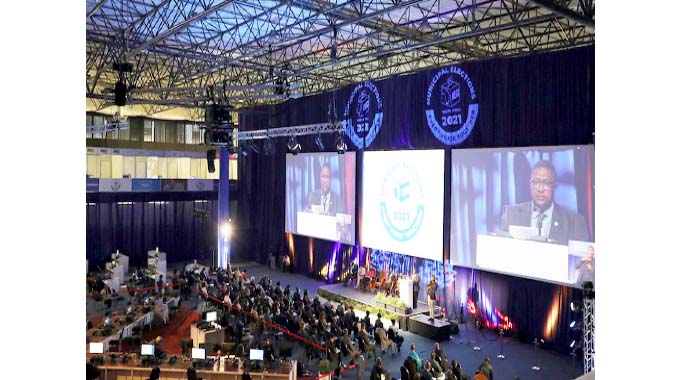
Johannesburg — The Electoral Commission CEO Sy Mamabolo has denied that there was a fire at the Results Operation Centre (ROC) in Tshwane on Saturday night.
“There was a burning of a circuit breaker on the distribution box. There were no flames but the burning….in other words the oversupply of heat resulted in malfunctioning. The unit was completely destroyed necessitating a replacement,” Mamabolo said.
He said the decision to evacuate the ROC came after an electricity supply problem.
“We evacuated the building because there wasn’t sufficient electric supply into the building so for safety purposes we took everybody out while we investigated and established the facts. There is nothing worse than having to identify the problem living people here and subject them to risk. ”
According to Mamabolo, at the time the incident came to light, they didn’t know the extent what the problem is hence the need to establish fact, as soon as they were established get the replacement needed and restore operation.
Mamabolo said they needed to first understand the problem if it was a sabotage or a mere engineering glitch, they needed to know what they were dealing with and all the agencies that they were working with were involved trying to establish the facts.
He added that the Commission’s partner, City of Tshwane, acted swiftly to control the situation with police to secure the centre and by 10pm, operations were restored.
At around 6pm on Saturday night there were reports that a fire broke out leading to the centre to be evacuated.
During the evacuation the commission left South Africans in the dark, due to lack of communication on what was going on.
Mamabolo admitted that communication is key but the commission was dealing with an emergency and they needed to make sure what they were dealing with before they could communicate.
“You cannot communicate facts you are not sure about, you have got to establish your facts then confidently speak to the people. That was the delay we had to understand what had happened,” Mamabolo said.
He further stated that they have always dealt with matters relating to electoral processes transparently, nothing to hide.
“The very existence of this centre is about transparency, that is why we are all here, that’s why parties and media is here precisely to give people an opportunity for unfettered access to all role players so I don’t think there was anything untoward. We had an emergency situation where we needed to establish what the problem was and once we knew we had to communicate with the country,” he said.
Meanwhile, DA federal council chairperson Helen Zille has expressed concern about the IEC’s handling of the local government elections, saying the party is hoping for “no messing around” from the electoral commission.
“The DA is very ready, we just hope the IEC is ready and we hope that there is no messing around with the MEC7 forms. We will be watching that very, closely,” she said on Saturday.
“We don’t have confidence in the IEC, we’ve said that often. They’ve got a lot to prove to win our confidence back,” she said.
Zille, who has been based and campaigning in Nelson Mandela Bay for the past month flew into Cape Town on Thursday night to vote in the city on Saturday.
Just before casting her special vote at Pinelands High School on Saturday, she told journalists: “The IEC had a list of MEC7 forms, those are people who are voting outside the places they are registered. Suddenly that tripled in a very short space of time and we were concerned about that.”
An MEC7 form is a form that is filled in by a registered voter whose name does not appear on the voters’ roll. The voter has to prove that they registered.
The party was also worried about the extent to which re-demarcation, the MEC7 forms and a possible risk of people not being able to use the infrastructure or connectivity not being there because of load-shedding. “They fundamentally affect the freeness and fairness of this election,” she said.
Zille is however confident that the DA will retain its majority in Cape Town as Capetonians know that the choice is between the blue and the yellow.
“The yellow party [ANC] can’t point to a single government that they have run well in the whole of SA, even though they run 90 percent of all local authorities,” she said.
“They can’t point to a single example where they run well and the DA can point to many examples and that’s why we dominate the league tables of the best run authorities,” she said.
She said voters in Cape Town understood that an election was about getting service delivery right, it’s about getting things done and it’s about comparing the offers of different parties
“If you compare the offer of the DA and the ANC, it’s really no contest, it’s no contest if you vote for the right things. If you want your town to flourish and grow, if you want confidence and investment and jobs, you obviously vote DA,” said Zille.
She said while every single metro had poor areas, there was no comparison in terms of the package of free basic services that the DA offered, the services in general, responsiveness of its councillors, the infrastructure, water, sanitation, roads and public transport.
“Poor people live a much better life in Cape Town than anywhere else,” said Zille.
In response, IEC spokesperson Kate Bapela said: “When we announce the results we will have a clear indication of the number of MEC7 individuals who cast their votes during the local municipal elections.” — Political Bureau


 Online Reporter